

Table of Contents
- What Sustainable Jewelry Really Means (and What It Doesn't)
- Ethical Jewelry Questions to Ask Before You Buy
- Your Ethical Jewelry Checklist for the Showroom Conversation
- Questions to Ask About Ethical Gemstones and Diamond Origins
- Questions to Ask About Recycled Gold Jewelry and Precious Metals
- How to Verify Sustainability Claims and Spot Greenwashing
- Aftercare, Repair, and End-of-Life Questions Most Buyers Forget
- Conclusion
- Frequently Asked Questions
Last Updated: October 21, 2026
What Sustainable Jewelry Really Means (and What It Doesn't)
Sustainable jewelry is made with materials and methods that limit harm to people and the planet, from mine to finished piece.
"Sustainable" is a marketing word, not a regulated one. A brand can print it on a box without proving a thing.
At LÖF, we work with 18k recycled gold, platinum, ethically sourced gemstones, and antique diamonds, so we have sat on both sides of this conversation.
Ethical Jewelry Questions to Ask Before You Buy
Ethical jewelry questions to ask fall into two buckets: what goes into the piece, and who touched it along the way. Start with materials and labor, then work outward to documentation and aftercare.
A good jeweler will welcome these. A defensive one tells you plenty.
Questions About Metals and Stones
Ask where the gold or platinum came from and whether it is recycled or newly mined. Then ask for stone specifics: origin country, whether natural, lab-grown, or antique, and what documentation backs the claim. Strong answers name a source and offer paperwork; vague ones are a red flag.
- Is this gold recycled, and can you show me the recycled content?
- Where were these gemstones sourced, and by whom?
- Are the diamonds natural, lab-grown, or antique?
Questions About Labor and Community Impact
Fair labor questions matter as much as environmental ones. Ask whether the jeweler knows the workshops behind the piece and whether those workers are paid fairly and treated safely. Mining affects whole communities, so a responsible jeweler can speak to worker welfare and community impact.
- Which workshops or suppliers made this piece?
- How do you verify fair labor at your suppliers?
- What is your policy on responsible mining and human rights?
Your Ethical Jewelry Checklist for the Showroom Conversation
Bring a short ethical jewelry checklist so you do not freeze at the counter. The goal is not to interrogate anyone but to see how they handle specific, fair questions, and the follow-up.
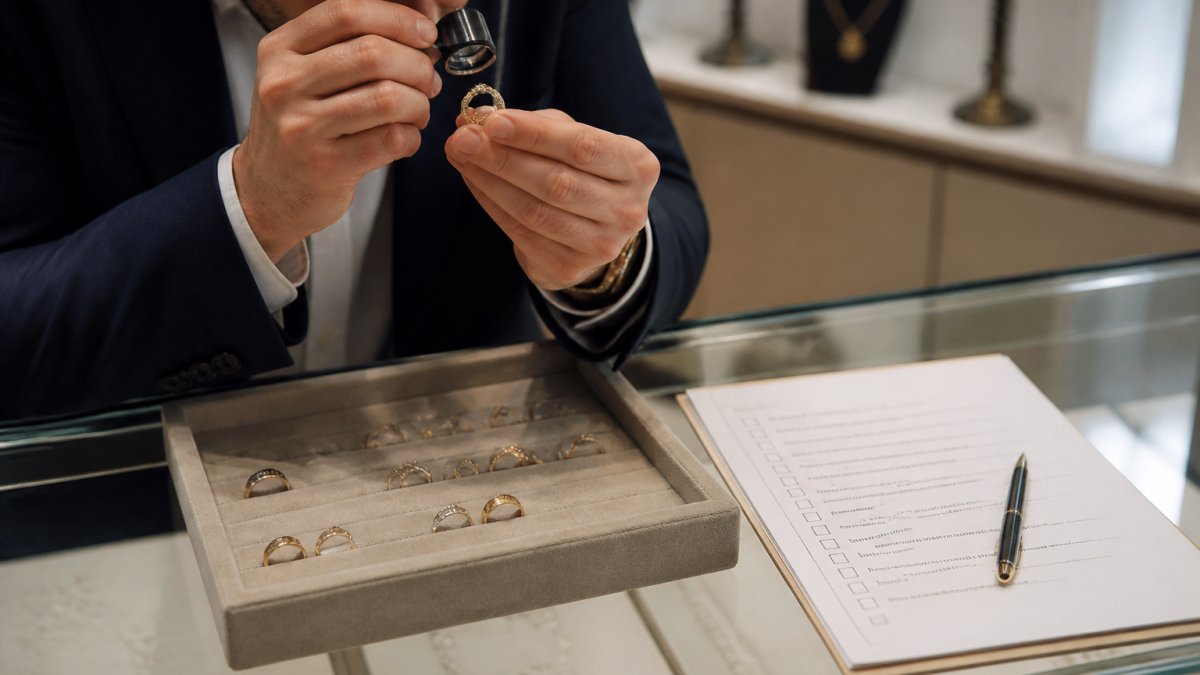
Use this priority order. Start with the questions that matter most to you and work down.
- Metal origin: recycled or mined, and proof of recycled content
- Stone origin: country and supplier named
- Diamond type: natural, lab-grown, or antique, stated clearly
Write your top three must-haves before you go in. If a jeweler cannot answer those three, that is your answer.
How to Evaluate the Answers You Get
A checklist only helps if you know what a good answer sounds like.
Specific and documented. The jeweler names a refiner, supplier, country, or certification body and offers to show the paperwork.
Specific but undocumented. The jeweler names a source but cannot produce a document.
Vague or deflecting. The answer uses words like "ethical," "responsible," or "eco-friendly" without a source, a name, or a document.
What Credible Documentation Looks Like
You do not need to be an auditor, but you should recognize the common document types. Ask to see the actual file or a copy, not a logo on a webpage.
- Recycled content: a transaction certificate or refinery statement showing the percentage of recycled metal.
- Diamond sourcing: a Kimberley Process certificate for rough diamonds, and for larger stones a grading report from a lab such as GIA or IGI that notes origin where available.
- Colored gemstones: a gemological report from a recognized lab, plus a supplier statement naming the country of origin.
If a jeweler cannot produce any of these, that does not automatically make them dishonest, small studios may lack full documentation. But the claim is unverified, so weigh it accordingly.
The Follow-Up Questions That Reveal the Most
The first answer is rehearsed; the second is where you learn the most. After any sustainability claim, ask one of these:
- "Can you show me the document behind that?"
- "Where does the chain of custody stop, and why?"
- "What percentage of your collection meets this standard?"
A jeweler who answers these calmly and specifically is demonstrating the transparency you want. One who becomes defensive, changes the subject, or repeats the marketing line is telling you something too.
A Note on Budget and Accessibility
You do not need a five-figure budget to ask good questions. Lower-cost paths include vintage and antique pieces (no new mining), simpler designs using fewer documented materials, and prioritizing one verified element, such as recycled gold, over verifying everything at once. A fair jeweler will help you direct your budget toward the claims that matter most rather than upselling a label.
Questions to Ask About Ethical Gemstones and Diamond Origins
Ethical gemstones are stones whose origin, mining conditions, and trading route the seller can explain; diamond sourcing works the same way. The question is not "is this stone ethical?" but "how do you know, and can you show me?" Gemstone origin is often harder to trace than gold: small stones pass through many hands, and the further a stone travels from the mine, the more likely the paper trail thins out.
Stated Origin vs. Chain of Custody vs. Verified Traceability
These three terms get used interchangeably but mean very different things.
Stated origin is a claim. The jeweler says the stone came from Sri Lanka, Botswana, or Canada.
Documented chain of custody is a paper trail: each handler, mine, cutter, polisher, trader, setter, records that the stone passed through their hands.
When a jeweler says a stone is "traceable," ask which of these three they mean.
Questions to Ask by Stone Type
For mined diamonds and colored stones:
- Which country was this stone mined in, and which mine if known?
- Can you show me the Kimberley Process certificate or the lab report?
- Where does the chain of custody stop, and why?
For lab-grown diamonds:
- Where was the stone grown, and by which producer?
- What energy source powers the growth process?
- Does the grading report state it is lab-grown?
Lab-grown stones avoid new mining, but the energy used to grow them varies widely by producer and is rarely disclosed. Ask directly; a producer that tracks its energy source can usually say so.
For antique and vintage stones:
- How do you confirm the piece is genuinely antique?
- Is there any documentation of its history or provenance?
- Has the stone been reset or altered?
Antique and vintage jewelry sidesteps new mining entirely, which is why heirloom pieces appeal to conscious buyers. The catch: "antique" gets used loosely, so ask how the age is confirmed, hallmarks, mount style, cutting technique, or a written appraisal.
A Fair Comparison: Mined, Lab-Grown, Recycled, and Vintage
No single category is automatically sustainable. Each carries trade-offs, and a fair jeweler will explain them without pushing you toward the priciest option.
| Option | Key Question to Ask | What to Watch For |
|---|---|---|
| Mined diamonds and stones | Which mine and country? | Chain of custody often stops early; community impact varies by mine |
| Lab-grown diamonds | Where was it grown and by whom? | Energy source rarely disclosed |
| Antique and vintage | Can you confirm it is genuinely antique? | Provenance claims need evidence |
| Recycled gold and metals | What is the verified recycled content? | "Recycled" with no paperwork |
To decide, rank what matters most, avoiding new mining, supporting a specific community, minimizing energy use, or keeping the piece in circulation, and choose the category that best matches. A jeweler who walks you through that trade-off honestly is more valuable than one claiming a single perfect answer.
Questions to Ask About Recycled Gold Jewelry and Precious Metals
Recycled gold is refined from existing jewelry, electronics, or industrial scrap rather than freshly mined metal. The questions to ask about recycled gold jewelry center on proof: how much is recycled, and who verified it.
Ask these directly:
- What percentage of this piece is recycled gold or platinum?
- Who certifies the recycled content, and can I see it?
- Do you use recycled metals across your whole collection or just some pieces?
At LÖF, our pieces are crafted from 18k recycled gold and platinum, and we are happy to walk a client through what that means for a specific design.
How to Verify Sustainability Claims and Spot Greenwashing
Greenwashing is when a brand makes an ethical or environmental claim it cannot back up. To catch it, match every claim to evidence: a certificate, an audit, a named supplier, or a documented policy. Traceability has real limits, and honest jewelers admit it, a small gemstone may be traceable to a country but not a single mine. The question is whether the jeweler is transparent about where the chain breaks.
Watch for these greenwashing signs:
- Buzzwords with no supporting document
- A certification logo with no certificate number
- Vague phrases like "eco-friendly materials" and nothing more
For independent guidance on avoiding misleading environmental claims, see the FTC Green Guides, which explain how environmental marketing claims should be substantiated.
Aftercare, Repair, and End-of-Life Questions Most Buyers Forget
Durability and repairability are sustainability issues, and almost nobody asks about them. A piece worn for decades and passed down has a far lower footprint than one replaced every few years. Ask how the piece is made to last, and what happens when it needs work.
- Can you resize and repair this piece years from now?
- Do you offer a take-back or recycling program for old pieces?
- What is the expected lifespan of this setting and these stones?
A jeweler with a real repair and take-back policy is thinking about the whole life of the piece, not just the sale, a strong signal of genuine commitment.
Conclusion
The hardest part of buying sustainable jewelry is not finding beautiful pieces. It is getting straight answers about where the metal and stones came from and who made them. Ask the questions, request the documents, and trust the jewelers who answer without flinching.
At LÖF, we build heirloom-quality pieces from 18k recycled gold, platinum, ethically sourced gemstones, and antique diamonds, and we welcome every one of these questions. Our bold, architectural designs, like The Astor Ring in recycled gold with baguette diamonds, are made to be worn daily and passed down.

Frequently Asked Questions
What questions should I ask a jeweler about sustainability?
Start with the metals: ask whether the gold is recycled and where it was refined. Then ask about gemstone origins, whether stones are mined, lab-grown, or antique, and whether the jeweler can show documentation. Follow with labor questions: where the piece was made and whether workers are paid fairly. Finish with aftercare: repair, resizing, and take-back policies. A jeweler who answers clearly and without defensiveness is a better signal than one who recites marketing language about sustainable jewelry.
How can I tell if a jeweler's sustainability claims are genuine?
Ask for specifics rather than adjectives. Genuine claims name a refiner, a mine, a certification body, or a supplier standard. Request sourcing documentation or third-party verification for the exact piece you are considering, not just the brand overall. Watch for vague phrases like eco-friendly materials with no supporting detail. A jeweler who admits the limits of their traceability is often more trustworthy than one who claims perfect supply chain knowledge.
Is recycled gold more sustainable than newly mined gold?
Recycled gold avoids new mining, which reduces environmental impact, water use, and mining waste. It is chemically identical to newly mined gold, so quality and durability are unchanged. Ask your jeweler whether the recycled content is certified and whether the refinery is audited. For a piece like a ring in 18k recycled gold, the sustainability benefit comes from keeping existing metal in circulation rather than extracting more.
What should I ask about a jeweler's labor practices?
Ask where the piece was fabricated and whether the workshop is audited for fair labor and worker welfare. Request details on supplier standards and whether the jeweler visits or verifies its partners. Questions about community impact, artisanal mining, and human rights in the supply chain matter too. If a jeweler cannot answer, ask whether they are working toward traceability and how. Transparency about gaps is more useful than a blanket ethical jewelry claim.
For broader context on responsible sourcing standards, the Responsible Jewellery Council sets third-party certification benchmarks, and the Kimberley Process governs rough diamond trade. Use them as a starting point, then ask your jeweler for the documents behind any claim.