

Table of Contents
- Start With Certification: Ethical Jewelry Certification Standards That Matter
- Follow the Chain: Traceability in Fine Jewelry Supply Chains
- How to Spot Greenwashing in Jewelry Marketing Language
- Verify Recycled vs. Newly Mined Materials
- Small-Scale vs. Large-Scale Mining: Why It Matters for Your Jewelry
- How to Verify Ethical Jewelry Sourcing: A Step-by-Step Checklist
- Common Mistakes When Verifying Ethical Jewelry Sourcing
- Frequently Asked Questions
Last Updated: September 30, 2026
Start With Certification: Ethical Jewelry Certification Standards That Matter
Ethical jewelry sourcing is the practice of confirming that the gold, platinum, and gemstones in a piece were extracted, traded, and crafted without funding conflict, harming workers, or damaging land and water.
The Certification Bodies Worth Knowing
A certification body is an independent organization that inspects a supply chain and issues a written standard a jeweler must meet. The main names to know:
- Responsible Jewellery Council (RJC): audits business practices, labor, and sourcing
- Fairmined: focuses on artisanal and small-scale mining communities
- Fairtrade Gold: sets a minimum price and premium for small miners
- Kimberley Process: a government-backed scheme to block conflict diamonds
- SCS Global Services: verifies recycled and responsibly sourced precious metals
What Each Certification Actually Covers
That gap is where most confusion starts. A logo on a homepage doesn't guarantee the ring in your cart.
Follow the Chain: Traceability in Fine Jewelry Supply Chains
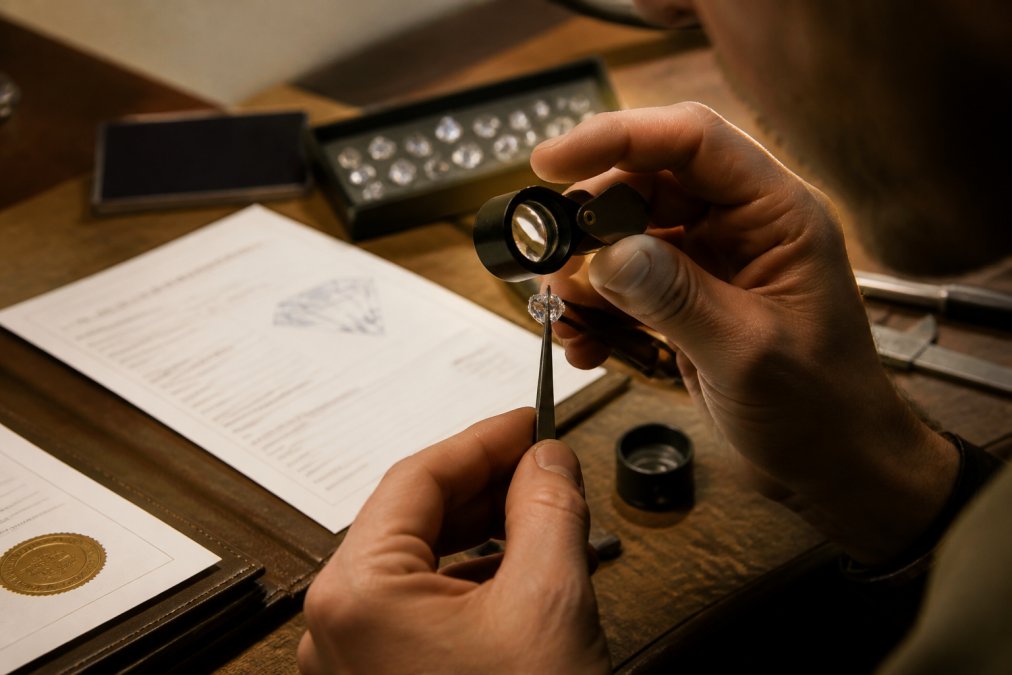
Traceability is the ability to follow a gemstone or metal from its origin to the finished piece. Provenance is the documented history of that journey. Together they form the backbone of any real ethical claim.
From Mine to Market: Mapping the Supply Chain
A fully mapped chain has five stages:
- Mining (large-scale or artisanal)
- Refining and smelting
- Cutting and polishing
- Trading and brokerage
- Setting and finishing
Most brands can name stages four and five. Very few can name stages one and two. That silence matters, because the ethical risk in jewelry sits almost entirely in stages one through three.
The Documents That Actually Prove Provenance
Traceability is not a feeling. It is a stack of paper (or its digital equivalent). Depending on the piece, a serious jeweler should be able to produce some combination of:
- Kimberley Process Certificate: accompanies rough diamond shipments between participating countries. It confirms the shipment is not from a conflict zone, but it does not cover labor, environment, or cutting conditions.
- Refiner's chain-of-custody statement: names the refinery and confirms the metal's origin or recycled content.
- Supplier declarations: written statements from cutters, dealers, or setting workshops confirming origin and handling.
- Audit summaries: a certifying body's report on the business practices of a supplier in the chain.
- Invoices and shipping records: the unglamorous paperwork that lets an auditor reconstruct the journey.
Digital Verification Tools: Blockchain, QR Codes, and Their Limits
Some houses now use blockchain ledgers to log each handoff. Others attach QR-coded certificates to a piece so a buyer can scan and see the recorded journey. These tools are genuinely useful for one reason: they make tampering with the record harder after the fact.
A Practical Traceability Test
Before buying, ask the jeweler to walk you through the chain for one specific piece. A brand with real traceability will answer within a day or two, because the information is already on file. A brand without it will pivot to general statements about its values. That pivot is your answer.
How to Spot Greenwashing in Jewelry Marketing Language
Greenwashing is when a brand uses vague or misleading environmental and ethical claims to appear more responsible than it is. Recent guidance from the UK Competition and Markets Authority on green claims makes clear that broad, unverifiable terms can breach consumer protection law.
Red Flags in Marketing Claims
- "Eco-friendly" with no standard named
- "Conflict-free" used without mentioning the Kimberley Process or an audit
- "Ethically sourced" with zero supplier detail
- A certification logo with no certificate number
- Sustainability pages that talk about feelings, not audits
Verify Recycled vs. Newly Mined Materials
Recycled gold and newly mined gold are chemically identical. You cannot tell them apart by eye, by touch, or by a standard assay. That is not a flaw in your inspection skills; it is a fact of metallurgy. Once gold is refined, its atomic structure carries no memory of where it came from.
What "Recycled" Is Supposed to Mean
Recycled precious metals come from existing above-ground sources: old jewelry, industrial scrap, electronic waste, and manufacturing offcuts. The ethical appeal is straightforward. Recycled metal avoids new mining impacts, which can include habitat destruction, water use, and community displacement.
The Chain-of-Custody Record
The document that matters is a chain-of-custody record from the refiner. It should show:
- The refiner's name and location
- The source category of the metal (post-consumer jewelry, industrial scrap, etc.)
- The date and volume of the batch
- A statement that the metal was not sourced from newly mined material
Certification Programs That Cover Recycled Metal
A few standards specifically address recycled content:
- SCS Global Services verifies recycled and responsibly sourced precious metals under its sustainability certification programs.
- Responsible Jewellery Council (RJC) members commit to chain-of-custody practices that can include recycled inputs, though RJC membership alone does not certify a specific piece as recycled.
- Fairmined and Fairtrade Gold focus on newly mined artisanal gold, so they are not the right marks to look for on a recycled-metal claim.
This is where shoppers get confused. A brand can hold RJC membership and still sell a piece made from newly mined gold. The membership describes the business; the chain-of-custody record describes the metal.
Why This Matters More Than It Sounds
If you are choosing recycled metal for environmental reasons, an unverified claim means you may be paying a premium for nothing. If you are choosing it for ethical reasons, an unverified claim means you cannot know whether the metal funded mining you would object to.
Questions That Separate Real Claims From Marketing
- Which refiner processed this metal?
- Can I see the chain-of-custody statement for this batch?
- Is the recycled content certified by a third party, or self-declared?
- Does the certification apply to this piece, or only to the brand's overall sourcing?
If the answers are specific and documented, you have done something most buyers never do. If they are vague, you have your answer without spending a cent.
Small-Scale vs. Large-Scale Mining: Why It Matters for Your Jewelry
Artisanal and small-scale mining employs millions of people worldwide and often supports entire communities, but it can also involve unsafe conditions and child labor when unregulated. Large-scale mining brings more oversight and environmental rules, yet it can displace communities and reshape landscapes.
How to Verify Ethical Jewelry Sourcing: A Step-by-Step Checklist
Run this before you buy. It takes about ten minutes and saves years of doubt.
Step 1: Check Certifications and Audit Reports
Ask for the certificate number, then confirm it on the certifying body's own site. A logo is not proof. A searchable record is.
Step 2: Request Traceability Documentation
Ask for the country of origin for each stone and the refiner for the metal. A serious house will have this on file. A vague answer is an answer.
Step 3: Ask the Right Questions
- Where was this stone mined?
- Which refiner processed the gold?
- Is this diamond antique or newly mined?
- Can I see the audit report?
Step 4: Cross-Check Claims With Independent Sources
Verify certification numbers directly with the issuing body. Check the Kimberley Process official site for how conflict diamond controls work, and read the Responsible Jewellery Council standards to see what RJC members actually commit to.
| Verification Step | What to Ask For | Time Needed | Red Flag If Missing |
|---|---|---|---|
| Certification check | Certificate number | 2 min | Logo with no number |
| Traceability | Country of origin, refiner | 3 min | "We can't share that" |
| Direct questions | Mine, refiner, stone age | 3 min | Vague or deflected answers |
| Independent cross-check | Issuing body's public record | 2 min | No public record found |
Common Mistakes When Verifying Ethical Jewelry Sourcing
At LÖF, every piece is meticulously crafted from 18k gold, platinum, and ethically sourced gemstones and antique diamonds. We're glad to walk you through the documentation behind any piece.
Frequently Asked Questions
What certifications should I look for in ethical jewelry?
Look for certifications from the Responsible Jewellery Council (RJC), Fairmined, or Fairtrade. These bodies audit mining, refining, and manufacturing practices. RJC certification covers the entire supply chain, while Fairmined focuses on artisanal and small-scale mining. Ask to see the certification number and verify it on the body's website. A legitimate brand will provide this without hesitation.
How can I tell if a jewelry brand is actually sustainable or just greenwashing?
Check for specific, verifiable claims. Vague phrases like 'eco-friendly' or 'responsibly made' without third-party certification are red flags. Look for named certifications, traceability reports, or published audit summaries. If a brand claims recycled gold, ask for proof of origin. Legitimate brands provide documentation, not just marketing language. When in doubt, request a chain of custody report.
What is the difference between conflict-free and ethically sourced diamonds?
Conflict-free means a diamond did not finance armed conflict, as defined by the Kimberley Process. Ethically sourced goes further: it considers labor conditions, environmental impact, and community benefits throughout the supply chain. A diamond can be conflict-free but still mined under poor labor practices. Look for certifications that address both, such as RJC or Fairmined.
How do I verify the supply chain of a luxury jewelry maison?
Start by asking for traceability documentation from mine to finished piece. Request the names of refineries and mines, and check if they appear on certified lists. Also look for independent audit reports. If a brand cannot provide this, consider it a warning sign. Transparency is the hallmark of true ethical sourcing.
The hard part isn't caring about ethical sourcing. It's getting proof that holds up. LÖF was founded by jeweler and designer Morgan Mackintosh to make that proof part of the purchase, with 18k recycled gold and platinum, ethically sourced gemstones, and antique diamonds in every collection. Explore heirloom-quality pieces like The Astor Ring and The Margueritte Cuff, and choose options with confidence.