

Table of Contents
- Why Pre-Owned Fine Jewelry Matters
- Cost Savings and Value for Money
- How to Buy Pre-Owned Fine Jewelry Responsibly
-
Authenticating Pre-Owned Jewelry: What to Verify
- Step 1: Read the hallmarks before anything else
- Step 2: Weigh the metal against the asking price
- Step 3: Examine gemstones under magnification
- Step 4: Look for repair and alteration signals
- Step 5: Assess condition against a repair budget
- Step 6: Match documentation to the piece
- Step 7: Get independent verification before finalizing
- Resale Value of Fine Jewelry and Long-Term Investment
- Sustainable Fine Jewelry and Ethical Considerations
- Unique Finds, History, and Heirloom Appeal
- Frequently Asked Questions
Last Updated: October 17, 2026
Why Pre-Owned Fine Jewelry Matters
Pre-owned fine jewelry delivers the same craftsmanship, materials, and design at a fraction of the new-retail markup, not settling for less, but being strategic about where your money goes.
The appeal extends beyond economics: a vintage ring carries decades of design heritage and an estate diamond represents a legacy, narrative and provenance newly manufactured jewelry cannot replicate.
Cost Savings and Value for Money
The most immediate advantage of buying pre-owned fine jewelry is the financial reality: you typically pay 30-50% less than retail for comparable new pieces.
A pre-owned piece from a reputable seller typically includes documentation, appraisals, or certificates of authenticity.
The resale market also provides an exit strategy: unlike fast-fashion jewelry, fine jewelry retains marketability, so changing tastes or circumstances don't strand your investment.
How to Buy Pre-Owned Fine Jewelry Responsibly
Start with seller reputation. Research the seller's history, reviews, and return policies.
Request documentation. Reputable sellers provide certificates of authenticity, gemological reports, or appraisals for significant pieces.
Examine detailed photographs and video. Legitimate sellers provide high-resolution images and video from multiple angles, under different lighting, with measurements.
Understand the piece's history. Ask about provenance: an estate, a previous owner, a collection?
Authenticating Pre-Owned Jewelry: What to Verify
Authenticity verification separates confident purchases from risky ones. Rather than stopping at "check the hallmark and ask for a GIA report," run this repeatable inspection sequence on any piece, in order, before money changes hands.
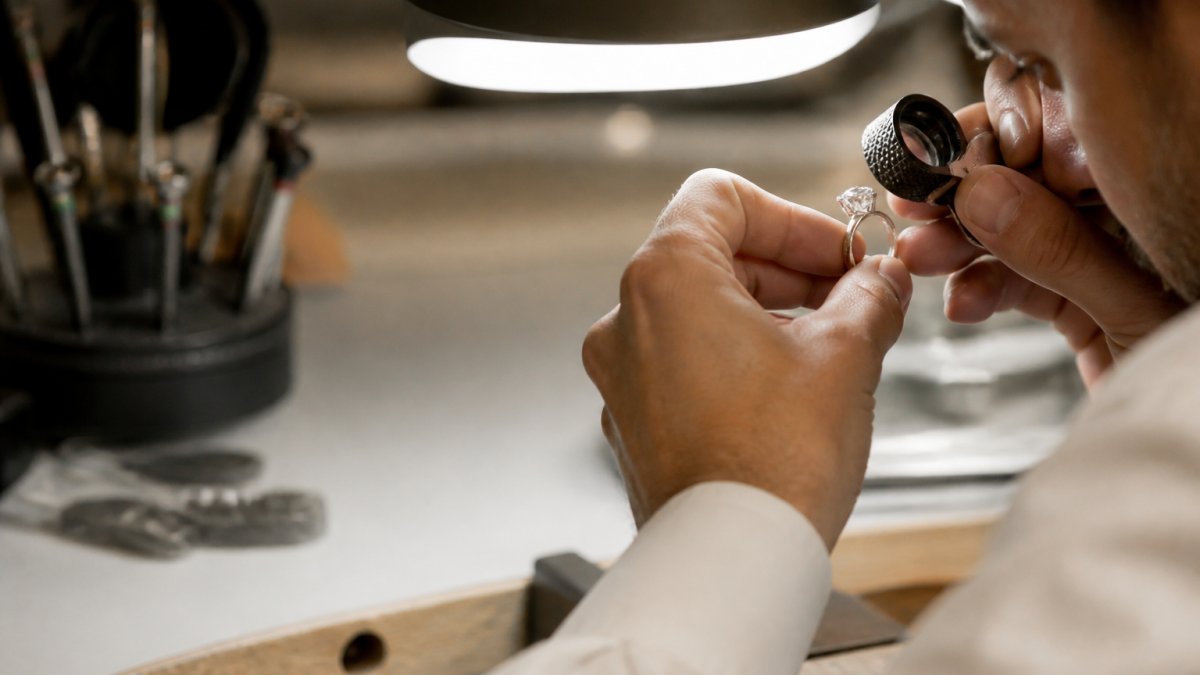
Step 1: Read the hallmarks before anything else
Fine jewelry is stamped with metal purity marks: 18k or 750 for 18-karat gold, 14k or 585 for 14-karat, 950 or 900 for platinum, and 925 for sterling silver. These stamps usually sit inside ring shanks, on bracelet clasps, on pendant bails, or along the inner edge of a chain tag. Read them with a loupe, looking for a stamp that is crisp, correctly placed, and matched to the metal's color and heft.
Step 2: Weigh the metal against the asking price
Metal has a calculable floor value. Ask for the gram weight, then compare it with the current spot price (published daily by sources such as the World Gold Council or major metals exchanges). A piece advertised as 18k gold that weighs far less than its price implies, or a "platinum" piece that feels light for its size, deserves a question.
Step 3: Examine gemstones under magnification
Diamonds and colored gemstones show identifying characteristics under a loupe or microscope: inclusions, color zoning, growth patterns, and fluorescence. For diamonds, a GIA grading report is the standard reference; for colored stones, reports from recognized laboratories (for example, the American Gemological Laboratories or Gübelin) carry weight. If a significant stone has no report, ask why. Check the setting too: prongs should grip evenly, the girdle should not be chipped, and the stone should sit level.
Step 4: Look for repair and alteration signals
Pre-owned pieces are often resized, re-set, or repaired, which is normal. What matters is whether the work was disclosed and done well. Under magnification, check for:
- Solder seams that are discolored or lumpy rather than smooth and matched to the surrounding metal
- Prongs of different thickness or shape, suggesting one was replaced
- A shank that is thinner on one side, a sign of repeated resizing
- Settings that do not sit flush or stones that rattle slightly in their seats
None of these automatically disqualifies a piece. They change the price you should be willing to pay.
Step 5: Assess condition against a repair budget
Wear is expected; damage is different. Deep scratches, bent or missing prongs, loose or cracked stones, and stretched chains affect appearance and structural integrity. Ask the seller directly about damage, request close-ups of any problem area, then price the fix: a jeweler can quote re-tipping prongs, replacing a stone, or re-shanking a ring before you commit. A bargain can stop being one once a repair quote is added.
Step 6: Match documentation to the piece
Certificates, appraisals, and gemological reports are only useful if they describe the piece in front of you. Check that report numbers, weights, and stone counts match. An appraisal is a valuation opinion, usually for insurance, not a guarantee of authenticity or quality; third-party laboratory reports carry more independent weight than a seller's certificate. Keep copies of everything for insurance and resale.
Step 7: Get independent verification before finalizing
For any purchase above a threshold you set in advance, budget for an independent inspection by a qualified jeweler or gemologist and, where the value justifies it, a formal appraisal. The cost is modest relative to the purchase and insures against overpaying or acquiring a compromised piece. If a seller resists independent verification, treat that as information about the seller.
Resale Value of Fine Jewelry and Long-Term Investment
Pre-owned fine jewelry can hold value better than mass-market jewelry, but the honest version of this claim is narrower than most sales copy suggests. Jewelry is not a guaranteed investment, and treating it as one is the fastest way to overpay. What it offers is a calculable floor (metal and stone value), a variable premium (designer name, rarity, provenance, condition), and a resale market that pays somewhere between the two.
Separate the floor from the premium
Every fine jewelry piece has a floor: the value of its metal and stones if sold for material content. That floor moves with commodity prices and is why a gold or platinum piece rarely becomes worthless. Above it sits a premium driven by checkable factors:
- Maker and model: A documented piece from an established house or a recognized designer can carry a premium that ordinary pieces do not. An attribution without documentation is a story, not a premium.
- Rarity: Pieces that are out of production, from a specific era, or in an unusual configuration attract collector demand. Rarity is not the same as age; plenty of old jewelry is common.
- Condition: Original, unaltered condition supports value. Heavy restoration, replaced stones, or resizing can reduce it.
- Provenance: Documented history, original boxes and papers, and prior ownership records add confidence and sometimes price.
- Certification: Independent gemological reports make a stone easier to value and easier to resell.
A piece with a strong floor and a documented premium is a different asset from a trendy piece with neither. The first may retain a meaningful share of what you paid; the second may not.
Compare total cost, not sticker price
The useful comparison is not "pre-owned versus new retail" but total cost of ownership across the pieces you are actually considering. Build it on these inputs:
- Asking price of the piece.
- Metal weight and stone specifications, so you can estimate the material floor.
- Comparable sales for similar pieces from the same maker or era, where you can find them through auction results and specialist resale listings.
- Repair or restoration costs quoted by a jeweler before purchase.
- Taxes, shipping, and any buyer's premium if you are buying at auction.
- Appraisal cost, if you need one for insurance.
- Expected resale range, based on the floor plus a realistic premium, not the retail price.
A lower sticker price can be the more expensive choice if the piece needs repairs, lacks certification, or carries a premium the resale market won't pay back. A higher-priced piece with documentation and original condition can be the better value. The comparison, not the discount, is what matters.
What resale actually looks like
Resale channels pay differently. A dealer or estate buyer typically offers a wholesale-level price reflecting the floor plus a margin, not the retail price you paid. Auction can produce more for rare or collectible pieces but adds fees, time, and uncertainty. Private resale can capture more retail value but requires documentation, authentication, and a trusting buyer. In practice, most ordinary pre-owned fine jewelry resells for a fraction of its new retail price, a fraction that improves with strong floors, recognized makers, and clean documentation.
When appreciation is plausible, and when it is not
Appreciation is plausible in narrow cases: rare pieces from respected makers, pieces with documented historical significance, and items in exceptional original condition where collector demand exceeds supply. It is not plausible for ordinary pieces bought at retail-adjacent prices, heavily worn items, pieces with significant repairs, or trend-driven designs. Even then, appreciation is not guaranteed and depends on market conditions at sale.
A realistic way to think about value
The most useful mental model is hybrid: part consumption, because you wear and enjoy the piece, and part stored value, because the metal and stones retain a floor and documented pieces retain some premium. You get use and financial durability, not a promised return. Buy pieces you'd be happy to own even if resale were disappointing, and let documentation, condition, and maker reputation protect the value you can reasonably expect.
Sustainable Fine Jewelry and Ethical Considerations
Choosing pre-owned fine jewelry aligns with environmental and ethical values that matter to many collectors: it extends the lifecycle of an existing piece rather than driving demand for new mining and manufacturing.
Mining for precious metals and gemstones carries environmental costs: water consumption, habitat disruption, and carbon emissions.
Ethically sourced gemstones, particularly diamonds, have become a concern for many buyers, with conflict diamonds, labor exploitation, and environmental damage driving interest in alternatives.
At LÖF, we're committed to sustainable luxury through ethically sourced gemstones and recycled precious metals. Pre-owned fine jewelry shares this philosophy: luxury that respects both environmental limits and human dignity.
Unique Finds, History, and Heirloom Appeal
A one-of-a-kind vintage ring carries design DNA from a specific era: Art Deco geometry, Victorian romanticism, mid-century modernism.
Estate jewelry often includes pieces from renowned designers or houses no longer in production.
The narrative matters too. A pre-owned piece carries stories: who owned it before you, what occasions it marked, how it's been cared for.
Pieces like LÖF's The Tallulah Drama Cuff, with its hand-set antique baguette diamonds in 18k yellow gold, exemplify the kind of heirloom-quality jewelry that gains meaning with time.

Buying pre-owned fine jewelry requires diligence, but the rewards justify the effort: luxury materials, exceptional craftsmanship, and distinctive pieces at prices that make financial sense.
Frequently Asked Questions
Is it worth buying pre-owned fine jewelry?
Yes, pre-owned fine jewelry often delivers superior value compared to new pieces. You gain access to designer and luxury pieces at lower prices, one-of-a-kind designs with history and provenance, and the assurance that the piece has proven durability. For those seeking sustainable luxury, pre-owned fine jewelry reduces environmental impact while maintaining the craftsmanship and quality of new alternatives.
How can you tell if pre-owned jewelry is authentic?
Verify authenticity by requesting documentation, certificates, and detailed provenance history. Inspect hallmarks on precious metals, 18k gold and platinum should bear clear stamps. Have a professional jeweler examine the gemstones, settings, and metalwork for quality and wear patterns consistent with age. Ask sellers for detailed photos, condition assessments, and appraisals. Reputable sellers provide transparent information and return policies protecting your purchase.
Is buying pre-owned jewelry more sustainable?
Buying pre-owned fine jewelry is significantly more sustainable than purchasing new pieces. It eliminates the environmental cost of mining new precious metals and gemstones, reduces waste, and extends the lifecycle of existing jewelry. Sustainable fine jewelry combines luxury with ethical responsibility, allowing you to wear heirloom-quality pieces while honoring both the wearer and the planet.
Which types of fine jewelry hold their resale value best?
Classic designer pieces, vintage and antique jewelry with documented provenance, and fine jewelry featuring high-quality gemstones and precious metals hold resale value strongest. Pieces crafted in 18k gold or platinum with ethically sourced or antique diamonds tend to appreciate or maintain value over time. Statement pieces with architectural design and bold craftsmanship also retain value when they represent timeless elegance rather than fleeting trends.