

Table of Contents
- Step 1: Define the Legacy and Emotional Story
- Step 2: Repurposing Heirloom Jewelry: Assessment and Provenance
- Step 3: Ethical Gemstone Sourcing for Custom Jewelry
- Step 4: The Custom Jewelry Design Process: CAD vs. Hand-Forging
- Step 5: How Long Does Custom Jewelry Take to Make?
- Step 6: Troubleshooting Common Design Failures and Ensuring Durability
- Step 7: Appraisal, Insurance, and Maintenance for Custom Legacy Jewelry
- Frequently Asked Questions
Last Updated: October 2, 2026
Step 1: Define the Legacy and Emotional Story
Creating custom legacy jewelry begins with a story, not a sketch. Before any metal is chosen or stone sourced, you need to define what the piece must carry forward. This is the step most people rush, and it is the one that decides whether the finished piece feels meaningful or merely expensive.
The strongest commissions start with a simple question: whose story is this? A grandmother's ring, a first milestone, a birth, a marriage. Each answer shapes every decision that follows.
Start by writing down three things:
- The person or moment the piece honors
- The emotion you want it to carry (love, resilience, remembrance)
- Who will wear it next, and after them
That last point matters more than people expect. Custom legacy jewelry is wearable art built for more than one lifetime.
Step 2: Repurposing Heirloom Jewelry: Assessment and Provenance
Repurposing heirloom jewelry starts with an honest assessment of what you already own. Provenance is the documented history of a piece, and it decides whether you restore, redesign, or simply reset the stones.
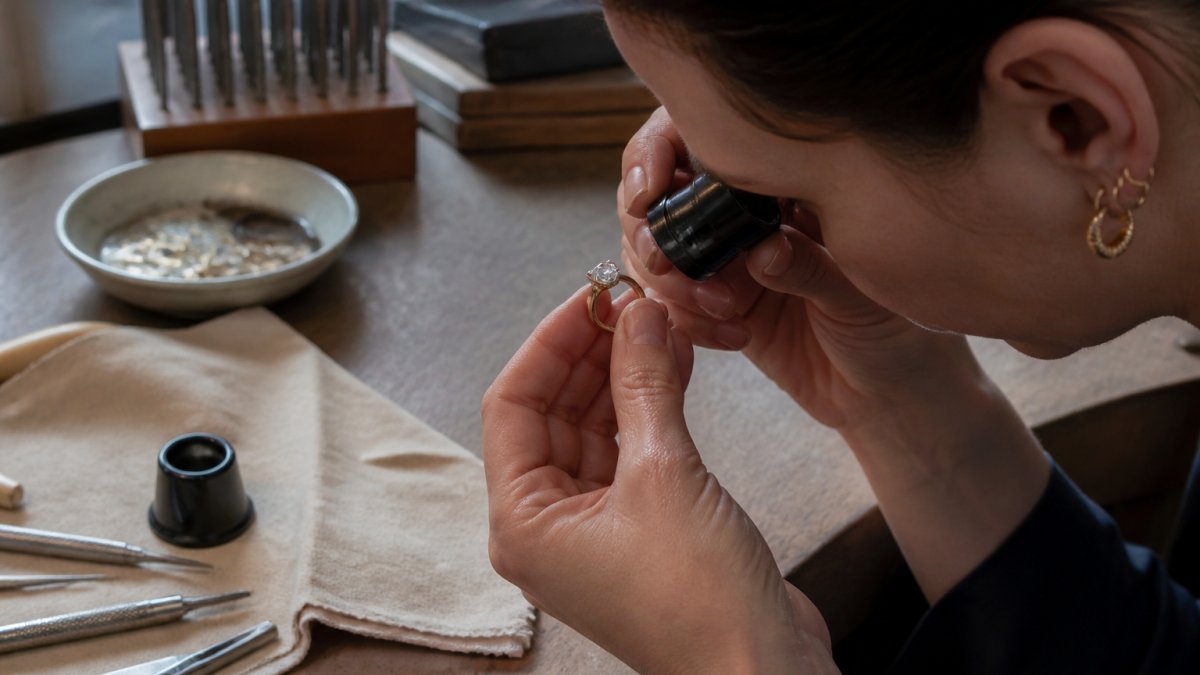
A jeweler will check four things:
- Metal condition. Old gold may be worn thin or mixed with unknown alloys.
- Stone security. Loose settings and hidden chips are common in vintage jewelry.
- Provenance. Certificates, receipts, and family records all raise value.
- Sentimental weight. Some pieces should stay intact, and that is a valid choice.
The Gemological Institute of America's guide to diamond grading explains how stones are graded, which helps you understand what you are working with before you commit to a redesign.
A common mistake is melting down a piece before it has been appraised. Once the metal is gone, so is the history.
Step 3: Ethical Gemstone Sourcing for Custom Jewelry
Ethical gemstone sourcing for custom jewelry means knowing exactly where a stone came from and how it was mined, cut, and traded. For a legacy piece, this matters twice over: you are buying beauty and a clean conscience.
Look for three markers of responsible sourcing:
- Traceable origin, documented from mine to market
- Conflict-free certification for diamonds
- Recycled or repurposed precious metals
Antique diamonds are one of the strongest ethical choices available. They were mined decades ago, so they carry no new mining impact, and each one has a cut and character modern stones rarely match.
Ask your jeweler directly what proof they can show. A serious maison will answer without hesitation. If the answer is vague, walk away.
Step 4: The Custom Jewelry Design Process: CAD vs. Hand-Forging
The custom jewelry design process usually follows one of two technical paths: CAD design or hand-forging. CAD (computer-aided design) builds the piece as a precise 3D model before casting. Hand-forging shapes the metal directly with tools, hammer, and torch. Understanding the trade-offs between them is essential because the choice affects not only the look of the piece but also its durability, repairability, and cost.
Here is how the two compare across the factors that matter most for a legacy piece:
| Stage | CAD Design | Hand-Forging |
|---|---|---|
| First draft | 3D render in days | Sketch, then metal |
| Precision | Very high, repeatable | Organic, one-of-a-kind |
| Best for | Symmetry, stone-heavy pieces | Sculptural, textured forms |
| Revisions | Easy before casting | Limited once forged |
| Feel | Clean and exact | Warm and hand-made |
| Durability | Consistent if wall thickness is designed correctly; cast metal can be slightly more porous | Superior grain structure and work-hardening; often stronger at stress points |
| Repairability | Easier to replicate parts digitally | Requires a skilled bench jeweler for repairs |
| Cost driver | Design time and casting setup | Labor hours and metalworking skill |
Most commissions move through both. A jeweler may model the structure in CAD, then finish and set by hand. Wax modeling still plays a role too, giving a physical model you can hold before casting. The key is to ask which method will be used for the structural elements, the parts that bear stress, because that is where durability is won or lost.
For a deeper dive into how CAD software is used in jewelry, the Gemological Institute of America's overview of jewelry design technology provides a useful primer. But remember: the best design is one that balances beauty with the realities of daily wear. If you plan to wear the piece often, discuss metal thickness and setting security at the CAD stage, not after casting.
Step 5: How Long Does Custom Jewelry Take to Make?
Custom jewelry typically takes six to twelve weeks from approved design to finished piece. Simple pendants and single-stone resets sit at the shorter end. Complex commissions with sourcing, CAD work, and multiple stone settings run longer.
The timeline breaks down roughly like this:
- Consultation and story mapping: 1-2 weeks
- Stone sourcing and appraisal: 2-4 weeks
- Design and CAD or wax model: 1-3 weeks
- Fabrication and stone setting: 2-4 weeks
- Final polish, appraisal, and delivery: 1 week
Sourcing is the wildcard. If you want a specific antique diamond or a rare colored gemstone, the search can add weeks. Build that buffer in if the piece is tied to a date.
Step 6: Troubleshooting Common Design Failures and Ensuring Durability
Jewelry durability problems almost always trace back to one of four design failures. Catching them at the sketch stage saves you a costly rebuild later.
| Problem | Cause | Fix |
|---|---|---|
| Stone falls out | Too-thin setting walls | Thicker bezel or prongs |
| Band bends or cracks | Metal too thin for daily wear | Increase gauge or alloy |
| Prongs catch on fabric | High, unprotected settings | Lower the setting profile |
| Surface scratches fast | Soft alloy for the use case | Choose a harder alloy |
A few practical habits protect the finished piece:
- Remove rings before heavy lifting or gym work
- Store pieces separately to avoid metal-on-metal scratches
- Clean with warm water and a soft brush, not harsh chemicals
- Have settings checked once a year
What most guides miss is that everyday wear pieces need thicker metal than occasion pieces. If you plan to wear it daily, say so at the design stage.
Step 7: Appraisal, Insurance, and Maintenance for Custom Legacy Jewelry
Appraisal and insurance turn a beautiful object into a protected asset. A jewelry appraisal is a written valuation of the piece's materials, workmanship, and replacement cost, and you need one before you can insure it properly. But for a custom legacy piece, there is an additional layer: documenting the ethical and legal provenance of every material, which protects both your investment and your peace of mind.
Follow these steps after delivery:
- Get an independent appraisal from a qualified gemologist who specializes in custom and antique jewelry.
- Photograph the piece from every angle, including close-ups of hallmarks, stone settings, and any unique design details.
- Add the appraisal to a scheduled insurance policy, standard homeowners policies often cap jewelry coverage, so a rider or standalone policy is usually necessary.
- Keep certificates for every stone in a safe place, along with any documentation of ethical sourcing (e.g., conflict-free diamond certificates, recycled gold receipts).
- Reappraise every three to five years, or after any significant market shift in gold or gemstone prices.
Maintenance keeps value intact. Antique diamonds and precious metals hold up well, but settings loosen over time. An annual check catches problems while they are cheap to fix. For pieces with soft stones like opals or emeralds, avoid ultrasonic cleaners and steam; use only warm water and a soft brush.
For a piece meant to pass down, keep the paperwork with it. Provenance and documentation are part of the legacy, and they raise the value for whoever inherits it. This includes not just the appraisal but also the story of the materials: where the gold came from, how the stones were sourced, and any certifications that prove ethical origin. That documentation is increasingly important to heirs who want to know their inheritance aligns with their values.
Frequently Asked Questions
Can I make custom jewelry from old jewelry?
Yes. Repurposing heirloom jewelry is a common way to create custom legacy pieces. A jeweler can assess the metal and stones, then melt down or reset them into a new design. At LÖF, for example, the Button No. 01 pendant allows you to choose a gemstone, and all antique diamonds and precious gemstones come with a certificate.
How long does custom jewelry take to make?
Timelines vary by design complexity. Expect at least 4-6 weeks for a simple piece and 8-12 weeks for intricate work involving CAD design, wax modeling, and stone setting. Hand-forging takes longer than casting. Always get a written timeline during your design consultation.
What does ethical gemstone sourcing for custom jewelry involve?
It means tracing stones from mine to market, avoiding conflict diamonds, and using recycled precious metals. LÖF uses recycled 18k gold and platinum, ethically sourced gemstones, and antique diamonds, which are repurposed and come with certificates. Ask your jeweler for documentation.
How do I ensure my custom jewelry design is durable enough to be an heirloom?
Choose hard metals like 18k gold or platinum, avoid overly thin prongs, and request a design review for stress points. LÖF's pieces use solid 18k recycled gold and platinum, which resist wear. Regular maintenance, like checking stone settings annually, helps preserve durability.