

Last Updated: October 24, 2026
Quick Summary
A diamond anklet and a gold chain anklet fail in different places: the chain usually outlasts the setting, and diamond settings are generally more sensitive to physical impacts than the chain itself. A plain chain has fewer components, while a diamond anklet adds a setting to every stone that takes repeated impact at ankle height.
- The best gold karat for a daily anklet is 14k or 18k, not 24k.
- A chain under 1mm is decorative and will not survive daily wear.
- Bezel settings enclose the stone edge in metal, so there is no prong to catch.
- Swimming in chlorinated pools and wearing an anklet under tight boots loosen settings fastest.
- A snapped chain is a quick solder, but a loose diamond needs a setter.
Table of Contents
- Diamond Anklet vs Gold Chain Anklet: What Actually Fails First
- Diamond Settings vs Chain Links: Where Wear and Tear Begins
- The Best Gold Karat for an Anklet That Survives Daily Use
- Anklet Chain Strength: Link Styles, Thickness and Clasp Security
- Can You Wear a Diamond Anklet Every Day?
- How to Care for a Gold Anklet: Cleaning, Checks and Water Exposure
- Repair, Resetting and the Real Cost of Long-Term Ownership
- Choosing Your Heirloom Anklet at LÖF
- Frequently Asked Questions
Diamond Anklet vs Gold Chain Anklet: What Actually Fails First
A diamond anklet and a plain gold chain anklet fail in different places, and that difference decides which one survives daily wear. According to Celinni's guide to choosing a gold anklet, diamond settings are generally more sensitive to physical impacts than the chain itself, so the metal holding the stones becomes the weak point long before the links do.
Here is the short version:
| Failure Point | Diamond Anklet | Gold Chain Anklet |
|---|---|---|
| Most likely first issue | Loose or worn setting | Stretched or snapped link |
| Second most likely | Lost stone | Clasp failure |
| Main risk factor | Knocks against hard surfaces | Constant tension and snagging |
| Repair difficulty | Higher, needs a setter | Lower, often a simple solder |
| Typical lifespan with care | Long, with setting checks | Long, with link inspections |
A plain chain has fewer components, which is why AJ Luxe's waterproof jewelry guidance recommends simple continuous chains for active wear. Fewer joints mean fewer things to break. A diamond anklet adds a setting to every stone, and each setting is a small mechanical assembly that takes repeated impact at ankle height.
Below, we break down exactly where each design gives out, which gold karat holds up, and how to care for either piece so it lasts decades rather than seasons.
Diamond Settings vs Chain Links: Where Wear and Tear Begins
Ankles live a harder life than wrists, meeting chair legs, car doors, gym equipment and sand thousands of times a year.
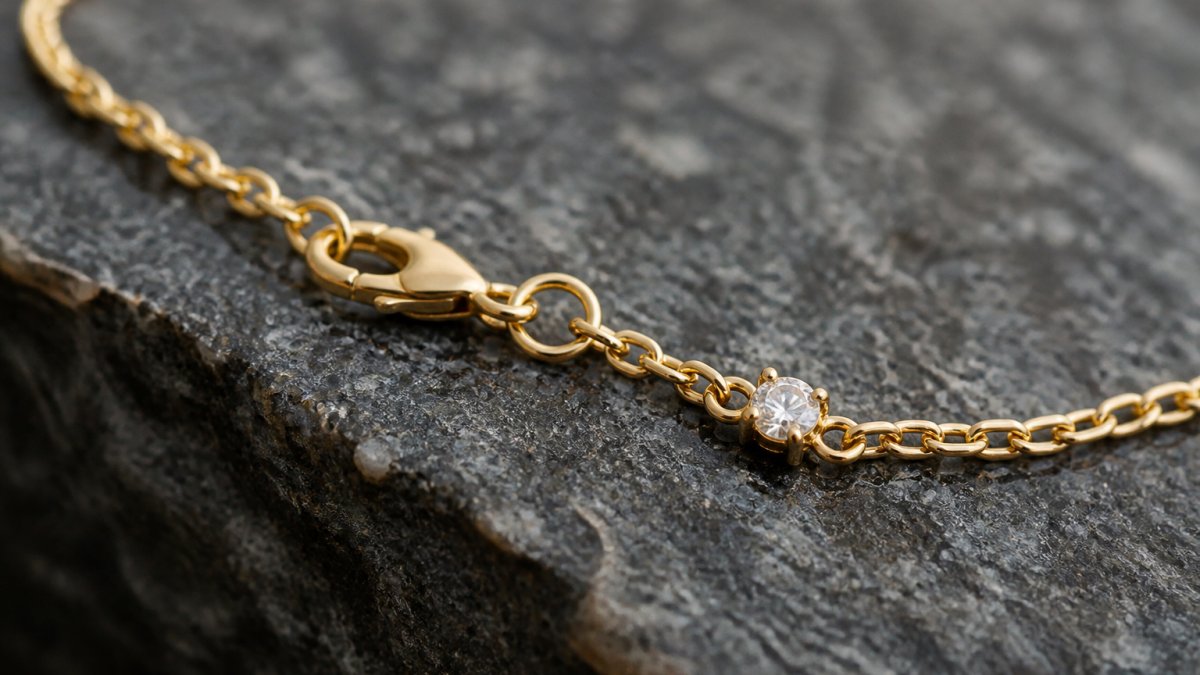
The chain fails through tension. A link that snags on fabric or catches under a shoe strap gets pulled, and thin links deform before they snap.
The diamond setting fails through impact. Prongs bend, bezels take dents, and a stone can work loose in its seat.
The Best Gold Karat for an Anklet That Survives Daily Use
The best gold karat for an anklet worn daily is 14k or 18k, not 24k. Pure 24k gold is too soft for a piece that takes constant knocks. Park Place Jewelers' 2026 gold anklet guide identifies 14k gold as more durable than 24k because it is alloyed with harder metals, which suits the wear and tear of daily use.
Here is how the options compare for an anklet:
- 24k gold: Beautiful color, far too soft. Best reserved for earrings and occasional pieces.
- 18k gold: The sweet spot for fine jewelry. Enough alloy for structural strength, enough gold for a rich tone. This is what we use at LÖF.
- 14k gold: Harder and more scratch-resistant, slightly paler. A practical choice for a piece worn in water and sand.
- Gold plated and gold filled: A base metal core with a gold layer. The layer wears through at friction points, which is where fading and discoloration come from. Not an heirloom material.
If you are weighing recycled gold specifically, our guide on whether recycled gold is durable for everyday wear covers how it performs over years of use.
Anklet Chain Strength: Link Styles, Thickness and Clasp Security
Chain strength comes down to link style, metal thickness and clasp type.
Link style and how each one fails:
- Cable chain: Round or oval links alternating at 90 degrees. The most repairable style because each link is a simple loop that can be opened, re-soldered, or replaced. Fails by link deformation under tension, usually at the solder seam. Good for a diamond anklet because a broken link can be fixed without touching the setting.
- Box chain: Square links that sit flush and resist twisting. Presents a clean line and is harder to snag than a cable chain. Fails by link separation at the corners, which is a more involved repair than a cable link. Works well with bezel-set diamonds because the chain does not rotate the setting against the skin.
- Rope chain: Interlocking links spiraled together. Looks substantial but has more internal friction, so it wears against itself over time. Fails by internal abrasion and link thinning rather than a single snap. Not ideal under a prong setting because the chain's movement transfers to the stone.
- Snake chain: Tightly fitted scales over a core. Looks like a solid tube but kinks permanently once bent. A kinked snake chain is difficult to repair and often needs section replacement. Avoid for an anklet that sees shoe straps and gym equipment.
Thickness and what the numbers mean: A chain under 1mm is decorative and will not survive daily wear.
Soldering and jump rings: A chain is only as strong as its solder joints. Machine-soldered links are consistent; hand-soldered links vary by jeweler.
For diamond pieces, Jesco's guidance on anklet construction advises selecting designs with secure, strong clasps and sturdy chain links, because those are what keep the stones safe during active movement.
Can You Wear a Diamond Anklet Every Day?
Yes, you can wear a diamond anklet every day, provided the setting is protective and the chain is sturdy.
The distinction changes what you buy rather than whether you buy. Bezel settings enclose the stone edge in metal, so there is no prong to catch.
What most guides miss is that the metal matters as much as the setting.
Watch out: swimming in chlorinated pools and wearing an anklet under tight boots are the two fastest ways to loosen a setting. Neither destroys the piece, but both accelerate the checks you need.
How to Care for a Gold Anklet: Cleaning, Checks and Water Exposure
Caring for a gold anklet takes about five minutes a week and one professional inspection a year, the difference between a piece that lasts five years and one that lasts fifty. The routine differs for a diamond anklet and a plain gold chain, because the two fail under different conditions.
Weekly:
- Wipe the piece with a soft dry cloth after wear to remove sweat and body oils.
- Check the clasp by opening and closing it a few times. It should snap, not drag.
- Run a finger along the chain to feel for rough or bent links.
- For diamond pieces, run a fingernail gently across each stone. A stone that rocks or clicks is loose and needs a setter before it falls out.
Monthly:
- Wash in warm water with a drop of mild soap, then rinse and dry fully with a lint-free cloth.
- For diamond pieces, look at each stone under bright light. A stone sitting lower than its neighbors is loose.
- Check the area around the setting for thinning metal, especially at prong tips and bezel edges.
- Inspect the jump ring and clasp connection for opening or wear.
Activity-by-activity guidance:
- Swimming (pool or sea): Solid gold and platinum handle water without tarnishing; plated pieces do not, and the layer wears at friction points. Chlorine and salt can degrade solder over time and accelerate wear at prong tips, so rinse with fresh water afterward. A plain gold chain tolerates swimming better than a diamond anklet because there is no setting to trap chlorine or salt against metal.
- Sweat and sunscreen: Sweat is mildly acidic and, over years, dulls gold and leaves residue around settings. Sunscreen is worse for diamond anklets: it collects under prongs and bezels, dulls brilliance, and attracts grit that abrades the setting. Wipe both after wear, but clean diamond settings more thoroughly and often.
- Sand and grit: Sand is the most underrated threat to a diamond anklet. Grains lodge under prongs and between bezel and stone, and every step grinds them against the metal. A plain chain sheds sand; a setting traps it. Rinse and inspect after beach wear, and limit time on sand in a prong-set diamond anklet.
- Footwear friction: Tight boots, sock cuffs and shoe straps rub against an anklet all day. For a plain chain, the risk is link abrasion and snagging; for a diamond anklet, the setting can catch on fabric and be pulled. A bezel setting resists this; a tall prong setting does not. If you wear boots regularly, a bezel-set diamond or a plain chain is more practical.
Water exposure summary: Solid gold and platinum handle water without tarnishing; plated pieces do not, and the layer wears at friction points. Chlorine and salt are the real concerns for any setting, so rinse with fresh water after the sea or a pool.
Our step-by-step guide on how to clean sustainable gold jewelry walks through the full process, including what to avoid.
Repair, Resetting and the Real Cost of Long-Term Ownership
The purchase price is not the full cost of ownership, and this is where diamond and chain anklets diverge most.
That asymmetry is the strongest argument for buying well once. A solid 18k gold chain with a protective setting costs more upfront and needs almost nothing afterward.
Repairability also depends on construction. Our article on how long fine jewelry lasts across generations covers what determines a piece's working life.
Choosing Your Heirloom Anklet at LÖF
An heirloom anklet is built from materials that do not degrade: solid gold or platinum, secure settings, and a chain heavy enough to hold its shape for decades.
The Empire Strand shows construction-aware design in practice: a 3.5mm box chain in solid 18k yellow gold, with handcrafted rectangle and hexagon links and a baguette diamond set into the clasp.
If you are building a legacy piece, our guides on seven ways to preserve heirloom gemstones and how to choose sustainable heirloom jewelry cover the long view.
Frequently Asked Questions
Which is more durable: a diamond anklet or a gold chain anklet?
A plain gold chain anklet usually lasts longer with less attention because it has fewer components to fail. A diamond anklet can hold up well, but the setting holding each stone is more sensitive to impacts than the chain itself, so durability depends on the setting as much as the metal. Simple continuous chains have fewer joints and therefore fewer breakage points. If you want a diamond anklet for regular wear, look for secure clasps, sturdy links and a protected setting.
Can you wear a diamond anklet every day?
Yes, provided the piece is built for it. Diamond anklets suit daily wear when the setting is strong and the chain is sturdy, since the diamonds themselves are hard but the metal holding them is the vulnerable part. Remove the anklet for gym sessions, contact sports and heavy cleaning, and check the setting and clasp monthly. A well-made diamond anklet worn with that routine can stay in rotation for years.
Does an anklet chain break easily?
An anklet sits in one of the highest-wear positions on the body, so chain quality matters more than it does on a necklace. Simple, continuous chains with fewer joints reduce breakage risk compared with complex multi-component designs. Clasp security is the other weak point: a lightweight spring ring on a thin chain is the most common failure. Choose a sturdy clasp and check the links near the clasp, where stress concentrates.
What gold karat is best for a durable anklet?
14k and 18k gold both work well for an anklet, and the trade-off is hardness versus gold content. Higher-karat gold such as 24k is softer and more prone to scratching and deformation under daily wear, while alloyed 14k gold is harder because it contains other metals. 18k gold, which LÖF uses across its pieces, balances a high gold content with enough alloy strength for regular wear. Match the karat to how often you plan to wear the piece.
The hardest part of buying an anklet is not choosing between diamonds and a plain chain. It is finding a piece whose construction justifies the years you plan to wear it. LÖF makes that decision easier with solid 18k gold and platinum, antique and ethically sourced stones, and settings designed to be worn rather than stored. Explore the collection and choose options that will still be worth passing down.
