

Last Updated: October 27, 2026
Quick Summary
Choose lab-grown diamonds for more visible carat weight per dollar, or natural diamonds for geological rarity and stronger resale narrative. Either way, a diamond anklet needs like-for-like comparison on metal, total carat weight, setting and length, plus monthly checks of prongs, clasp and chain links.
- Lab-grown diamonds appeared in 51% of newly appraised engagement rings from January through June 2026.
- The median lab-grown diamond price per carat fell 55%, from $4,622 to $2,057.
- Compare anklets on equal terms: same metal, total carat weight, setting style and length.
- Run a fingernail along each stone monthly and stop wearing the piece if a prong moves.
- Store the anklet flat or hanging, not coiled tight, to protect the chain's shape.
Table of Contents
- Lab-Grown vs Natural Diamonds: What Actually Separates Them
- Why the Origin Story Matters More on an Anklet Than a Ring
- Diamond Anklet Buying Guide: The 4Cs, Settings and Fit
- Like-for-Like Price Comparison: What Your Budget Actually Buys
- Diamond Anklet Care: Keeping Stones Secure Through Daily Wear
- Ethical Diamond Jewelry: Reading Certification and Disclosure Claims
- Choosing Your Diamond Anklet at LÖF
- Frequently Asked Questions
Lab-Grown vs Natural Diamonds: What Actually Separates Them
Choosing between lab grown and natural diamonds for anklets comes down to one question: do you want a stone grown in weeks or one formed over millions of years?
Lab-grown diamonds are diamonds created in a laboratory that replicate the natural diamond's chemical composition, crystal structure and optical properties. Natural diamonds form deep in the earth under extreme heat and pressure over geological time.
The distinction lives in origin and price, not appearance. Both take a cut grade, a color grade, a clarity grade and a carat weight from the same 4Cs scale.
Where they diverge is supply. According to BriteCo's 2026 Jewelry, Diamond & Watch Price Index, lab-grown diamonds appeared in 51% of newly appraised engagement rings from January through June 2026. That adoption curve is reshaping how buyers think about every diamond piece, anklets included.
Why the Origin Story Matters More on an Anklet Than a Ring
Natural diamonds appeal to buyers who value geological rarity and tradition. Blue Nile's comparison of lab-grown and natural diamonds notes that natural stones are prized for their origin and rarity, while lab-grown stones offer greater accessibility and a wider range. Both share identical visual qualities.
There's a second layer here that most guides skip: emotional significance. An anklet often marks a milestone or carries an heirloom intention. If the piece is meant to be passed down, the origin story becomes part of the object's meaning, not just its paperwork.
Diamond Anklet Buying Guide: The 4Cs, Settings and Fit
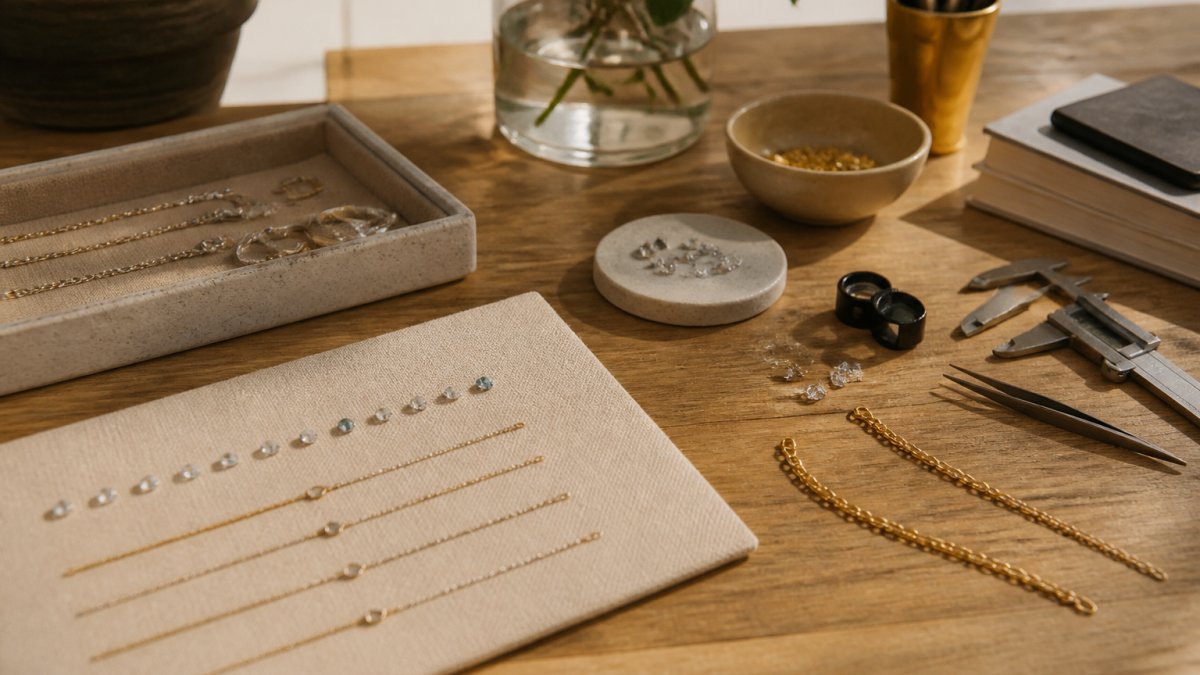
Start with the 4Cs, then solve for fit.
For a full walkthrough on measuring, see our guide on how to measure your ankle for a bracelet. For a deeper dive into metals, settings and sizing, our diamond anklet buying guide covers the full decision.
Like-for-Like Price Comparison: What Your Budget Actually Buys
Price is where the two paths split hardest, but broad claims like "lab-grown is cheaper" don't help you budget for an anklet. What matters is comparing equivalent pieces: same metal, same total carat weight, same setting style, same chain construction. Most guides skip that like-for-like comparison because it requires specifying the build. Here's how to do it yourself.
Build the comparison on equal terms
- Metal and chain: 14k or 18k gold, same chain style (cable, curb, or box) and same clasp type.
- Total carat weight (TCW): the sum of all stones in the anklet, not the size of any single stone.
- Setting style: all bezel or all prong, not a mix.
- Stone quality band: same cut, color, and clarity range (for example, G-H color, VS clarity).
- Anklet length: 9, 10, or 11 inches, since metal weight scales with length.
What the per-carat gap means for an anklet
Lab-grown stones cost less per carat, and the gap has widened as production scaled. According to Faruzo's lab-grown diamond market analysis, the median lab-grown diamond price per carat fell 55%, from $4,622 to $2,057. The comparison period isn't specified in the published data, so treat the direction as the signal rather than a fixed timeline.
A realistic like-for-like framework
| Budget Goal | Lab-Grown Path | Natural Path |
|---|---|---|
| Maximum total carat weight | More stones or larger stones for the same metal budget | Fewer or smaller stones at the same spend |
| Metal-to-stone cost ratio | Metal and labor may dominate the total | Stones represent a larger share of the total |
| Replacement exposure | Lower financial exposure if the anklet is lost or damaged | Higher replacement cost for equivalent visual size |
| Resale expectation | Limited resale value | Stronger resale and investment narrative |
| Visual impact on the ankle | Larger, more visible stones | Smaller, subtler stones |
Ask for the quote breakdown
For a deeper look at how metal choice affects the total, see our diamond anklet buying guide.
Diamond Anklet Care: Keeping Stones Secure Through Daily Wear
An anklet lives a harder life than a ring or pendant. It sits against skin, rubs against shoe straps and socks, catches on bedding, and is often worn in the shower or at the beach. Most care guides treat diamond jewelry as one category; an anklet needs its own routine because the risks are different.
The four anklet-specific risks
- Snagging: prong settings catch on fabric, tights, and shoelaces. A snagged prong can bend or lift, loosening the stone.
- Impact and compression: shoes, boots, and tight socks press the anklet against the ankle, stressing settings and chain links.
- Water and chemical exposure: chlorine, salt water, and soap residue attack metal over time and leave film on stones that dulls sparkle.
- Chain stretch and clasp wear: constant movement and tension wear the clasp and stretch fine chain links, which can open gaps that let stones shift.
A monthly inspection routine
- Run a fingernail along each stone. If a prong moves or a stone rocks in its setting, stop wearing the piece until a jeweler tightens it.
- Check the clasp. Open and close it several times; it should snap firmly, not feel loose or gritty.
- Look for chain gaps. Hold the chain up to light and check for opened links or stretched sections, especially near the clasp.
- Check the jump rings and connectors. These are the points most likely to fail first on an anklet.
Cleaning without damaging the setting
Clean with warm water, mild soap, and a soft brush, then dry fully before storing. Avoid chlorine and harsh cleaners, which attack metal over time. For an anklet, pay extra attention to the underside of the chain, where skin oils and soap residue collect and dull the stones.
Storage that protects the chain
Store the anklet flat or hanging, not coiled tight, to protect the chain's shape. A coiled chain develops kinks and stress points that can fail later. Keep it separate from other jewelry so it doesn't tangle or scratch.
When to see a jeweler
For a direct comparison of how diamond and gold chain anklets hold up under daily wear, our durability comparison breaks down the trade-offs.
Ethical Diamond Jewelry: Reading Certification and Disclosure Claims
For a closer look at what conflict-free certification actually guarantees and where it falls short, read is conflict-free diamond certification worth it. Our rundown of ethical jewelry certifications to look for in 2026 gives you a practical checklist to verify sourcing before you buy.
Choosing Your Diamond Anklet at LÖF
At LÖF, we offer sustainable high and fine jewelry meticulously crafted from 18k gold, platinum, ethically sourced gemstones, and antique diamonds. Our jewelry uses recycled and repurposed gold.
If you want architectural, heirloom-quality design, that's what we make.
Frequently Asked Questions
What is the difference between lab-grown and natural diamonds?
Both are real diamonds with the same chemical composition and crystal structure.
Are lab-grown diamonds a good choice for an anklet?
They can be, particularly if you want a larger stone or a more elaborate design for a set budget. Lab-grown stones carry the same hardness as natural diamonds, so they handle the knocks of daily ankle wear equally well. The trade-off is resale: lab-grown prices have fallen sharply, with the median price per carat dropping 55% to $2,057 according to Faruzo's 2026 market data. Buy a diamond anklet for the wearing, not the resale.
Does a lab-grown diamond have the same resale value as a natural diamond?
No. Natural diamonds hold some secondary market value, though far below retail. Lab-grown stones have seen steep price declines as production scales, so resale is minimal. If an heirloom piece you intend to pass down matters more than upfront savings, natural or antique diamonds are the safer choice. If you want maximum sparkle for your budget and plan to keep the piece, lab-grown makes sense.
How should I care for a diamond anklet?
Remove it before swimming, showering with harsh soaps, or heavy exercise, since chlorine and sweat dull metal and loosen settings over time. Clean monthly with warm water, mild soap and a soft brush, then dry fully before storing. Have the settings checked by a jeweller once a year, because ankle chains take more contact than bracelets. Store flat in a soft pouch to prevent chain kinking.
The real challenge isn't picking a side in the lab-grown versus natural debate. It's finding a piece you'll still want on your ankle in twenty years, made by someone who can prove where the materials came from. LÖF crafts sustainable fine jewelry from 18k gold, platinum and ethically sourced stones, with recycled gold and antique diamonds at the center of the collection. Get started with LÖF and choose an anklet built to be worn, kept and passed down.
