

Last Updated: October 25, 2026
Quick Summary
To measure your ankle for a bracelet, wrap a soft tape around the narrowest point of your ankle, just above the ankle bone, and keep it snug but not tight. Write down that circumference, then add 1 to 2 cm of ease to get your anklet length.
- Measure at the end of the day, when slight swelling is at its most honest.
- You should be able to slide one fingertip under the tape.
- A string or paper strip works if you measure it flat with a ruler.
- Add 1 cm for a snug fit, 1.5 cm for classic, 2 cm for relaxed.
- If choosing between two lengths for a fixed clasp, size up rather than down.
Table of Contents
- How to Measure Ankle Circumference Accurately
- How to Measure for an Anklet Without a Tape Measure
- Where an Anklet Should Sit and How Much Room It Should Have
- Anklet Size Chart: Converting Your Measurement to a Length
- Sizing for Different Anklet Styles and Closures
- Measurement Mistakes That Lead to a Poor Fit
- Choosing Your LÖF Anklet With Confidence
- Frequently Asked Questions
How to Measure Ankle Circumference Accurately
Learning how to measure your ankle for a bracelet takes about two minutes, and it is the single step that decides whether an anklet sits right or spends its life in a drawer. At LÖF, we would rather you get this right before you order than send a piece back after. A bracelet that slips over the heel or digs into the skin is almost always a sizing problem, not a design problem.
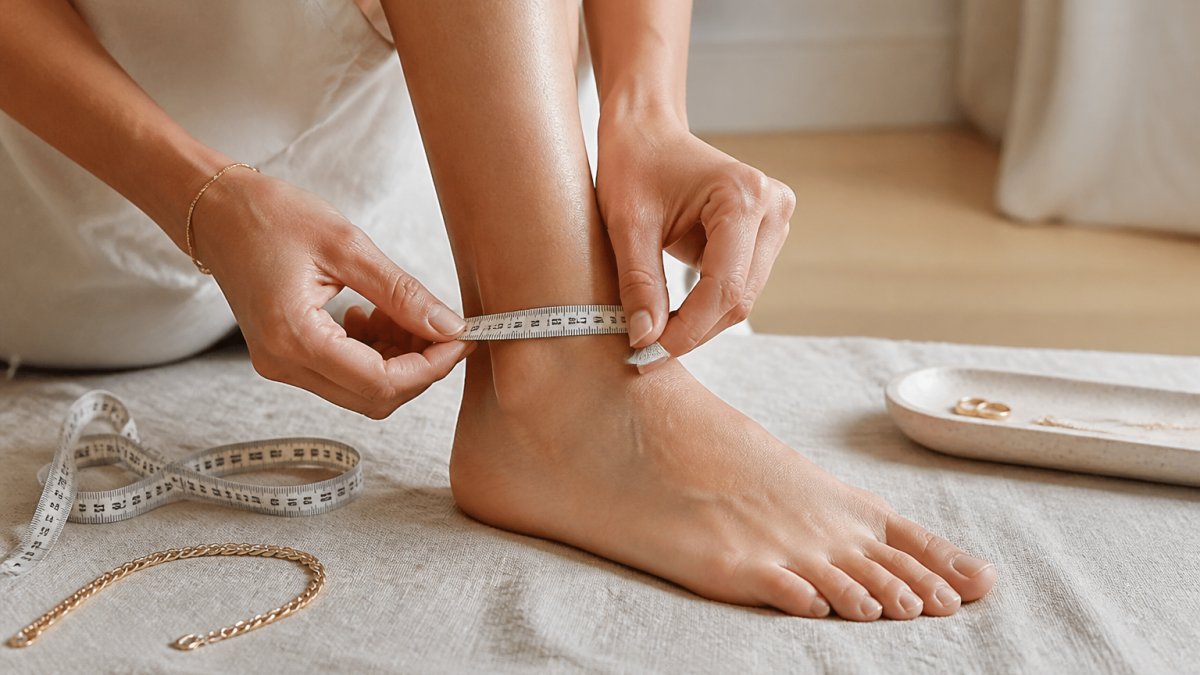
Here is the short answer: wrap a soft tape around the narrowest point of your ankle, just above the ankle bone, keep it snug but not tight, and write down the number.
Ankle circumference is the full distance around the narrowest part of your lower leg, measured just above the bony point on the outside of the ankle.
Three things matter before you start:
- Measure at the end of the day, when slight swelling is at its most honest
- Stand or sit with your foot flat, not pointed
- Measure the ankle you will actually wear the anklet on
Most people assume both ankles match. They often do not. A difference of a few millimetres is common, and on a fine chain that difference shows.
Step 1: Wrap the Tape Around Your Ankle
Place the zero end of a soft tape measure against your skin. Wrap it around the back of your ankle and bring it to the front. The tape should cross just above the ankle bone, at the narrowest point between the bone and the base of your calf.
Keep the tape level all the way around. A tape that rides up at the back gives you a measurement that is too small.
Step 2: Check the Tension
Snug, not tight. You should be able to slide one fingertip under the tape. If the tape leaves a mark on your skin, it is too tight. If it slides down your foot, it is too loose.
Step 3: Record the Number
Read the measurement where the tape meets the zero end. Write it down in both centimetres and inches if you can. Metric sizing is common on fine jewelry from European maisons, and having both numbers saves you a conversion later.
Repeat the measurement once more. If the two numbers differ, take the average. Repeatability is the simplest check on accuracy you have.
How to Measure for an Anklet Without a Tape Measure
No tape measure in the house is not a reason to guess.
The method is the same: wrap, mark, measure flat.
- Cut a length of string or ribbon about 30 cm long
- Wrap it around your ankle at the narrowest point, just above the bone
- Pinch the point where the string meets its own start
- Lay the string flat on a table
- Measure from the end to your pinch point with a ruler
A strip of paper works better than string if you have both. String stretches under tension, and a stretched string reads long. Paper holds its length.
Watch out: a fabric tape that has been stretched or stored coiled can read a few millimetres long. Check any soft tape against a rigid ruler before you trust it for a fine chain.
Where an Anklet Should Sit and How Much Room It Should Have
An anklet should sit just above the ankle bone with enough slack to drape slightly, not enough to slide over the heel.
This is the part most size guides skip. Your measured circumference is not your anklet length.
Think of it in three fit preferences:
- Snug fit: 1 cm of ease. Sits high and stays put. Good for fine chains you never want to notice.
- Classic fit: 1.5 cm of ease. The default for most people, with a little drape.
- Relaxed fit: 2 cm or more. Drapes lower toward the bone. Better for charm styles and heavier links.
Where you wear the anklet changes the number too. High on the ankle above the bone needs less ease. Low, resting near the foot, needs more, because the ankle widens as you move down toward the heel.
Anklet Size Chart: Converting Your Measurement to a Length
Use this chart to turn your ankle measurement directly into a recommended anklet length. Find your circumference in the first column, then read across to the length that matches your fit preference.
| Ankle Circumference | Typical Size | Snug Length (+1 cm) | Classic Length (+1.5 cm) | Relaxed Length (+2 cm) | Recommended Length (Classic) |
|---|---|---|---|---|---|
| 7.1 in / 18 cm | Small | 7.5 in / 19 cm | 7.7 in / 19.5 cm | 7.9 in / 20 cm | 7.7 in / 19.5 cm |
| 7.9 in / 20 cm | Small to Medium | 8.3 in / 21 cm | 8.5 in / 21.5 cm | 8.7 in / 22 cm | 8.5 in / 21.5 cm |
| 8.7 in / 22 cm | Medium | 9.1 in / 23 cm | 9.3 in / 23.5 cm | 9.4 in / 24 cm | 9.3 in / 23.5 cm |
| 9.4 in / 24 cm | Large | 9.8 in / 25 cm | 10 in / 25.5 cm | 10.2 in / 26 cm | 10 in / 25.5 cm |
| 10.2 in / 26 cm | Large to Extra Large | 10.6 in / 27 cm | 10.8 in / 27.5 cm | 11 in / 28 cm | 10.8 in / 27.5 cm |
If you measured in inches, multiply by 2.54 to get centimetres (Approximate Conversions from U.S. Customary Measures to Metric | NIST). An 8-inch ankle is about 20.3 cm, which puts you in the small to medium band and points to a classic length of roughly 8.5 inches (21.5 cm).
If your measurement falls between two rows, round up to the next row for a classic or relaxed fit, or stay on the lower row for a snug fit. A half-centimetre either way rarely changes how a chain drapes, but rounding up protects against a chain that feels tight by evening.
The average adult ankle measurement falls somewhere in the middle of this chart, but averages are a poor substitute for your own number. Ankles vary with height, build, and how much time you spend on your feet.
Sizing for Different Anklet Styles and Closures
Different styles and closures change the length you need, even on the same ankle.
| Style or Closure | How It Affects Fit | Adjustment to Your Measured Circumference |
|---|---|---|
| Fine chain with spring ring or lobster clasp | Fixed length, sits close to the skin | Add 1 to 1.5 cm (classic fit) |
| Fine chain with extender chain | Adds 2 to 5 cm of adjustment | Order your classic length; use the extender to fine-tune |
| Bold or chunky link chain | Link width consumes length in the curve | Add 1.5 to 2 cm beyond classic |
| Beaded anklet | Beads sit proud of the skin and reduce inner circumference | Add 0.5 to 1 cm beyond classic |
| Charm anklet | Charms hang and add weight, pulling the chain lower | Add 2 cm or more (relaxed fit) |
| Elastic or stretch anklet | Stretches to fit a range; no clasp | Order your snug or classic circumference; elastic accommodates 1 to 2 cm |
| Adjustable slider | You set the fit each time | Order your classic length; slider covers a range of about 3 to 5 cm |
Closures matter just as much as style:
- Spring ring and lobster clasp: Fixed length. You must get the measurement right, because there is no adjustment.
- Extender chain: Adds a few centimetres of adjustment. A forgiving choice for a first anklet or a gift.
- Adjustable slider: Lets you set the fit yourself each time. Useful if your ankle swells through the day.
Style also sets the target. A delicate chain looks best worn high and close. A bold architectural link needs a touch more drape so it does not press into the ankle bone. Charm anklets need the most ease of all, since the charms hang and add weight.
As a rule: the heavier the piece, the more ease it needs. Match the closure to how much adjustment you want, and match the style to how much drape you want.
Measurement Mistakes That Lead to a Poor Fit
Most bad fits trace back to one of five mistakes. All of them are easy to avoid.
- Measuring over clothing. A sock or legging adds bulk and gives you a length that is too long. Measure on bare skin.
- Measuring at the widest part. The widest point sits lower, near the foot. Measuring there gives you a chain that slides down. Measure at the narrowest point above the bone.
- Pulling the tape tight. A tight tape reads small, and a small chain will not close comfortably. Snug, with one fingertip of give.
A common mistake is measuring one ankle and assuming the other matches. Check both if the anklet will move between them.
Choosing Your LÖF Anklet With Confidence
Once your measurement is written down, the rest is straightforward. You know your circumference, you know your fit preference, and you know your length.
LÖF pieces are made from 18k gold and platinum, with recycled and repurposed gold and ethically sourced gemstones and antique diamonds. If you are weighing up styles, our guide on how to choose a diamond anklet vs gold chain anklet for lasting wear covers durability and daily wear in more detail.
When you are ready to see how a measured length looks on a real piece, you can browse The Empire Chain or explore The Vera Chain in your size.
Best for: anyone who has measured once and wants a piece that fits on the first try. Skip if: you have not measured yet.
Frequently Asked Questions
Is my ankle the same size as my wrist?
No. Ankles usually measure larger than wrists, often by 2 to 4 cm, so a bracelet size will rarely translate into an anklet size. Measure your ankle directly rather than borrowing a wrist measurement. If you already know your wrist size, treat it as a rough reference only and confirm with a soft tape measure around the ankle bone.
How much extra length should I add to my ankle measurement?
Add roughly 1 to 2 cm to your measured ankle circumference for a comfortable fit that still holds the anklet in place. A snug fit sits closer to the measurement itself, while a relaxed drape needs closer to 2 cm. If you plan to wear the anklet over a sock or prefer a looser chain, add a little more and choose a piece with an extender chain.
Can I measure my ankle without a tape measure?
Yes. Wrap a piece of string, ribbon, or folded paper around your ankle, mark where the ends meet, then lay it flat against a ruler. Record the length in centimetres. Repeat twice to check accuracy, since string can stretch or sit unevenly. This method works well for online anklet sizing when no soft tape measure is at hand.
Should an anklet be tight or loose?
A well-fitted anklet rests lightly against the skin without pressing into it or sliding down over the foot. You should be able to slip one finger under the chain. Anything tighter risks discomfort and chain strain, while anything looser tends to catch on shoes and clothing. Use an anklet size chart and your measured circumference to land in the right range.
Getting the fit right is the difference between an anklet you forget you are wearing and one you notice all day. LÖF makes that easier with pieces crafted from 18k gold and platinum, recycled gold, and ethically sourced stones, so the chain that fits you is also one you can pass down. Measure once, add your ease, and choose with confidence. Get started with LÖF and find an anklet made to sit exactly where it should.
