

Table of Contents
- Understanding Antique Diamonds: Why They Need Different Care
- Safe Cleaning Solutions for Antique Settings
- Step-by-Step: How to Clean Antique Diamonds at Home
- Signs of Damage in Antique Diamond Settings
- Professional Jewelry Inspection Frequency
- Storage and Travel Care for Antique Diamonds
- What to Avoid: Dos and Don'ts of Antique Diamond Care
- Frequently Asked Questions
Last Updated: September 12, 2026
Understanding Antique Diamonds: Why They Need Different Care
Antique diamonds are gemstones cut before the mid-20th century, with hand-cut facets, open culets, and proportions modern cutting cannot replicate. Learning how to care for antique diamonds starts with one key fact: their settings are often as old as the stones themselves, and both need gentler handling than contemporary pieces.
Unlike modern brilliant cuts, antique stones such as Old European Cuts and rose cuts have thinner girdles and shallower angles. Their settings, often platinum or 18k gold with fine prongs and filigree, have had decades or centuries to loosen, so harsh cleaning can damage metal or dislodge a stone before you notice.
At LÖF, we work with antique diamonds because they carry history no new stone can match. The trade-off: they reward attentive, low-impact maintenance rather than the quick ultrasonic dips many modern jewelry owners rely on.
Gemological Institute of America guide to diamond care
Safe Cleaning Solutions for Antique Settings
The safest cleaning solution for antique settings is mild dish soap diluted in lukewarm water, a few drops in a small bowl. It lifts oils and everyday grime without attacking metal or porous gemstones.
Avoid anything with ammonia, chlorine, or abrasives: these dull platinum, weaken solder joints in older pieces, and damage porous stones like opals or emeralds often set alongside antique diamonds (gia.edu). Ultrasonic and steam cleaners pose a similar risk, vibration and heat can loosen prongs that have held firm for a century.
For heavy buildup, use a jewelry degreasing solution formulated for delicate settings, applied with a soft brush rather than soaking the whole piece.
| Solution | Safe for Antique Diamonds? | Why |
|---|---|---|
| Mild dish soap + lukewarm water | Yes | Gentle on metal and stone |
| Ammonia-based cleaner | No | Dulls platinum, weakens solder |
| Ultrasonic cleaner | No | Vibration loosens old prongs |
| Steam cleaner | No | Heat stress on delicate settings |
| Commercial degreasing solution | Yes, if labeled gentle | Removes oils without abrasion |
Step-by-Step: How to Clean Antique Diamonds at Home
You can clean most antique diamond jewelry at home in under ten minutes with items you likely already own. The order of steps matters more than the tools.
Gathering Your Tools
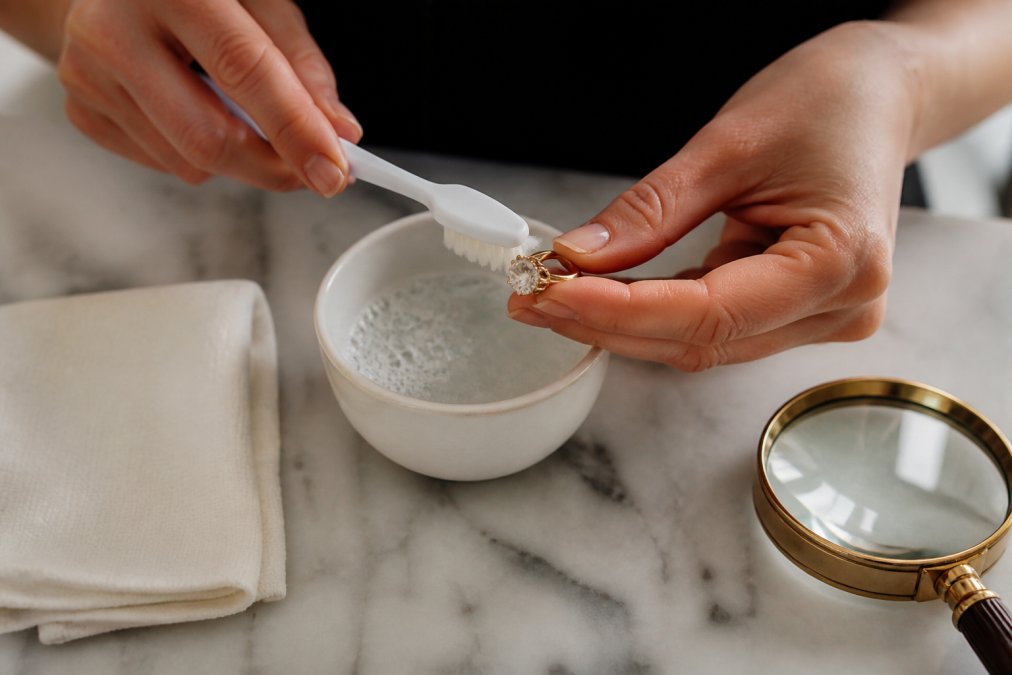
Assemble everything on a lint-free cloth so nothing scratches against a hard surface:
- Mild dish soap
- Lukewarm water in a small ceramic bowl
- A soft-bristled toothbrush, ideally a baby or extra-soft brush
- A lint-free cloth or microfiber towel
- A magnifying glass for a post-clean inspection
The Gentle Cleaning Process
- Soak the piece in the soapy water for five to ten minutes to loosen debris and dead skin.
- Brush gently around the prongs, under the stone, and through any filigree, using light circular motions.
- Rinse under lukewarm running water with the drain stopped, or hold the piece over the bowl.
- Pat dry with a lint-free cloth. Never rub, since friction can catch a loose prong.
- Inspect the setting with your magnifying glass while the piece is dry.
Signs of Damage in Antique Diamond Settings
Most guides tell you to 'check for loose stones.' That advice is useless without knowing what you're looking at. Antique settings fail in predictable ways, each with a distinct visual signature, so you can distinguish normal wear from active damage that means you must stop wearing the piece immediately.
Wear vs. Damage: The Distinction That Matters
Wear is cumulative and slow: metal thins, prong tips round off, patina develops from decades of contact with skin, fabric, and air. It's not an emergency, but it signals it's time to schedule maintenance.
Damage is a discrete event or accelerated failure: a prong bends, a solder joint cracks, a stone shifts in its seat. It can happen in a single moment, catching a ring on a doorframe, dropping a pendant on tile, and means you stop wearing the piece until a jeweler assesses it.
The practical test: if a change appeared gradually and the stone still feels secure, it's likely wear. If it appeared suddenly, or the stone moves at all, treat it as damage.
What to Look For, and How to Test It
Run these checks every three to six months in good light, with a 10x jeweler's loupe or magnifying glass. A phone camera with macro mode also works.
- Prong tips. Look at the end of each prong where it folds over the stone's girdle. A healthy tip is rounded and flush against the stone; a worn tip looks flattened, thinned, or has a bright polished spot. A visible gap between prong tip and stone edge puts the stone at risk.
- Stone movement. Press gently with a fingertip, not a fingernail, which can chip a girdle. A secure stone won't move; one that rocks, clicks, or shifts is loose. Don't clean or wear it until a jeweler tightens the setting.
- Solder joints. On filigree, gallery, or multi-stone settings, examine where metal meets metal. A hairline crack appears as a dark line under magnification, and solder cracks are common on pieces previously resized or repaired.
- Metal surface. Pitting or chalky white discoloration on gold can indicate chemical exposure, often from pool chlorine or household cleaners. Platinum's matte patina is normal; deep scratches or gouges are not.
- Stone appearance. A diamond still cloudy after cleaning may have debris trapped beneath the setting, or may have shifted to an angle that reduces light return. On foil-backed antique stones, a dark or greenish edge tint means the foil has degraded, cleaning can't fix it.
When to Stop and Call a Jeweler
Stop wearing the piece and book an inspection if you find any of the following:
- Any stone movement, no matter how slight
- A visible gap between a prong and the stone
- A crack in metal or solder
- A stone that has changed color or clarity since your last check
- A prong that has broken off entirely (keep the stone and the piece in a sealed bag, do not attempt to re-set it yourself)
A loose stone caught early is usually a minor bench repair. A lost antique diamond is often irreplaceable, since matching an Old European Cut or rose cut by color, cut, and character is difficult and sometimes impossible.
Professional Jewelry Inspection Frequency
Professional jewelry inspection frequency for antique pieces should be every six months, or annually at minimum (gia.edu). Modern jewelry can often go a year between checks, but antique settings with decades of wear benefit from closer monitoring.
A jeweler will tighten prongs, check solder joints, and confirm the stone is seated correctly. It's also the moment to review your insurance appraisal, since antique diamond values shift with market conditions. Ask for a written condition report each visit and keep it with your purchase documentation.
Storage and Travel Care for Antique Diamonds
Storage and travel are where antique diamonds face their highest risk, not because the threats are exotic, but because they're cumulative and invisible. A modern ring can survive a decade loose in a shared jewelry box; an antique piece with thinned prongs and a century-old solder joint may not survive one trip in a checked bag.
At-Home Storage: Beyond the Soft Pouch
A soft pouch is the minimum, not the ideal. The goal is to eliminate three risks: metal-on-metal contact, stone-on-stone abrasion, and airborne sulfur compounds that tarnish silver and degrade antique finishes.
- Individual compartments. Each piece needs its own lined slot or pouch. Diamonds are the hardest gemstone and will scratch gold, platinum, and softer stones like the opals and emeralds often set alongside antique diamonds.
- Anti-tarnish protection. For silver and lower-karat gold antique pieces, place a small anti-tarnish strip or a piece of acid-free tissue in the compartment. Avoid storing silver in direct contact with rubber bands, which contain sulfur.
- Humidity control. Store jewelry in a dry area, not a bathroom, where steam and humidity accelerate tarnish and can affect foil-backed stones. A simple silica gel packet in the jewelry box helps in humid climates.
- Avoid hanging storage. Necklaces and bracelets stored on hooks put constant tension on clasps and chain links. Antique clasps are often hand-made and not designed for the load of a heavy pendant. Lay pieces flat instead.
Travel Care: A Step-by-Step Protocol
Travel exposes antique jewelry to temperature swings, humidity changes, jostling, and loss or theft. A little preparation prevents most problems.
- Pre-travel inspection. Two weeks before a trip, inspect every piece using the checks above. If anything is loose or worn, see a jeweler before you leave, repairs are far harder on the road.
- Photograph and document. Take clear photos of each piece from multiple angles and keep your appraisal or insurance documentation separate from the jewelry. If a piece is lost or stolen, your insurer will ask for it.
- Choose the right case. A hard-shell case with padded compartments beats a fabric roll for air travel, fabric rolls offer no crush protection, and antique settings can bend under luggage weight.
- Carry, don't check. Never pack antique jewelry in checked luggage. Keep the case in your personal item, not an overhead bin where it can shift during turbulence.
- Manage humidity in transit. A small anti-tarnish strip or silica packet helps with the humidity swings of pressurized cabins and tropical destinations, especially important for silver.
- Wear with caution. Remove an antique ring before swimming (chlorine and salt water attack metal and can loosen settings), before applying sunscreen or insect repellent, and before any activity where it could catch on fabric or equipment.
What Not to Do
- Don't use a hotel safe for high-value pieces unless you're certain of its security and the hotel accepts liability. Many hotel safes aren't insured for jewelry.
- Don't clean antique pieces with hotel bathroom supplies. Bar soap, harsh hand soap, and rough towels can cause damage. Bring a small travel kit with mild soap and a soft brush.
- Don't leave pieces in a hot car. Heat stress affects older metals and can accelerate foil degradation on foil-backed stones.
What to Avoid: Dos and Don'ts of Antique Diamond Care
The difference between a piece that lasts generations and one that needs constant repair comes down to a few habits.
Do:
- Clean with mild soap and lukewarm water
- Remove jewelry before swimming, showering, or applying lotion
- Schedule professional inspections twice a year
- Store pieces separately in soft pouches
Don't:
- Use ultrasonic or steam cleaners on antique settings
- Expose pieces to chlorine, ammonia, or abrasive cleaners
- Wear antique rings during gardening, cleaning, or gym sessions
- Assume a tight stone will stay tight without periodic checks
For collectors who want antique diamonds they can wear daily without constant worry, LÖF crafts pieces from 18k gold, platinum, and ethically sourced antique stones, built to be worn and passed down rather than locked away.
Caring for antique diamonds asks for patience, not expensive products. The right routine, mild soap, a soft brush, and regular professional checks, keeps century-old stones brilliant for the next generation. LÖF builds heirloom-quality jewelry around exactly that idea, using recycled precious metals, antique diamonds, and ethically sourced gemstones so each piece is made to be maintained and treasured. Explore the collection and choose options that suit your everyday wear or your most significant occasions.
Frequently Asked Questions
Are antique diamonds more fragile than modern diamonds?
Antique diamonds are not inherently more fragile than modern ones because diamond hardness remains the same. However, their settings often feature delicate prongs, filigree, or older metalwork that can weaken over time. The risk lies in the setting, not the stone. Inspect prongs regularly and avoid ultrasonic cleaners if the setting feels loose. With proper antique diamonds care, these stones last for generations.
Can I use an ultrasonic cleaner on antique diamond jewelry?
Avoid ultrasonic cleaners for antique diamond jewelry. The vibrations can loosen older prongs, dislodge tiny accent stones, and damage patina on vintage metalwork. Instead, use a safe cleaning solution for antique settings: lukewarm water with mild dish soap and a soft-bristled toothbrush. For pieces with porous gemstones or intricate filigree, skip soaking altogether and wipe gently with a damp lint-free cloth.
How often should I have my antique diamond ring professionally inspected?
Schedule a professional jewelry inspection every six months for antique diamond rings worn daily. If you wear the piece only for special occasions, once a year is sufficient. During these visits, a jeweler checks for loose settings, worn prongs, and signs of damage in antique diamond settings. Regular inspections catch small issues before they become costly repairs and help maintain insurance appraisals.
What is the safest way to store antique diamond jewelry to prevent damage?
Store each antique diamond piece in its own soft-lined pouch or compartment to prevent scratches and tangles. Keep jewelry away from direct sunlight and humidity, which can affect metal and certain gemstones. For travel, use a hard case with individual slots. If you own high-value pieces, consider a locked jewelry box or safe. Proper storage preserves sparkle and protects delicate settings from accidental drops.