

Last Updated: October 23, 2026
Quick Summary
Resizing vintage gold rings is typically possible, but the process depends on the ring's age, construction, and structural integrity. A professional goldsmith must assess whether resizing is safe and feasible for your specific piece before any work begins.
- Vintage rings can usually be safely sized one to three sizes up or down depending on the direction and ring condition.
- Sizing down is generally less risky than sizing up because it removes metal rather than introducing new material that must match the existing alloy.
- Pre-resizing assessment by a goldsmith should include written documentation of the ring's condition, photographs, and identification of any existing damage or risks.
- Some vintage ring styles resist resizing, including eternity bands with stones all the way around and pieces with delicate filigree or intricate surface work.
- Ring adjusters, necklace conversion, or shank rebuilding offer alternatives when traditional resizing poses too much risk to the vintage piece.
Table of Contents
- Can Vintage Gold Rings Be Resized?
- Understanding Ring Resizing Limitations
- How Ring Resizing Works: The Repair Technique
- Repairing a Broken Gold Ring During Resizing
- Vintage Ring Restoration: Pre-Repair Inspection
- Gold Ring Resizing Cost and Timeline
- Sizing Up Versus Sizing Down: What's Possible
- Alternatives When Resizing Isn't Suitable
- Frequently Asked Questions
Can Vintage Gold Rings Be Resized?
Yes, vintage gold rings can typically be resized, but the process depends entirely on the individual ring's condition and construction. Resizing vintage gold rings isn't a one-size-fits-all solution.
The real question isn't whether resizing can happen, it's whether resizing should happen for your specific ring.
At LÖF, we understand that heirloom pieces carry both monetary and emotional value. That's why we emphasize professional assessment before committing to any restoration work on vintage jewelry.
What Makes Vintage Rings Different
Vintage rings differ from modern pieces in fundamental ways. They were often made with different soldering techniques, alloy compositions, and construction methods that no longer reflect current standards.
Older rings frequently feature:
- Hand-forged construction with variable wall thickness
- Softer solders that weaken under heat
- Original sizing adjustments that have already stressed the metal
These factors mean a vintage ring's ability to withstand resizing depends on its specific history and construction, not just its age.
Age-Related Wear and Structural Integrity
Decades of daily wear affect gold differently than you might expect. The metal becomes work-hardened and brittle in some areas while remaining soft in others. A ring worn constantly develops stress points that a jeweler must identify before resizing.
Common age-related issues include:
- Thinned shanks from decades of sizing or polishing
- Micro-cracks invisible to the naked eye
- Weakened solder joints from exposure to heat and chemicals
A professional assessment should always precede resizing work. The goldsmith will examine the ring under magnification and may recommend documentation before proceeding.
Understanding Ring Resizing Limitations
Not every vintage ring can be resized to every size. Ring resizing limitations exist for practical reasons rooted in metallurgy and construction. Understanding these limits helps you make informed decisions about your heirloom piece. Learn whether recycled gold is durable for everyday wear after resizing.
Ring Styles That Resist Resizing
Certain vintage ring designs present genuine challenges for resizing work. The style itself may make adjustment difficult or impossible without compromising the piece's integrity.
Rings that resist resizing include:
- Eternity bands with stones all the way around (removing metal breaks the design)
- Extremely ornate or sculptural pieces where metal removal disrupts the pattern
- Rings with integral design elements that cannot be separated
A goldsmith can sometimes work around these limitations. For example, an eternity band might be resized through the bottom if the stones allow it. But some styles genuinely cannot be adjusted without permanent damage.
Metal Alloy and Solder Compatibility
Vintage gold rings often contain alloys that differ from modern standards. This matters enormously during resizing because the solder used to rejoin the band must be compatible with the existing metal.
Gold alloys vary by era and origin:
- Pre-1920s rings often contain higher copper content for durability
- Mid-century pieces may use different alloy ratios than modern 18k gold
- Rings from different regions used region-specific alloy standards
When a goldsmith cuts and rejoins the shank, the solder must flow properly and bond securely. Incompatible alloys create weak joints that fail under stress. A professional assessment identifies the exact alloy composition and determines whether modern solder will work or if specialized techniques are needed.
How Ring Resizing Works: The Repair Technique
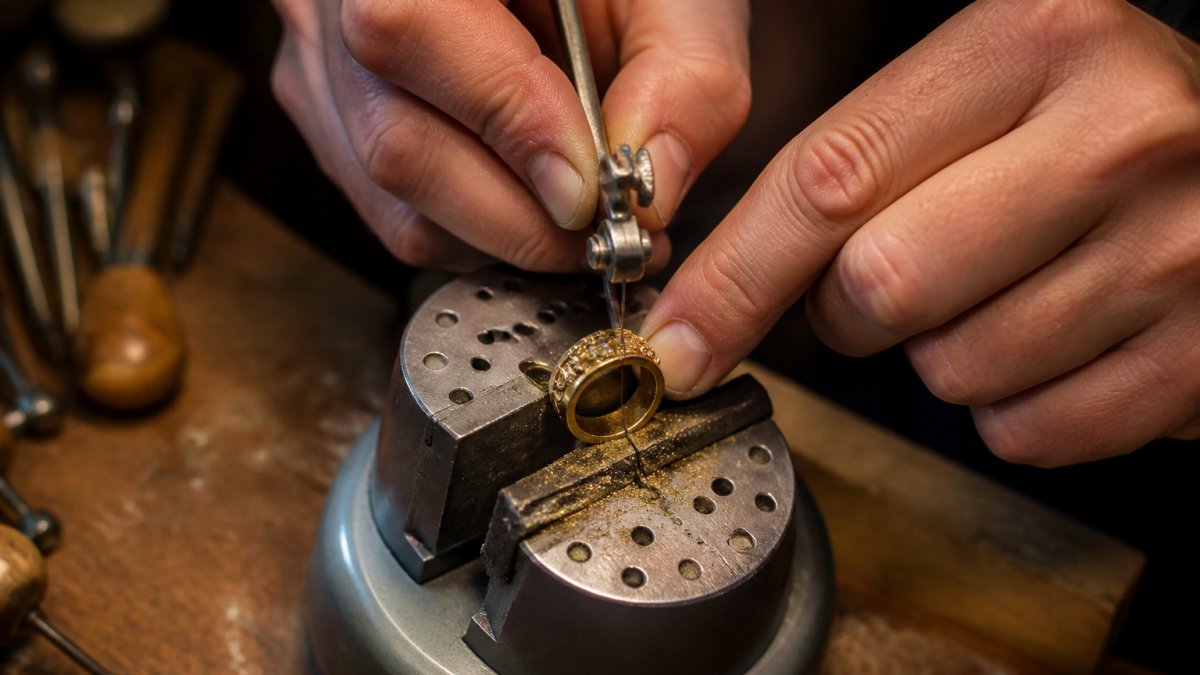
Repairing and resizing vintage gold rings involves cutting the shank, adjusting the metal, and rejoining it securely. The process sounds straightforward but requires precision and skill, especially with vintage pieces.
Cutting the Shank and Adding or Removing Metal
The goldsmith cuts the ring at a specific point, usually on the side or bottom where the cut is least visible.
If sizing up, the jeweler removes a section of metal. If sizing down, metal must be added.
The cutting process:
- Marks the cutting line with precision
- Uses specialized tools to cut straight through the band
- Files the ends smooth and flat
For sizing down, the jeweler typically solders a piece of matching gold into the gap. For sizing up, metal is simply removed and the ends are brought together.
Rejoining and Soldering Methods
After the metal adjustment, the shank must be rejoined. This is where the goldsmith's skill becomes most critical. The joint must be structurally sound and invisible to the eye.
Traditional soldering remains the standard method for vintage rings.
Modern alternatives exist:
- Laser welding for precise, minimal-heat joining
- Ultrasonic welding in some cases
- Traditional torch soldering with appropriate flux
The choice depends on the ring's alloy, thickness, and the jeweler's expertise. For vintage pieces, traditional soldering often works best because it's been proven over decades.
Repairing a Broken Gold Ring During Resizing
Sometimes resizing uncovers damage. A ring that appears sound may crack or break during the cutting process, revealing hidden structural weakness. This isn't failure, it's discovery.
Prong and Stone Setting Assessment
Before resizing begins, the goldsmith examines the stone settings. Prongs that hold stones must be secure and properly aligned. If a stone is loose, resizing work could dislodge it entirely.
Assessment includes:
- Checking each prong for tightness and alignment
- Testing stone security with gentle pressure
- Examining the setting base for cracks
Many vintage rings benefit from having stones reset during resizing work. This ensures the stone won't shift or fall out when the band is adjusted. It's additional work and cost, but it protects your heirloom.
Addressing Cracked Bands and Recurring Issues
A crack discovered during resizing must be repaired before the ring can be properly resized. The goldsmith will evaluate whether the crack is isolated or indicates systemic weakness throughout the band.
Cracked bands require:
- Assessment of crack length and location
- Evaluation of whether the entire band needs reinforcement
- Potential rebuilding of the affected area
Some vintage rings show recurring issues, they've been sized multiple times and each adjustment weakened the band further. In these cases, the jeweler may recommend a different approach, such as adding a reinforcing band inside the ring or rebuilding the entire shank.
Vintage Ring Restoration: Pre-Repair Inspection
Before any resizing work begins, a thorough inspection protects both you and the jeweler. This assessment determines what's possible and what alternatives might be better.
Documentation and Assessment by a Goldsmith
A professional goldsmith should provide written documentation of the ring's condition before work begins. This protects you by creating a record of the ring's starting state and establishes realistic expectations for the outcome.
The assessment should include:
- Detailed description of the ring's construction and alloy
- Photographs of any existing damage or wear
- Identification of stones and their security
This documentation becomes part of your ring's history. If you ever sell or insure the piece, this record proves what condition it was in before restoration work.
Ask the goldsmith specific questions during the assessment:
- Can this ring be safely resized to the target size?
- What risks exist given its current condition?
- Will resizing require additional repairs?
Gold Ring Resizing Cost and Timeline
Gold ring resizing cost varies based on multiple factors. Understanding what drives pricing helps you budget appropriately and evaluate whether resizing makes sense for your piece.
Factors That Affect Pricing
The cost of resizing depends on the ring's complexity, the amount of metal adjustment needed, and whether additional repairs are discovered during work.
Key cost factors:
- Size of the adjustment (larger changes cost more)
- Ring's metal composition and alloy compatibility
- Presence of stones requiring resetting
A simple sizing down on a plain band costs less than resizing an ornate vintage setting with stones.
For a realistic estimate, consult directly with a professional goldsmith who can examine your specific ring.
Turnaround Time and Repair Warranties
Most ring resizing takes one to three weeks from start to finish, depending on the jeweler's workload and the ring's complexity. Vintage rings with additional repairs often take longer.
Timeline considerations:
- Simple sizing: one to two weeks
- Sizing with stone resetting: two to three weeks
- Sizing with repairs or alloy matching: three to four weeks
Ask about the jeweler's warranty on completed work. Reputable goldsmiths typically guarantee their soldering and sizing work for a specified period. This protects you if the joint fails or the sizing proves inaccurate.
Sizing Up Versus Sizing Down: What's Possible
The direction of sizing affects feasibility and cost. Sizing up and sizing down present different challenges for vintage rings.
Sizing down (making the ring smaller) involves removing a section of metal.
Sizing up (making the ring larger) requires adding metal.
Most vintage rings can be safely sized one to three sizes in either direction. Beyond that range, the goldsmith may recommend alternatives rather than risk compromising the ring's integrity.
Vintage rings can typically be adjusted safely within specific size ranges, with different challenges depending on direction.
| Direction | Method | Safe Range | Key Consideration |
|---|---|---|---|
| Sizing down | Remove metal section | One to three sizes | Less risky; no new metal introduced |
| Sizing up | Add matching gold | One to three sizes | Requires alloy compatibility; more complex |
Alternatives When Resizing Isn't Suitable
When resizing poses too much risk or isn't feasible, other solutions protect your vintage ring while making it wearable.
Consider these alternatives:
- Ring adjusters or sizers - Small metal bands that fit inside the ring to reduce size without cutting the original band
- Wearing on a different finger - A ring sized for the ring finger might fit perfectly on the middle finger
- Necklace conversion - Have the ring mounted on a chain to wear as a pendant, preserving the original band
These alternatives respect the ring's vintage construction while solving the practical problem of fit. Some preserve the original band entirely, which matters if you value authenticity above wearability.
At LÖF, we recognize that vintage and antique pieces deserve thoughtful care.
Vintage gold rings carry stories worth preserving. Explore how LÖF's approach to sustainable, heirloom-quality jewelry reflects the same commitment to longevity and craftsmanship that vintage restoration demands, choose options to discover pieces designed to become treasured heirlooms themselves.
Frequently Asked Questions
Can a vintage gold ring be resized?
Yes, but not all vintage gold rings can be resized safely. Decades of wear may have thinned the shank or weakened parts of the ring. A qualified goldsmith must inspect the ring to assess its structural integrity before resizing. Some vintage rings, particularly those with intricate settings, delicate bands, or damage, may require alternative solutions rather than traditional resizing.
What are the main ring resizing limitations for older pieces?
Vintage rings face several resizing constraints. Rings with ornate designs, multiple stone settings, or thin bands resist resizing due to construction complexity. Gold alloy compatibility matters: vintage gold may have different solder properties than modern gold. Substantial size changes (more than 2-3 sizes) can compromise structural integrity. Rings with recurring damage or prior repairs may not withstand the resizing process.
How much does it typically cost to resize a vintage gold ring?
Ring resizing costs vary based on the complexity of the work, the ring's condition, and the jeweler's expertise. Simple sizing often costs less than restoration involving prong repair, stone resetting, or rejoining damaged sections. Expect pricing to depend on the extent of metal removal or addition, whether laser welding or traditional soldering is needed, and the jeweler's location and reputation. Contact a goldsmith for a personalized quote based on your ring's specific needs.
What should I do before having a vintage ring resized?
Request a thorough pre-repair inspection from an experienced goldsmith or jeweler. Ask them to document the ring's current condition, including any wear, prior repairs, or stone setting issues. Discuss sizing limits specific to your ring's construction and metal type. Get a detailed estimate covering the resizing process, any necessary repairs, turnaround time, and warranty coverage. This assessment protects your heirloom and ensures realistic expectations.
