

Quick Summary
To style statement cuffs, start by measuring your wrist so the piece fits without sliding or pinching, then choose one bold anchor piece and keep other jewelry quieter. Build a layered stack by placing the widest cuff nearest the hand, adding one or two slim bangles above it, and stopping once the stack feels full rather than crowded.
- Measure your wrist in the late afternoon, when your hands are at their usual size.
- A wide cuff should cover no more than one-third of the distance from wrist bone to elbow.
- Place your widest cuff closest to the hand, then add one or two slim bangles above it.
- Choose a matte-finish sculptural cuff for conservative workplaces to avoid distracting shine.
- Store cuffs flat or in a soft pouch and remove them before swimming or applying lotion.
Table of Contents
- Start With the Right Fit: How to Measure Your Wrist for a Cuff
- Choose an Anchor Piece Before You Add Anything Else
- How to Wear a Wide Cuff Bracelet Without Overwhelming Your Wrist
- How to Stack Cuff Bracelets and Bangles for a Layered Look
- How to Style Bracelets With Different Outfits
- Are Cuff Bracelets Still in Style, and How to Keep Yours Looking New
- Booking a Fitting or Choosing Your First LÖF Cuff
- Frequently Asked Questions
Start With the Right Fit: How to Measure Your Wrist for a Cuff
Last Updated: November 3, 2026
Style statement cuffs and bangles can transform a plain outfit, but only when they fit. A cuff that slides around or pinches the wrist looks careless. Cuffs made for bold, sculptural styling make getting the size right matter even more.
The first step is simple: measure your wrist. Wrap a soft measuring tape around the wrist bone where a watch would sit. Note the number. Then add a little room so the bracelet can move without catching.
Watch out: a cuff that fits snugly in the store can feel tight after a warm day or a salty meal. Measure in the late afternoon, when your hands are at their usual size.
Here is what to keep in mind when you size up:
- Hinged cuffs need to slide over the hand, so the opening must be wide enough for your palm.
- Solid bangles need a little extra room, because they cannot open.
- Wide cuffs sit lower on the wrist and need a slightly looser fit than narrow ones.
LÖF lists standard cuff sizes of 6, 7 and 8 inches for pieces like The Harlow Cuff, and custom sizing is available. Because the team reaches out after purchase to confirm your size, it helps to have your measurement ready.
Choose an Anchor Piece Before You Add Anything Else
Start with one bold piece and build around it, since style statement cuffs work best as a single focal point. This is the simplest way to avoid a cluttered wrist.
An anchor piece is the cuff that draws the eye. Everything else on the arm should support it. For a dramatic option, The Tallulah Drama Cuff is a good example, with staggered antique baguette diamonds set around a wire bangle in 18k yellow gold.
Once the anchor is chosen, keep the other pieces quieter. Thin bangles in a matching metal tie the look together. Avoid adding a second bold cuff of similar size, because two focal points compete for attention.
How to Wear a Wide Cuff Bracelet Without Overwhelming Your Wrist
Wide cuffs make a strong statement, but they also take up a lot of visual space. The key is to balance the cuff against your wrist proportions and the rest of your outfit, not just to wear less jewelry.
Start with wrist proportion. A cuff that is wider than your wrist bone to knuckle length will visually shorten your arm. As a rule of thumb, a wide cuff should cover no more than one-third of the distance from your wrist bone to your elbow. If you have a shorter forearm, choose a cuff that is 1 to 1.5 inches wide; if you have a longer forearm, you can carry 2 inches or more. This is the kind of fit advice most guides skip, but it makes the difference between a cuff that looks intentional and one that looks like it is wearing you.
Balance the cuff against your frame. A wide cuff on a petite wrist can overwhelm the hand, so pair it with a slim ring or a delicate chain bracelet on the same arm to create contrast. On a larger wrist, a wide cuff can look proportionate on its own, but adding one thinner bangle above it keeps the stack from feeling heavy.
Sleeves change the effect. A cuff worn over a fitted sleeve looks deliberate because the sleeve acts as a neutral base. Under a loose sleeve, the cuff can disappear, so push the sleeve up to the forearm or choose a lighter gold tone to keep it visible. If you wear a wide cuff with a blazer, roll the sleeve once so the cuff sits against bare skin or a fitted cuff.
Watch out: a wide cuff that sits too low on the hand can restrict movement and feel uncomfortable after a few hours. Adjust the opening so the cuff rests just above the wrist bone, not on the back of the hand.
Finally, consider the neckline. A wide cuff draws the eye to the wrist, so if you are wearing a bold necklace or statement earrings, choose a slimmer bracelet instead of a second wide piece. If your outfit is simple, a wide cuff can be the only accessory you need.
How to Stack Cuff Bracelets and Bangles for a Layered Look
Layering is where statement jewelry becomes personal, and style statement cuffs anchor the stack. A good stack has one clear base and a few supporting pieces.
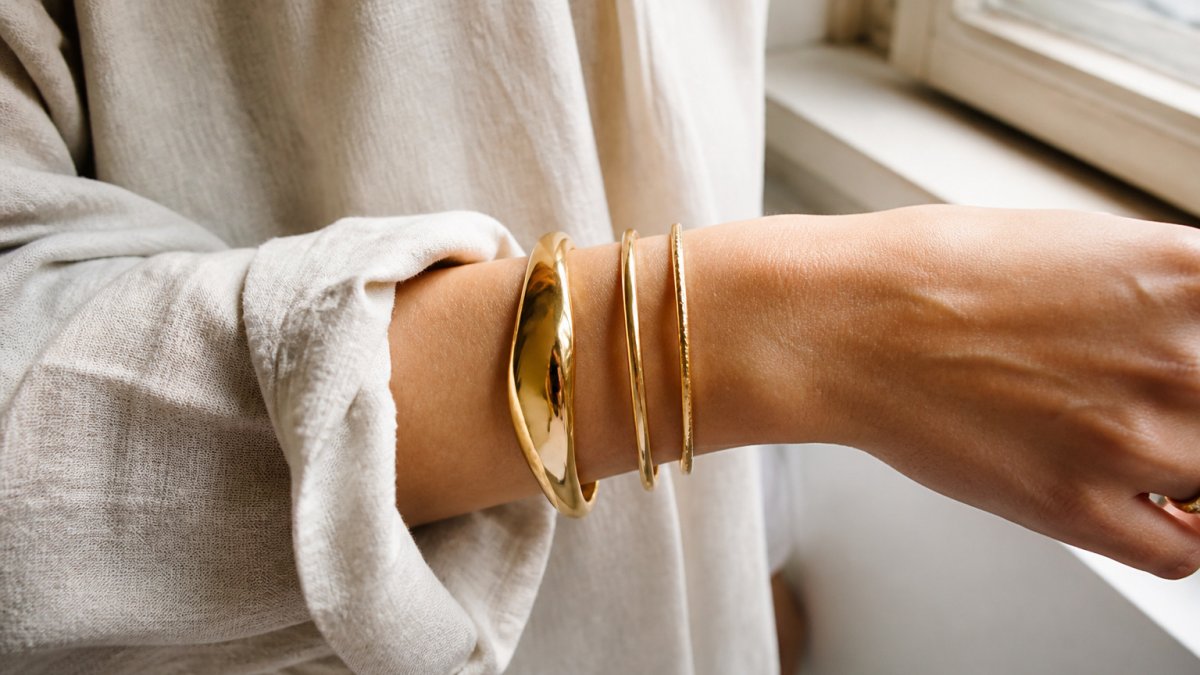
Here is a simple method:
- Place your widest cuff first, closest to the hand.
- Add one or two slim bangles above it.
- Mix textures, such as smooth gold beside a hammered or chain-link piece.
- Stop when the stack feels full, not crowded.
!Close-up of a woman's wrist wearing a sculptural gold cuff with two slim bangles stacked beside it, soft natural window light, neutral linen sleeve
Designers are also mixing sculptural cuffs with irregular chain-link designs for the coming season, as Austen & Blake's 2026 trend coverage and UNOde50's 2026 styling notes both point out. That mix works well because the contrast of smooth and textured metal keeps the stack from looking flat.
Watch out: stacking too many pieces with heavy clasps or hard edges can scratch the skin and tangle. Keep the stack to what is comfortable to wear all day.
Here is a simple order for building a layered stack around a cuff:
| Step | What to do | Note |
|---|---|---|
| 1 | Place your widest cuff first | Closest to the hand |
| 2 | Add one or two slim bangles | Above the cuff |
| 3 | Mix textures | Smooth gold beside hammered or chain-link |
| 4 | Stop when the stack feels full | Not crowded |
How to Style Bracelets With Different Outfits
The right cuff depends on the context, and the biggest gap in most styling guides is the difference between professional and casual settings. Here is how to adapt your cuff to each.
Professional settings. In an office or client-facing environment, a single slim bangle or a fine open cuff adds polish without distraction. Choose a cuff that sits close to the wrist and does not slide more than an inch, so it stays quiet when you type or write. Yellow gold and rose gold read warmer and more traditional; white metals read more modern. Avoid wide cuffs with high-shine finishes in conservative workplaces, because they catch light and draw attention. If you want to wear a statement piece, choose a sculptural cuff in a matte finish and keep the rest of your jewelry minimal.
Casual settings. Denim, knits, and t-shirts can carry more volume. Layer a chunky cuff with a thin bangle for an easy, relaxed look. Mixed metals work well here because the casual context makes the contrast feel intentional. A wide cuff over a fitted long-sleeve tee is a simple way to add structure to an otherwise soft outfit.
Evening and occasion wear. A wide, high-shine cuff works well as the focal point, especially in yellow gold. Pair it with bare arms or a sleeveless dress so the cuff has room to stand out. If the dress has embellishment or a bold print, choose a simpler cuff in a matching tone so the two do not compete.
Transitional weather. When you wear sleeves, push them up to the forearm so the cuff sits against skin. A cuff worn over a thin knit looks deliberate; over a heavy sweater, it can look bulky. In that case, choose a narrower cuff or wear the statement piece on the other wrist.
Keep your metals consistent with the rest of your jewelry when possible. Mixed metals can look intentional, but a single tone usually feels more polished in professional settings. The main rule is to let the cuff support the outfit, not fight it.
Are Cuff Bracelets Still in Style, and How to Keep Yours Looking New
Cuffs are not a passing trend. Open designs and sculptural shapes are still leading the season, and many women keep a cuff as a long-term piece.
To keep yours looking new, store it flat or in a soft pouch, away from other metals that can scratch it. Remove it before swimming, cleaning, or applying lotion. Wipe gold with a soft, dry cloth after wearing it. Have a jeweler check hinges and settings once a year, because a loose setting is easier to fix early.
The Maze Bangle, for example, is set with antique marquise diamonds that come with a certificate. Compare the deeper case for statement jewelry as an investment in Are Statement Earrings a Good Investment?.
Booking a Fitting or Choosing Your First LÖF Cuff
If you are new to statement cuffs, start with one piece you will wear often. Browse the full Statement collection to compare shapes, metals and stone settings.
For a warm, luminous option, The Édith Drop Cuff features a 2-carat antique pear diamond set in a 280-gram solid 18k gold cuff, with custom sizing available. Choosing the right size and anchor piece matters most.
Ready to find your first cuff? Explore the LÖF collection, pick one anchor piece, and build your stack from there.
Frequently Asked Questions
Can you wear a cuff bracelet and bangles together?
Yes, and it is one of the most common ways to style them. Pair one anchor cuff with slimmer bangles in the same metal or a complementary one, keeping the bangles on the same wrist or the opposite wrist. Limit the stack to two or three pieces so the cuff stays the focal point. If you already wear large earrings or a bold necklace, choose simple bangles rather than another statement cuff to avoid over-accessorizing.
Which wrist should you wear a cuff bracelet on?
Most people wear a cuff on the wrist they use less for writing and typing, which is usually the non-dominant hand. This keeps the piece from catching on things during daily tasks and makes the design easier to see when you gesture. The choice is practical rather than a strict rule, so wear it on whichever wrist feels most comfortable and balanced with the rest of your jewelry.
How do you wear a wide cuff bracelet?
Slide the cuff onto the wrist with the opening aligned with the back of your hand, then check that it sits just above the wrist bone without pinching. A wide cuff works best with fitted sleeves or pushed-up sleeves so the design is not hidden. Keep other bracelets slim while wearing a wide cuff. Hinged cuffs such as LÖF's Harlow Cuff open for easy on and off, and sizing should be confirmed before purchase.
Are cuff bracelets still in style?
Yes. Cuffs remain versatile when worn with simple outfits, so the best approach is to choose one well-made anchor piece rather than following every trend at once.
