

Quick Summary
Precious metal mining moves large volumes of rock and chemicals to recover small amounts of metal, damaging water quality, soil, air and nearby health. Gold mining alone emits over 100 million tonnes of CO2-equivalent yearly, and processing stages drive much of that impact. Recycled metal avoids most of these primary impacts.
- Global gold-mining greenhouse-gas emissions exceed 100 million tonnes of CO2-equivalent annually.
- Acid mine drainage can leach heavy metals into water for decades after a mine closes.
- Artisanal mining releases over 2,000 tonnes of mercury per year, mostly from heating amalgams.
- Cyanidation accounts for 55.2% of gold production's life-cycle environmental impact.
- Recycled gold and platinum avoid much of the land disturbance and emissions of new mining.
Table of Contents
- Why Precious Metal Mining Leaves a Heavy Footprint
- Water Contamination and Water Use from Gold Mining
- Soil Erosion, Land Disturbance and Vegetation Loss
- Air Pollution, Mercury and Greenhouse-Gas Emissions
- Effects of Gold Mining on Human Health and Nearby Communities
- How Recycling Gold Compares With Mining It
- Sustainable Precious Metal Mining: What Responsible Sourcing Looks Like
- Choosing Jewelry Made From Responsibly Sourced Metal
- Frequently Asked Questions
Why Precious Metal Mining Leaves a Heavy Footprint
Precious metal mining, including gold, silver and platinum-group metals, moves enormous volumes of rock and chemicals to recover small quantities of metal. Global greenhouse-gas emissions from the gold-mining industry exceed 100 million tonnes of CO2-equivalent annually, according to S. Kadivar et al., Science of the Total Environment, 2023. That figure alone explains why the sector draws scrutiny from regulators, investors and buyers alike.
Understanding the environmental impact of precious metal mining means looking at several pressures at once: water, soil, air, ecosystems and human health. The sections below cover each one, along with what responsible sourcing looks like in practice. At LÖF, we use recycled 18k gold and platinum in our pieces, and we explain where that choice fits into the bigger picture.
Water Contamination and Water Use from Gold Mining
Water is often the most visible casualty of precious metal mining, and it is also where the gap between a headline statistic and an actual mechanism matters most. Two distinct problems get bundled together: how much water a mine consumes, and how much it degrades the water it returns to the landscape. Competitors tend to cover the first and skip the second; this section treats both, because the environmental impact of precious metal mining is usually felt through quality, not just quantity.
On the quantity side, a study of reported environmental problems linked to gold mining found respondents identifying soil erosion at 20.8%, brook dehydration at 10.6% and water shortages at 8.8%, according to B. B. Mencho et al., study indexed in PubMed Central, 2022. Those proportions point to a pattern: dewatering of pits and diversion of streams can lower local water tables and dry up brooks that communities and ecosystems depend on, long after the mine has moved on.
On the quality side, four mechanisms do most of the damage:
- Acid mine drainage. When sulfide minerals in waste rock and tailings are exposed to air and water, they oxidize and produce sulfuric acid. The acid then mobilizes heavy metals such as arsenic, lead, cadmium and copper into groundwater and surface water. This is a chemical reaction, not a spill, so it can continue for decades or centuries after closure and is one of the main reasons abandoned sites are so hard to remediate.
- Cyanide leaching. Gold processing commonly uses a dilute cyanide solution to dissolve gold from ore. If containment fails, cyanide and its breakdown products can reach waterways; cyanide is acutely toxic to fish and aquatic invertebrates at low concentrations, and the risk is highest during transport, mixing and tailings management.
- Mercury in artisanal mining. In artisanal and small-scale gold mining, mercury is used to amalgamate gold from ore, and the mercury-contaminated tailings are often discharged directly into rivers and soils. This is a major pathway for downstream contamination and for mercury entering the food chain through fish.
- Tailings seepage. Tailings storage facilities are designed to hold process waste, but seepage through liners, overtopping and dam failures can release a slurry of fine particles, metals and process chemicals into downstream valleys. The failure pathway and long-term closure risks are covered in more detail below.
Watch out: a common pattern is to treat a mine's water permit as proof of performance. Permits set limits; monitoring and enforcement determine whether those limits are actually met, and remote sites often lack the sampling frequency to catch episodic releases.
For buyers and jewelers, the practical takeaway is that "low-water" or "recycled water" claims address only the quantity side. A credible water story also needs evidence of acid-drainage prevention, cyanide management and tailings seepage monitoring, ideally verified by a third party rather than self-reported.
The article breaks down the main water-related pressures from gold mining and what each one involves.
| Water pressure | Mechanism | Lasting risk |
|---|---|---|
| Acid mine drainage | Sulfide minerals oxidize into sulfuric acid | Heavy metals leach into water for decades |
| Cyanide leaching | Dilute cyanide dissolves gold from ore | Toxic to fish if containment fails |
| Mercury in artisanal mining | Mercury amalgamates gold; tailings discharged | Mercury enters the food chain via fish |
| Tailings seepage | Liner failure, overtopping or dam breach | Slurry of metals and chemicals downstream |
| Dewatering and diversion | Pits and streams drained or redirected | Lower water tables, dried brooks |
Soil Erosion, Land Disturbance and Vegetation Loss
Open-pit and underground mining both disturb large areas of land. Stripping vegetation exposes soil, and once the topsoil is gone, erosion accelerates. Waste rock and tailings pile up, changing the landscape and often burying habitat that took decades to establish.
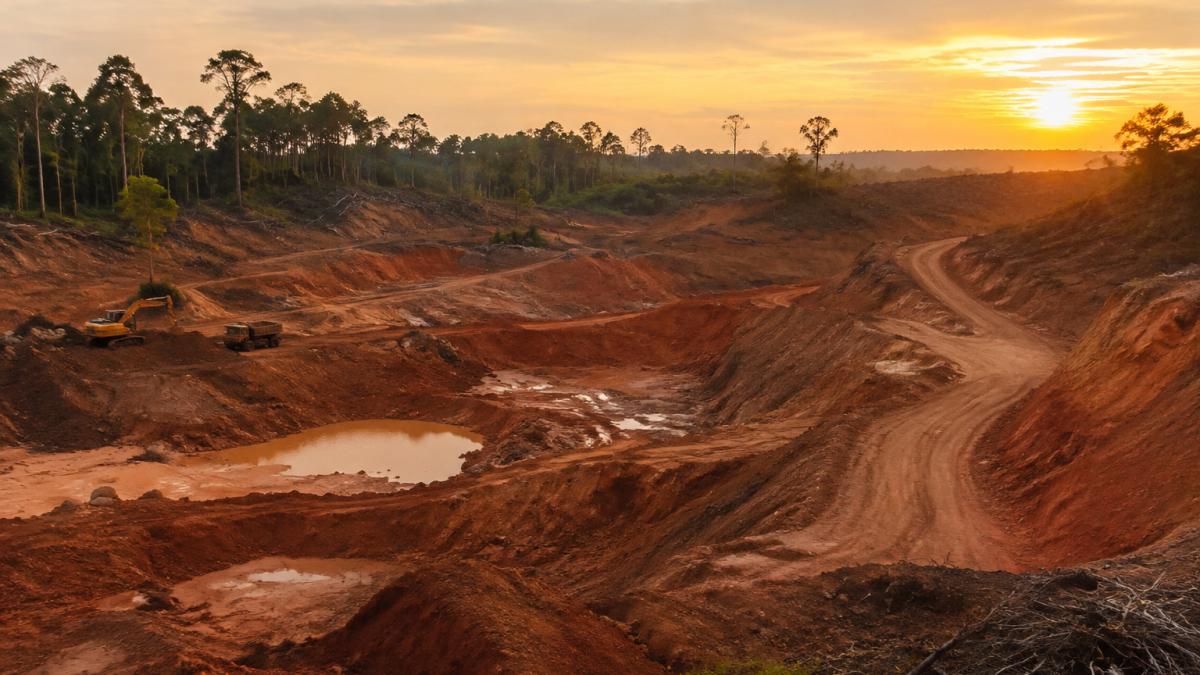
Ecosystem degradation and biodiversity loss follow. A 2023 study in Science of the Total Environment describes these risks as including vegetation loss and soil exploitation, linked to the ecosystem damage caused by extraction (S. Kadivar and co-authors, Science of the Total Environment, 2023). Rehabilitation is possible, but it is slow and costly, and many abandoned sites never fully recover.
Air Pollution, Mercury and Greenhouse-Gas Emissions
Most competitor articles treat air pollution as a local nuisance and greenhouse gases as a separate climate story. In practice they share the same root causes, energy use, ore processing and the burning of fuels and mercury, so this section connects them and adds the lifecycle framing that the top results largely miss.
Mercury. The United Nations Environment Programme reports that mercury emissions from artisanal and small-scale gold mining exceed 2,000 tonnes per year, with releases to air from heating amalgams a major contributor (United Nations Environment Programme mercury assessment). The mechanism matters: miners mix mercury with crushed ore to form an amalgam, then burn the amalgam to drive off the mercury and leave the gold behind. The mercury vapor travels downwind and deposits in soils and water, where it can be converted to methylmercury and accumulate in fish, which is why mercury is a public-health issue as much as an air-quality one. Industrial mines release far less mercury per unit of gold, but ore roasting and smelting can still emit mercury and sulfur dioxide, and sulfur dioxide contributes to acid deposition downwind.
Particulates and local air quality. Blasting, crushing, hauling and ore handling generate fine particulate matter (PM10 and PM2.5), which affects respiratory health in nearby communities. Diesel equipment adds nitrogen oxides and black carbon. These are local impacts, but they are the ones neighbors experience daily.
Greenhouse gases and the lifecycle view. Greenhouse-gas emissions come from electricity for crushing and grinding, diesel for hauling, fuel for smelting and refining, and land clearing that releases stored carbon. A 2026 life-cycle assessment of gold production reported a total single-score environmental damage of 4.99 × 10² Pt, with 55.2% of that impact associated with cyanidation (Sustainability (MDPI) life-cycle assessment of gold production, 2026). That finding is a useful corrective: processing stages, not extraction alone, often drive the largest share of impact, which is why per-ounce comparisons only make sense when they state their system boundaries.
A comparative angle competitors miss. The climate and air burden is not uniform across precious metals. Gold typically carries the highest emissions per kilogram because ore grades are low and processing is energy-intensive; silver is often produced as a by-product of base-metal mining, so its allocated footprint depends heavily on how impacts are shared; platinum-group metals are extremely energy-intensive per kilogram because they occur at very low concentrations and require smelting. Recycling avoids most of these primary emissions, which is why recycled gold and platinum are a meaningful climate choice, not just a land-use one.
Watch out: per-ounce or per-kilogram emissions figures are only comparable when the study states whether it includes refining, transport and land-use change. A number without boundaries is not a benchmark.
Effects of Gold Mining on Human Health and Nearby Communities
The health effects of precious metal mining fall hardest on people who live closest to sites. Heavy metals and mercury can enter food and drinking water, and dust and fumes affect respiratory health. Communities near artisanal operations often have the least access to protective equipment, testing and medical care.
Health impacts are also tied to the water and soil problems described above. Where drinking water is compromised, the risk to children and pregnant women is especially high. Studies of gold mining's environmental effects consistently treat public-health risk as part of the same problem, not a separate one.
How Recycling Gold Compares With Mining It
Recycling is not environmentally uniform. A 2020 study found that recycling high-value gold scrap has considerably lower environmental impact than recycling electronic gold scrap, cautioning against treating all recycled gold as having the same footprint (B. Fritz et al., Environmental impact of high-value gold scrap recycling, 2020).
Even so, recycled metal avoids the land disturbance, tailings and primary emissions of new mining. At LÖF, our 18k gold is recycled, and we cite recycled content in our pieces as a deliberate choice. Shoppers who want to understand what that means for a specific piece are welcome to ask us about its sourcing.
Sustainable Precious Metal Mining: What Responsible Sourcing Looks Like
Responsible sourcing reduces the impacts above, though no mine is free of them. Credible practices include water treatment and monitoring, mercury-free processing, progressive land rehabilitation and transparent reporting of emissions per unit of metal. Environmental monitoring and third-party verification matter more than vague sustainability claims.
For buyers, the useful question is whether a jeweler can show evidence. Greenwashing is common, so look for specific sourcing documentation rather than general statements.
Choosing Jewelry Made From Responsibly Sourced Metal
If you want to reduce your footprint, start with the metal. Recycled 18k gold and platinum avoid much of the primary mining impact, and antique diamonds avoid new extraction altogether. LÖF builds its high and fine jewelry from recycled gold and platinum, ethically sourced gemstones and antique diamonds, designed to be worn for decades.
Our Poiret Ring pairs 0.6ct emeralds with handcrafted 18k recycled gold, and the Margueritte Cuff uses 18k recycled gold with an old European cut diamond. Both are designed to be kept as heirloom pieces rather than replaced. Ask us about the sourcing behind any piece before you buy.


Frequently Asked Questions
How bad is gold mining for the environment?
Gold mining has measurable environmental costs. Gold mining produces significant greenhouse-gas emissions across the industry. Reported local problems include soil erosion, stream dehydration and water shortages. The severity depends on the mining method, with cyanide processing and artisanal mercury use among the largest contributors, so impact varies widely from one operation to another.
Does living near a mine affect your health?
Living near a mine can expose residents to heavy metals, contaminated water and airborne particles. Mercury released from heating amalgams in artisanal and small-scale gold mining is a major concern, and mercury emissions from heating amalgams are a significant concern. Exposure risk depends on distance, wind, water sources and whether monitoring is in place. Residents concerned about their exposure should request local water and air testing.
Can precious metal mining be sustainable?
Fully sustainable mining is not yet achieved, but impacts can be reduced substantially. Measures include lower-impact processing, tailings management, water recycling, land rehabilitation and independent monitoring. Recycled gold also reduces the need for new extraction, though the environmental profile varies by scrap type.
How can recycled precious metals reduce mining impacts?
Recycled gold avoids the land disturbance, water use and emissions of new extraction, which is why recycling is assessed as an alternative to primary mining. The reduction is not uniform. The source of recycled metal can affect its environmental profile. Buyers can ask jewelers whether their metal is recycled and how it was sourced.
