

Table of Contents
- What Defines Sustainable Luxury Jewelry in Modern E-Commerce
- Recycled Gold vs Mined Gold Jewelry: What the Difference Means for Your Investment
- The Benefits of Antique Diamonds in Luxury Jewelry
- How to Identify Sustainable Jewelry Certifications That Actually Matter
- Sustainable Luxury Jewelry for Luxury E-Commerce: What to Look For
- Investment Value, Repair, and the Circular Economy of Fine Jewelry
- Frequently Asked Questions
Last Updated: September 22, 2026
What Defines Sustainable Luxury Jewelry in Modern E-Commerce
Sustainable luxury jewelry is fine jewelry crafted from recycled precious metals, ethically sourced gemstones, and antique diamonds, produced with verified supply chain transparency and fair labor practices. At LÖF, we build every piece from 18k recycled gold, platinum, and traceable stones because the materials matter as much as the design.
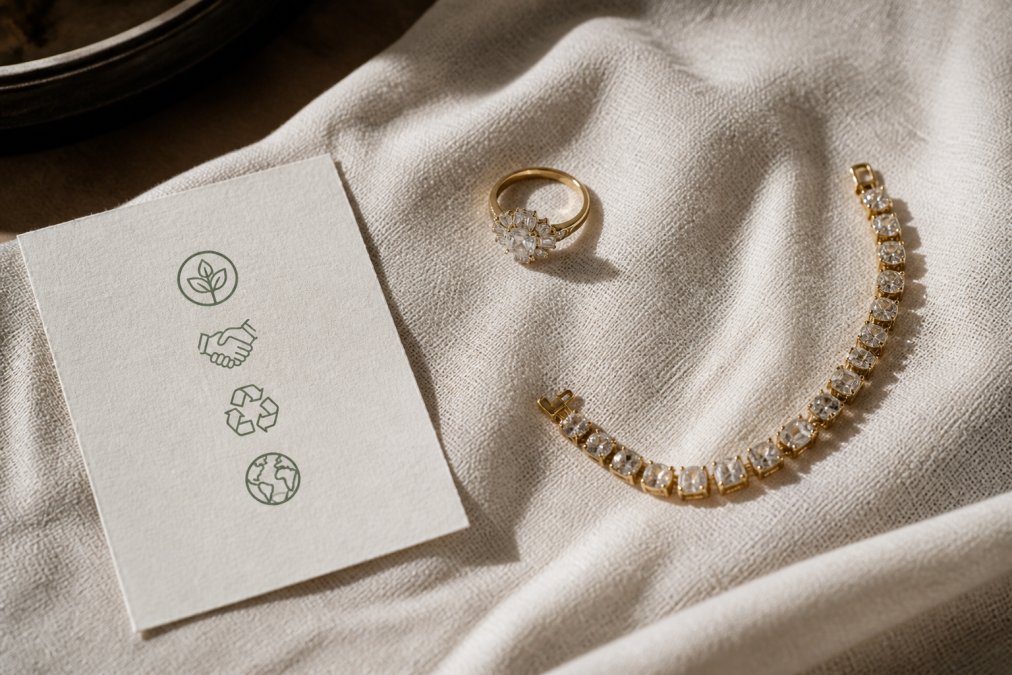
Three things define the category in practice:
- Material provenance: recycled gold, conflict-free stones, antique diamonds
- Supply chain transparency: documented sourcing from mine to finished piece
- Circular design: pieces built to be repaired, resold, and inherited
Recycled Gold vs Mined Gold Jewelry: What the Difference Means for Your Investment
Recycled gold is refined from existing jewelry, industrial scrap, and electronic waste; mined gold is extracted from the earth. Chemically, they are identical. Ethically and environmentally, they are not close.
The Environmental Cost of Mining
Traditional gold mining moves enormous volumes of rock for tiny yields, generates toxic waste, and frequently operates in regions with weak labor protections. U.S. Geological Survey mineral commodity data tracks global gold production, and the scale explains why the environmental footprint is so large.
Why Recycled Gold Commands Premium Value
Recycled gold carries a premium because of what it certifies, not what it contains. Buyers pay for verified provenance and the assurance that no new mining occurred.
| Factor | Recycled Gold | Mined Gold |
|---|---|---|
| Chemical purity | Identical | Identical |
| New mining required | No | Yes |
| Traceability | Documented | Often unclear |
| Environmental footprint | Low | High |
| Resale perception | Growing premium | Standard |
The Benefits of Antique Diamonds in Luxury Jewelry
Antique diamonds are stones cut before the modern era, typically 50 to 100 years old, recovered from estate and heirloom jewelry. They offer a distinct advantage: zero new mining, plus a cut character that modern brilliant cuts cannot replicate.
Three practical benefits:
- No new extraction: the stone already exists
- Rarity: finite supply, unlike continuously mined diamonds
- Character: hand-cut proportions that read as heirloom, not mass-produced
How to Identify Sustainable Jewelry Certifications That Actually Matter
Sustainable jewelry certifications are independent third-party verifications that confirm a brand's sourcing, labor, and environmental claims. The word "independent" does the heavy lifting here, but so does the word "scope." Two certifications can both be legitimate and still verify completely different things. Understanding what each one actually audits is the difference between reading a logo and reading a claim.
The Four Certification Types You Will Encounter
Most jewelry certifications fall into one of four categories, and a brand may hold several because no single standard covers everything:
- Supply chain / membership standards, verify that a company has policies, due diligence, and third-party audits across its operations. The Responsible Jewellery Council (RJC) is the best-known example. RJC certification covers members at multiple points in the chain (miners, refiners, manufacturers, retailers) and requires re-audit on a cycle, not a one-time badge.
- Mine-level fair trade standards, verify conditions at the point of extraction, including fair pricing, safe working conditions, and community development. Fairmined and Fairtrade Gold are the two most cited. These apply to small-scale and artisanal mining operations, which is where labor risk is often highest.
- Conflict-free trade governance, the Kimberley Process Certification Scheme governs the rough diamond trade and is a government-to-government framework, not a brand-level certification. It addresses conflict diamonds specifically; it does not address labor conditions, environmental impact, or mine-to-market traceability beyond the rough stage.
- Chain-of-custody and material-specific standards, verify that a specific material (recycled gold, recycled silver, lab-grown diamonds) meets a defined threshold. SCS Global Services, for example, offers recycled content certification, and lab-grown diamond standards exist through several bodies. These are narrower than RJC but more specific about the material itself.
What Each Standard Actually Verifies, and What It Does Not
| Standard | Verifies | Does Not Verify |
|---|---|---|
| RJC | Corporate governance, due diligence, human rights, environmental practices across members | Individual stone provenance; mine-level wages |
| Fairmined | Fair pricing, safe conditions, community development at certified artisanal mines | Refining, manufacturing, or retail practices downstream |
| Fairtrade Gold | Minimum price and premium paid to certified miners; working conditions | Design, finishing, or post-production handling |
| Kimberley Process | Rough diamonds are not from conflict zones | Labor conditions, environmental impact, or post-rough traceability |
| SCS recycled content | A defined percentage of recycled material in a product | Ethical sourcing of non-recycled components |
A brand can hold RJC certification and still source stones from a mine that is not Fairmined. A brand can sell Fairmined gold and still use conventionally mined diamonds. This is not greenwashing by itself, it is scope. The question to ask is which standard applies to which material in the specific piece you are buying.
How to Verify a Certification Claim in Practice
Certifications are only useful if you can confirm them. Three steps do most of the work:
- Ask for the certificate number and the certifying body. A legitimate certificate has both. "We are RJC certified" without a member number is a claim, not a verification.
- Check the certifying body's public directory. RJC, Fairmined, and Fairtrade all maintain member or certified-entity lookups. If the brand is not listed, the claim does not hold.
- Match the certificate to the material. A recycled gold certificate does not cover the diamond. A Kimberley Process statement does not cover the gold. Ask for documentation per material, not per brand.
Red Flags and Greenwashing Tactics
Greenwashing in jewelry looks like vague language with no documentation behind it. Watch for:
- "Eco-friendly" or "conscious" with no certifying body named
- A single certification presented as covering the entire piece
- Stock nature photography instead of actual sourcing details
- No ability to produce a certificate on request
- Recycled claims that cannot be verified by a third party
- Certification logos used without a member number or scope description
Responsible Jewellery Council certification standards
Fairmined certification and certified entities
Sustainable Luxury Jewelry for Luxury E-Commerce: What to Look For
Buying sustainable luxury jewelry online removes the showroom, so the verification burden shifts to you. Four criteria separate a confident purchase from a regretful one:
- Material documentation: can the brand prove recycled content and stone provenance?
- Photography quality: are images consistent, close-up, and unretouched?
- Return and repair policy: is there a real path to service the piece years later?
- Certification access: are certificates offered proactively or only on challenge?
Investment Value, Repair, and the Circular Economy of Fine Jewelry
Fine jewelry holds value differently than most luxury goods. A handbag depreciates the moment it leaves the boutique. A well-made 18k gold piece retains material value and can appreciate if the design or stones are distinctive. But the mechanism behind that value, and the infrastructure that protects it, is where most sustainable jewelry guides stop short. This section goes further.
Why Material Value Is the Floor, Not the Ceiling
Gold and platinum have commodity value independent of brand. An 18k gold ring contains 75% pure gold by weight; that portion can always be refined and resold. This is the floor. Above the floor, value depends on three things:
- Stone quality and provenance, a certified antique diamond with documented origin holds value differently than an undocumented stone of similar appearance.
- Design durability, pieces that read as classic rather than trend-driven tend to hold resale interest longer.
- Brand and documentation, original certificates, receipts, and provenance records materially affect resale outcomes.
The Repair and Refurbishment Infrastructure, What to Look For
Repair is the most under-discussed pillar of sustainable jewelry, and it is where luxury e-commerce brands differentiate. A piece designed to be repaired is a piece designed to be inherited.
Resale Channels and What They Reveal
Resale is where the circular economy becomes measurable.
What Circularity Actually Requires
Circular jewelry is not a slogan. It requires four operational commitments:
- Durable construction, settings that can be tightened, shanks that can be resized, clasps that can be replaced without remaking the piece.
- Documented materials, so the piece can be authenticated and valued at resale.
Ellen MacArthur Foundation circular economy research
Frequently Asked Questions
What defines sustainable luxury jewelry in the modern e-commerce landscape?
Sustainable luxury jewelry combines high-end craftsmanship with verifiable environmental and social responsibility. It uses recycled precious metals like 18k gold and platinum, ethically sourced gemstones, and antique or lab-grown diamonds. Transparency matters too: brands should disclose their supply chain and hold third-party certifications. LÖF, for example, uses recycled gold and antique diamonds in pieces designed as heirlooms, so the jewelry's lifecycle extends across generations rather than ending with one owner.
How can consumers verify the ethical sourcing of gemstones and precious metals?
Ask for documentation. Reputable brands provide third-party verification such as RJC certification or Fairmined accreditation. For gemstones, look for traceability from mine to market. For diamonds, request conflict-free guarantees under the Kimberley Process. If a brand cannot show paperwork or explain where its materials come from, treat that as a warning sign. LÖF uses antique diamonds and recycled gold, which bypasses new mining entirely, so the sourcing story is verifiable by design.
What is the difference between recycled gold and ethically mined gold in luxury jewelry?
Recycled gold is refined from existing jewelry, industrial scrap, or electronics. No new mining occurs. Ethically mined gold comes from operations that meet fair labor and environmental standards, but it still requires extracting new material from the earth. Recycled gold avoids mining waste, reduces carbon footprint, and delivers the same purity. LÖF uses 18k recycled gold in pieces like The Poiret Ring and The Astor Ring, so you get the same quality without the extraction cost.
Why are antique diamonds considered more sustainable than newly mined diamonds?
Antique diamonds were mined decades or centuries ago. They already exist above ground, so buying one creates zero new mining impact. They also carry historical character that modern cuts lack, which adds to their heirloom quality. LÖF incorporates antique diamonds into pieces like The Margueritte Cuff, giving old stones a new life in contemporary settings. For collectors who value both sustainability and provenance, antique diamonds offer a clear advantage over newly extracted stones.
The challenge with sustainable luxury jewelry is verification: anyone can claim it, few can prove it. LÖF was founded by jeweler Morgan Mackintosh to close that gap, building every piece from 18k recycled gold, platinum, ethically sourced gemstones, and antique diamonds, with documentation to match. Explore the collection and choose options that hold their value for generations.