

Table of Contents
- Why Your Skin Reacts: Understanding Contact Dermatitis
- Nickel Allergy Symptoms: How to Spot the Warning Signs
- Hypoallergenic Jewelry Materials That Are Safe for Sensitive Skin
- 18k Gold vs Plated Jewelry for Sensitive Skin: What Actually Lasts
- DIY Barrier Methods: How to Create a Protective Layer
- Jewelry Maintenance and Oxidation: Keeping Your Pieces Safe
- Budget-Friendly Hypoallergenic Options and Shopping Checklist
- Frequently Asked Questions
Last Updated: September 15, 2026
Why Your Skin Reacts: Understanding Contact Dermatitis
Jewelry skin allergies are immune reactions that occur when your skin contacts certain metals, most often nickel, cobalt, or chromium found in plated and alloy pieces. The result is contact dermatitis: a localized rash that appears where metal touches skin.
At LÖF, we work with 18k recycled gold and platinum daily, and the difference between reactive costume pieces and solid precious metals comes down to chemistry, not marketing. According to the American Academy of Dermatology, nickel is the most common cause of allergic contact dermatitis from jewelry, and it affects a significant share of adults, particularly women.
The mechanism is straightforward. Sweat and friction release trace metal ions from the surface of a piece. Those ions penetrate the top layer of skin, and an already-sensitized immune system flags them as a threat. The reaction you see (redness, itching, small blisters) is your body attacking itself in miniature.
This guide explains how to avoid jewelry skin allergies, from spotting symptoms early to choosing materials that simply do not release reactive ions in the first place.
Nickel Allergy Symptoms: How to Spot the Warning Signs
Nickel allergy symptoms typically appear 12 to 48 hours after contact and include redness, itching, dry patches, and in more severe cases, blistering or weeping skin. The reaction stays confined to the contact area.
Watch for these signs:
- A well-defined rash shaped like the jewelry (a ring band, an earring post)
- Itching that intensifies after sweating or hand-washing
- Dry, scaly patches that return every time you wear the same piece
- Small fluid-filled blisters in prolonged exposures
What most guides miss is that symptoms can build gradually. A piece that caused no reaction for months can suddenly trigger dermatitis once your immune system becomes sensitized. If you notice a rash that keeps returning to the same spot, treat the metal, not just the symptom.
Hypoallergenic Jewelry Materials That Are Safe for Sensitive Skin
Hypoallergenic jewelry materials are metals that resist releasing reactive ions, meaning they are far less likely to trigger contact dermatitis. The safest options are solid, high-purity metals rather than plated or alloyed pieces.
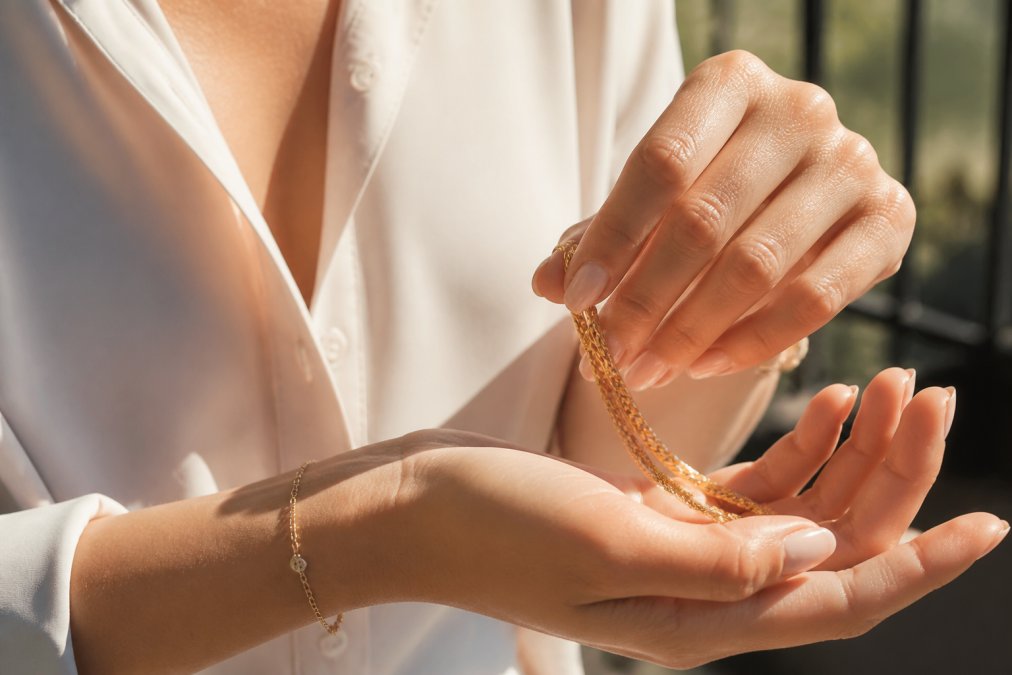
The materials dermatologists and jewelers consistently recommend:
- Platinum: naturally inert and nickel-free, ideal for daily wear
- 18k gold: 75% pure gold, and when alloyed without nickel, well tolerated
- Surgical-grade stainless steel: acceptable for many, though it can contain trace nickel
- Titanium and niobium: biocompatible and used widely in body piercings
- Sterling silver: generally safe, though the copper alloy can bother a small number of people
The common thread is metal purity. A solid 18k gold ring has no base metal to leach through, unlike gold-plated pieces where a thin layer sits over brass or copper.
18k Gold vs Plated Jewelry for Sensitive Skin: What Actually Lasts
Solid 18k gold is the better choice for sensitive skin because it contains no reactive base metal and does not wear through. Plated jewelry is a thin gold layer over brass, copper, or nickel alloy, and once that layer erodes, the reactive metal beneath is exposed.
Plating typically wears at friction points first: the inside of a ring band, earring posts, and clasp edges. That is exactly where reactions begin. A plated piece might be fine for a season, then suddenly cause itching as the base metal surfaces.
For anyone building a collection meant to last, this is where material choice becomes an investment decision rather than a cosmetic one. LÖF crafts pieces like The Poiret Ring from solid 18k recycled gold, so there is no plating to wear through and no base metal waiting underneath.

DIY Barrier Methods: How to Create a Protective Layer
DIY barrier methods physically separate reactive metal from your skin, and they work well as a short-term fix. The goal is a clear, non-reactive coating that blocks ion transfer. Most practitioners find that a barrier buys you weeks, not months, so the key is choosing the right barrier for the wear pattern and reapplying before it fails.
Practical options:
- Clear nail polish: two thin coats on the inside of a ring band or earring post. Let each coat dry fully before the next. Reapply weekly, or sooner if you see chipping. Nail polish is the cheapest barrier and the easiest to find, but it wears fastest at friction points.
- Jewelry lacquer: purpose-made sealants that cure harder than nail polish and last longer. Look for lacquers labeled nickel-free and skin-safe. They still wear at the same friction points, so inspect monthly.
- Adhesive barrier patches: small hypoallergenic films placed between skin and metal. These are useful for watch backs and pendants that sit flat against the chest, where a painted coating is hard to apply evenly.
- Silicone ring guards: useful for rings that spin or rub. They also reduce friction, which is one of the triggers that releases metal ions in the first place.
One warning: nail polish chips. A chipped edge exposes the exact spot where the base metal will react first, so reapply before it flakes rather than after the rash appears. A common pattern is a reaction that returns every two to three weeks on the same finger or earlobe; that timing usually tracks the barrier wearing through, not a new allergy.
Barrier methods differ by piercing type. On fingers, the main contact is the inside of the band, so paint the inner surface and the edges. On ear and nose piercings, the post and the back of the stud touch the most sensitive tissue, and that tissue is thinner and more permeable than skin on the hand. For piercings, coat the post and the butterfly back, not the decorative front. If you have a fresh piercing, do not apply nail polish or lacquer to the post until the piercing is fully healed, because trapping moisture and bacteria in an open wound raises the risk of infection (the NHS). Once healed, a coated titanium or solid gold post is usually well tolerated.
Barriers are a bridge, not a destination. They let you keep wearing a piece you already own while you decide whether to replace it with a solid metal. If a barrier fails repeatedly at the same spot, that is your signal to stop patching and change the metal.
Jewelry Maintenance and Oxidation: Keeping Your Pieces Safe
Jewelry maintenance reduces oxidation and buildup, which in turn reduces skin irritation. Tarnish, soap residue, and trapped moisture all increase the chance of a reaction, even on safe metals. What most guides skip is the mechanism: sweat, lotions, and perfumes are not just dirt, they are accelerants. Sweat is slightly acidic and contains salts that speed up metal ion release. Lotions and sunscreens leave a film that traps moisture against the metal.
A simple routine:
Budget-Friendly Hypoallergenic Options and Shopping Checklist
Use this checklist before you buy:
| Option | Upfront Cost | Lasts | Reaction Risk |
|---|---|---|---|
| Plated costume jewelry | Low | Months | High |
| Gold-filled | Moderate | 1-3 years | Moderate |
| Solid 14k gold | Higher | Decades | Low |
| Solid 18k gold or platinum | Highest | Generations | Very low |
Frequently Asked Questions
How can I tell if my jewelry contains nickel?
A skin patch test is the most reliable way to identify a nickel allergy. Your dermatologist can apply a small amount of nickel sulfate to your skin and check for a reaction after 48 hours. At home, you can use a nickel detection kit, which contains a solution that changes color when it touches nickel. If you have known metal sensitivity, assume any unmarked base metal contains nickel until proven otherwise.
What kind of jewelry doesn't irritate my skin?
Look for hypoallergenic jewelry materials like 18k gold, platinum, titanium, and surgical-grade stainless steel. These metals are biocompatible and rarely trigger allergic reactions. Sterling silver is also a good option, though it can tarnish. Avoid nickel-free plated jewelry, as the plating can wear off and expose the base metal underneath. Solid gold and platinum pieces are your safest bet for daily wear.
Why am I suddenly allergic to my jewelry?
You can develop a metal sensitivity at any age, even if you've worn the same jewelry for years. Repeated exposure to nickel or other allergens can eventually cause your immune system to react. Once a nickel allergy develops, it's permanent. If you notice new redness, itching, or a rash where your jewelry touches your skin, stop wearing the piece and see a dermatologist for a skin patch test.
Can 14k gold give you a rash?
Yes, it can. 14k gold contains 58.5% pure gold, with the rest made up of alloy metals like copper, silver, and sometimes nickel. If you have a nickel allergy, the alloy content can trigger contact dermatitis. For sensitive skin, 18k gold or platinum is a safer choice because they contain fewer base metals. LÖF uses 18k recycled gold and platinum, which are less likely to cause irritation.
Jewelry allergies are frustrating, but they are almost entirely a materials problem, and materials are a choice you control. If you are tired of reacting to pieces that were never built to last, LÖF offers an alternative: solid 18k recycled gold and platinum, ethically sourced gemstones, and antique diamonds, all crafted for heirloom wear. Explore the collection and choose options that honor your skin and the planet.