

Table of Contents
- What Defines Architectural Statement Jewelry for Women
- The History of Architectural Jewelry Movements
- How to Style Statement Jewelry for Professional Settings
- Top Architectural Statement Jewelry Pieces for Women
- Care and Maintenance of Industrial Materials
- How to Choose Ethical Fine Jewelry Brands
- Conclusion: Investing in Wearable Architecture
- Frequently Asked Questions
Last Updated: September 10, 2026
What Defines Architectural Statement Jewelry for Women
Architectural statement jewelry for women is wearable sculpture: pieces built from geometric structures, clean lines, and deliberate spatial composition rather than ornament for its own sake. At LÖF, we design around a simple belief that a jewel should hold its shape the way a building holds a space. That definition matters because it separates genuine architectural work from pieces that simply look chunky.
The distinction comes down to three things:
- Structure over surface. The form carries the piece. A hexagon-and-rectangle link chain reads as architecture because the geometry repeats with intent.
- Weight with purpose. Heft signals material honesty. A 180g cuff behaves differently on the wrist than a hollow one, and it should.
- Restraint in detail. Ornate details get stripped back so the silhouette does the talking.
The Victoria and Albert Museum jewellery collection archive documents how often sculptural form has returned to jewellery across the past century, usually in the wake of a broader design movement.
Geometric Structures and Clean Lines
Geometry is the grammar of this style. Squares, hexagons, elongated rectangles, and curved designs get repeated and stacked until the pattern itself becomes the ornament. Clean lines mean edges stay crisp and intersections are resolved precisely, not softened into blobs.
What most guides miss is that geometry alone is not enough. A piece can be entirely square and still feel flat if the proportions are wrong. The real skill sits in how modules relate to each other: link size against link count, band width against finger coverage, hoop diameter against hoop thickness. Precision in those ratios is what makes a piece read as designed rather than assembled.
Raw Materials and Industrial Aesthetics
Raw materials and industrial aesthetics describe the finish language: solid 18k gold, platinum, black enamel, and honest surfaces that show how the piece was made. Industrial aesthetics does not mean rough or unfinished. It means the construction is visible and unembarrassed.
Concrete jewelry and vintage lucite occupy the same territory in costume work, but for fine jewellery the equivalent is an unpolished or hand-textured gold surface that catches light unevenly. The finish becomes a design decision, not a shortcut.
The History of Architectural Jewelry Movements
Architectural jewellery is not a recent trend. Its clearest ancestor is the Bauhaus, which argued that form should follow function and that ornament should be earned rather than added. Jewellers trained in that thinking began treating a brooch or a cuff as a small structural problem: how few elements can carry the whole composition?
The movement resurfaced in waves. Mid-century modernist jewellers pushed abstraction and unconventional materials. The 1970s brought heavier, more sculptural gold with an emphasis on volume. The 1980s embraced visual boldness and statement jewelry as a social signal. Contemporary design has folded all of it together, pairing recycled metals and gold vermeil with antique stones so the structure feels new while the materials carry history.
That lineage explains why the style resists trend cycles. A geometric cuff from 1975 and one made this year can sit in the same jewellery box without either looking dated. The Bauhaus Archiv museum documentation on the school's design principles is worth reading if you want to see how directly those ideas transferred from buildings to objects.
How to Style Statement Jewelry for Professional Settings
The professional styling rule is straightforward: let one architectural piece lead and keep everything else quiet. A heavy cuff or a sculptural ring can carry a full work outfit, but only if you resist adding a second competing statement.
A practical approach that holds up across most office environments:
- One anchor piece. Choose the largest item you are wearing and treat it as the focal point.
- Neutral metal palette. Staying in a single gold tone keeps the look intentional rather than collected.
- Scale against neckline. A wide chain necklace needs an open neckline; a high collar needs earrings instead.
- Skip the stack. Layering three cuffs reads as costume in a meeting. One reads as taste.
- Match formality, not size. A 5.5mm box chain works with tailoring. A 280g cuff works with a plain shirt.
If you are coming from delicate, understated jewellery, expect an adjustment period. The first week in a substantial piece feels loud. By the second, everything lighter feels unfinished.
Top Architectural Statement Jewelry Pieces for Women
The strongest pieces in this category share one trait: they commit fully to a single structural idea. Below are the LÖF designs that best represent the style, from entry-point pieces to full commissions.
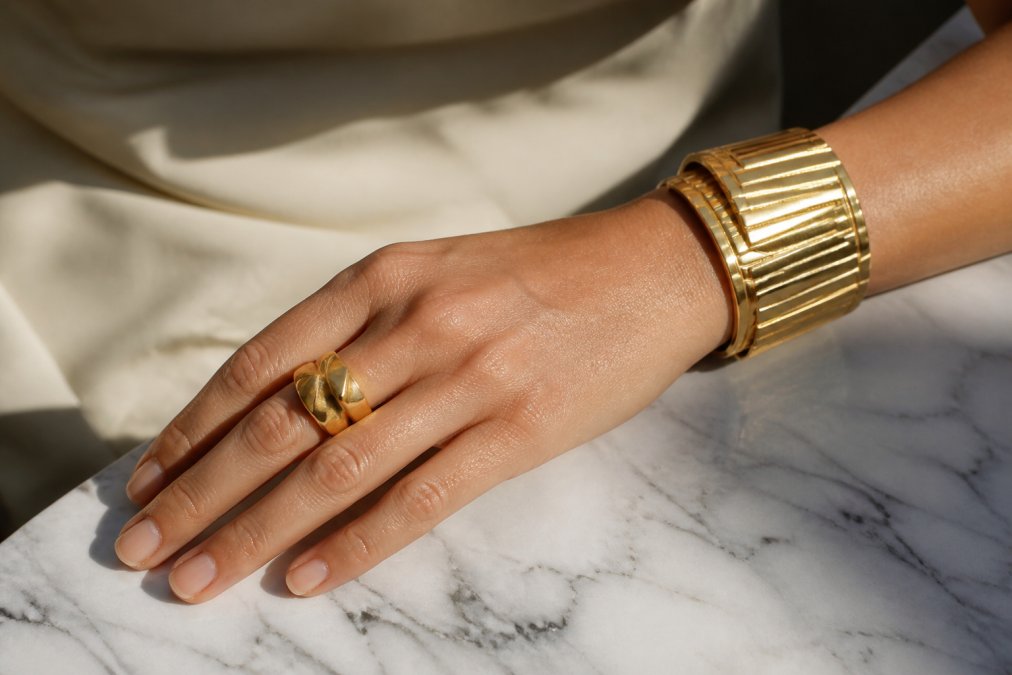
| Piece | Category | Material | Weight / Spec | Price |
|---|---|---|---|---|
| The Empire Chain | Necklace | 18k solid gold | ~300g, 5.5mm, 60+ handmade links | $80,000 |
| The Harlow Cuff | Bracelet | 18k gold | 180g, hinge opening | $80,000 |
| The Tallulah Earrings | Earrings | 18k gold, antique baguette diamonds | Channel set, certified antique | $40,000 |
| The André Necklace | Necklace | 18k yellow gold | 17", matchstick links | $40,000 |
| The Barbette Ring | Ring | 18k yellow gold, black enamel | 1.5ct baguette diamonds | $20,000 |
| The Maze Ring | Ring | 18k yellow gold | Antique marquise diamond | $18,000 |
| The Édith Hoops | Earrings | 18k yellow gold | 8mm width, 30mm diameter | $18,000 |
| The Baker Hoops | Earrings | 18k gold, black enamel | Ridged statement hoop | $18,000 |
| The Édith Studs | Earrings | 18k yellow gold | Oversized scrunched texture | $12,000 |
| The Édith Drop Cuff | Bracelet | 18k solid gold, antique pear diamond | 280g, 2ct bezel-set | Price on request |
The Empire Chain: A 300g Gold Statement
The Empire Chain is the most literal piece of wearable architecture in the collection. It is handcrafted in approximately 300g of 18k solid gold, built from more than 60 individual handmade links in a repeating hexagon-and-rectangle pattern. At 5.5mm wide it sits between a box chain and a collar, which is exactly the point: the geometry is legible from across a room.

Available in 18k solid white, yellow, and rose gold. The weight is the feature. Nothing about this chain is an accident of construction, and it shows.
The Tallulah Earrings: Antique Baguette Diamonds
The Tallulah Earrings set natural baguette-cut diamonds in a channel setting, which is the most architectural way to hold a stone: the metal forms a continuous line and each diamond becomes a segment of it. The diamonds are antique and arrive with a certificate.
This is the piece to choose if you want structural elegance without visible bulk. The channel does the structural work, so the earring stays clean against the ear.
The Maze Ring: Sculptural Marquise Diamond
The Maze Ring uses a signature maze motif set with an antique marquise diamond in 18k solid yellow gold. The marquise cut is the most directional of the classic cuts, and the maze setting frames it as a path rather than a centrepiece.
Available in plain gold or with black enamel, with further customization available. Choose the enamel version if you want the geometry to read at a distance; choose plain gold if you want it to read on contact.
The Barbette Ring: Cigar Band with Black Enamel
The Barbette Ring is a thick cigar band built from three separate bands joined together, with a hand-painted black enamel and gold square at the junction. Each band is crafted in 18k solid yellow gold, and the centre band is set with 1.5ct baguette diamonds.
This is a masterclass in balance. Three bands could easily look heavy; the enamel square breaks the mass and turns it into composition. It works as a unique engagement ring, a wedding band, or a right-hand statement.
The Harlow Cuff: 180g of 18k Gold
The Harlow Cuff is 180g of 18k gold with a hinge opening, available in plain gold, with jade, or with pink chalcedony, in 18k yellow, rose, or white gold. Standard sizes are 6, 7, and 8 inches, and custom sizing is available.
The hinge is the practical detail that makes a cuff this heavy wearable daily. You get the weight and presence of a solid cuff without wrestling it over the wrist bone.
The Édith Hoops and Baker Hoops: Textured Statements
The Édith Hoops are 18k yellow gold scrunched statement hoops at 8mm width and 30mm diameter, designed to pair with the Édith rings. The Baker Hoops take the same statement scale in 18k gold with black enamel ridging.
Both are everyday-weight pieces rather than occasion pieces, which is where the Édith texture earns its place. The scrunched surface means the gold catches light in fragments instead of one flat flash, so a large hoop reads as detailed rather than plain.
Care and Maintenance of Industrial Materials
Industrial finishes need different care than polished surfaces, and the difference is mostly about what you stop doing. Hand-textured gold, black enamel, and antique stones all respond badly to the same two things: abrasives and ultrasonic cleaning.
A workable maintenance routine:
- Store each piece separately in a soft pouch to prevent surface scuffing against other jewellery
- Wipe gold with a dry microfibre cloth after wearing to remove oils and residue
- Clean plain gold with warm water and a drop of mild soap, then pat dry
- Keep black enamel away from ultrasonic cleaners, steam cleaners, and polishing compounds
- Have antique diamond settings checked by a jeweller once a year for prong security
- Remove cuffs and heavy chains before gym sessions, gardening, or any task involving impact
The thing nobody tells you about heavy gold is that it is more forgiving than light gold, not less. Solid 18k at 180g or 300g does not deform the way thin hollow pieces do. What it does pick up is surface patina, which most owners come to prefer.
How to Choose Ethical Fine Jewelry Brands
Ethical fine jewelry brands are those that can document where their metal and stones came from, not those that simply use the right vocabulary. The question to ask is not whether a brand says "sustainable" but what it can show you.
A short verification checklist before you buy:
- Ask about metal origin. Recycled and repurposed gold should be traceable to a specific supply route, not described in general terms.
- Ask about stone provenance. Ethically sourced gemstones and antique diamonds should come with documentation. Antique stones carry their own history, which is part of the appeal.
- Ask what certification exists. If a brand claims certification, it should be able to name the certifying body. If it cannot, treat the claim as marketing.
- Ask about the workshop. Knowing who makes the piece and where is a reasonable question at this price point.
- Ask about longevity. Heirloom-quality means repairable and resizable, not just durable.
At LÖF, every piece is crafted from 18k gold, platinum, and ethically sourced gemstones and antique diamonds, with recycled and repurposed gold used throughout the collection. That is the standard to hold any brand to, including us.
Conclusion: Investing in Wearable Architecture
Buying architectural statement jewelry is a different decision from buying a trend piece. You are choosing a structure you will still want to wear in twenty years, which is why materials and construction matter more than whatever silhouette is popular this season. The Responsible Jewellery Council guidance on supply chain standards is a useful reference point if you want to understand what verified sourcing actually involves.
LÖF builds exactly that kind of piece: handcrafted 18k gold and platinum, recycled and repurposed metal, antique diamonds with certificates, and bold heirloom-quality designs made to be passed down rather than replaced.
Frequently Asked Questions
Is architectural statement jewelry still in style?
Yes. Architectural statement jewelry remains a strong category in 2026 because its geometric structures and clean lines sit outside short trend cycles. Pieces built from 18k gold and platinum, like LÖF's Maze Ring or Harlow Cuff, are bought as long-term investments rather than seasonal accessories. The style works because it pairs sculptural form with wearable scale, so it reads as modern without dating quickly.
What is the 2:1:1 rule in jewelry?
The 2:1:1 rule is a styling guideline for balancing metals and focal points. It suggests wearing two pieces of one metal, one piece of a second metal, and one statement piece to anchor the look. For architectural jewelry, this means letting a single bold item, such as the Empire Chain or Tallulah Earrings, carry the visual weight while smaller pieces stay quiet.
How do you style architectural statement jewelry for everyday wear?
Start with one sculptural piece and keep the rest minimal. A thick gold cuff or oversized studs work well with a plain shirt and tailored trousers because the contrast lets the jewelry lead. For daytime, choose pieces with a matte or brushed finish rather than high polish, and avoid stacking multiple heavy items on the same hand or wrist.
What materials are best for high-end architectural jewelry?
Solid 18k gold and platinum are the most durable choices for architectural designs because they hold sharp edges and structural shapes without bending. Recycled gold and antique diamonds also suit this style, since they carry the same physical properties as newly mined material. Avoid hollow or plated constructions, which can dent or wear through at the joints of geometric pieces.
How does LÖF incorporate sustainable practices into statement jewelry design?
LÖF uses recycled and repurposed gold, platinum, and ethically sourced gemstones, including antique diamonds that come with certificates. The brand's handcrafted construction methods, such as the 60+ individual links in the Empire Chain, are built for longevity rather than disposable trends. This approach supports the idea of heirloom-quality pieces that can be passed down rather than replaced.
The hard part is not finding a statement piece. It is finding one built well enough to justify the weight on your wrist and the price on the tag. LÖF makes that decision easier with solid 18k gold and platinum construction, ethically sourced gemstones and certified antique diamonds, and bold architectural designs intended as heirlooms. Get started with LÖF and choose a piece of wearable architecture you will still be wearing in thirty years.