

Table of Contents
- 1. Pair a Toi et Moi Engagement Ring With a Wedding Band
- 2. Mixing Metals in Wedding Ring Stacks: Yellow Gold, Platinum and Rose Gold
- 3. Match Band Width and Profile to Your Engagement Ring
- 4. Choose Curved and Contoured Custom Wedding Bands for a Flush Fit
- 5. The Custom Wedding Band Design Process, Step by Step
- 6. Stack Three or More Custom Wedding Bands for a Personalised Look
- 7. Wear Custom Wedding Bands Differently: Necklaces, Cuffs and Non-Traditional Shapes
- Frequently Asked Questions
Last Updated: September 16, 2026
1. Pair a Toi et Moi Engagement Ring With a Wedding Band
A toi et moi engagement ring with wedding band pairing works best when the band sits lower than the engagement ring's two stones. Toi et moi rings place two gemstones side by side, often across a wide head, so a standard band collides with the setting instead of resting beside it.

The fix is a band with a shallow profile and a narrow width. A 3mm band, like the pavé-set silhouette of The Zig Zag Wedding Band, slides underneath the stone spread rather than pushing against it.
Why Two-Stone Rings Need a Lower-Profile Band
Two-stone settings sit tall because each gemstone needs its own basket and gallery. That height creates a gap where a chunky band would otherwise sit flush. A lower-profile band closes that gap without forcing the two rings apart.
For a toi et moi set with a pear-shaped center, The Pear Wedding Band mirrors the stone's curve at 5mm wide, so the two shapes echo each other instead of competing.

2. Mixing Metals in Wedding Ring Stacks: Yellow Gold, Platinum and Rose Gold
Mixing metals in wedding ring stacks works when one metal leads and the others accent it. The old rule about never combining yellow gold with platinum is outdated; the real question is proportion and finish.
A few combinations that hold up over decades:
- Yellow gold engagement ring with a platinum band, where the contrast reads as intentional rather than accidental
- Rose gold band against a white gold or platinum engagement ring, which warms up a cool-toned stack
- All-platinum stack with a single yellow gold accent ring for texture without visual noise
The metal you wear daily takes the most wear. Platinum and 18k gold both hold up well.

3. Match Band Width and Profile to Your Engagement Ring
Band width and profile should follow the engagement ring, not fight it. A 5mm engagement band paired with a 1.5mm wedding band looks unbalanced; a 2mm engagement ring paired with a 5mm band buries it.
A simple rule: keep the wedding band within 1mm of the engagement ring's width, or go deliberately wider for a stacked, architectural look. Profile matters just as much. A flat profile sits flush against a flat band; a domed profile leaves a visible gap.
The Zig Zag Engagement Ring uses a 5mm band, so a matching 5mm wedding band keeps the proportions even. For a thinner engagement ring, The Édith Stick Ring at 1.5mm works as a delicate companion band rather than a competing statement.
4. Choose Curved and Contoured Custom Wedding Bands for a Flush Fit
A contoured wedding band curves around the engagement ring's center stone so the two sit flush with no gap. This matters most for solitaire and halo settings, where a straight band leaves a visible space at the base of the stone.
Curved bands are cut to match the exact diameter of the engagement ring's head. That's why they're almost always custom: a stock curve rarely matches a specific setting.
Measuring the Gap Before You Commission
Before commissioning a contoured band, measure three things:
- The width of the engagement ring's head at its widest point
- The height the center stone sits above the finger
- The distance between the two rings when both are worn
5. The Custom Wedding Band Design Process, Step by Step
The custom wedding band design process typically runs several stages. Most bespoke commissions take several weeks from first conversation to finished ring, depending on complexity.
6. Stack Three or More Custom Wedding Bands for a Personalised Look
Stacking three or more bands turns a wedding set into a personal collection rather than a matched pair. The trick is varying at least one element, width, texture, or metal, so the stack reads as designed rather than accidental.
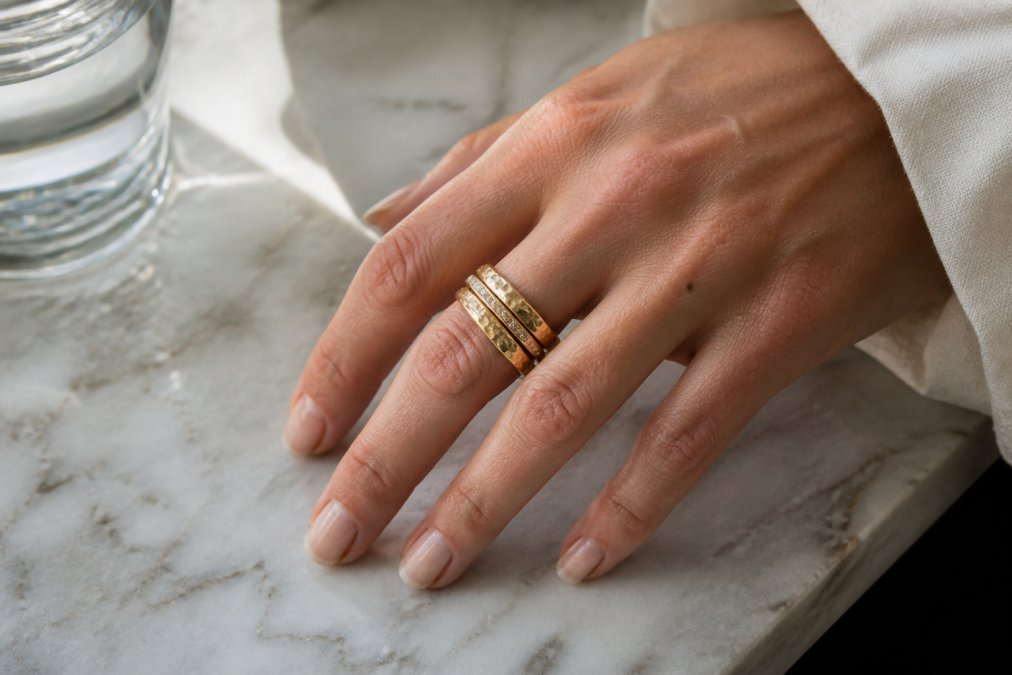
A workable formula for a three-band stack:
- One plain or lightly textured band as the anchor
- One diamond-set band for sparkle
- One sculptural or architectural band for contrast
The Margueritte Ring fits the sculptural slot, with staggered strips of 18k gold that catch light differently from a smooth band. The Tallulah Wired Ring, at 13mm wide with staggered baguette diamonds, works as a statement top layer rather than a base band.
7. Wear Custom Wedding Bands Differently: Necklaces, Cuffs and Non-Traditional Shapes
Custom wedding bands don't have to live on the ring finger. Wearing a band on a chain, pairing it with a cuff, or choosing a non-traditional shape gives the piece a second life beyond the ceremony.
A few ways to wear a band differently:
- Suspended on a fine chain as a pendant, either alone or layered with other necklaces
- Stacked with a cuff bracelet on the wrist for a coordinated set
- Worn on the index or middle finger as a standalone statement ring
The Margueritte Cuff, handcrafted in 18k recycled gold with a vintage-inspired pin and old European cut diamond, pairs naturally with the Margueritte Ring for a matched wrist-and-hand set. For something bolder, The Barbette Ring uses three joined bands in 18k yellow gold with black enamel and 1.5ct baguette diamonds, a piece that reads as sculpture first and wedding band second.
Non-traditional shapes, like The Tallulah Ring with its antique baguette diamonds, suit wearers who want a wedding band that doesn't look like everyone else's.
Frequently Asked Questions
How do I choose a wedding band for a custom engagement ring?
Start with the measurements, not the mood board. Note your engagement ring's band width, profile and the height of its setting, then decide whether you want a flush fit or a deliberate gap. A 3mm band such as The Zig Zag Wedding Band sits neatly against a slim solitaire, while a 5mm band like The Pear Wedding Band holds its own next to a wider engagement ring.
What is the best way to stack custom wedding bands with a toi et moi ring?
Toi et moi rings carry visual weight across two stones, so the band underneath should stay low. Choose a band with a shallow profile and, where the stones sit close to the finger, a contoured curve that follows the setting. Wearing the band on the opposite hand is also a legitimate option if the two-stone head is too wide to sit flush. The goal is a stack that reads as one composition rather than two rings competing.
Are there rules for mixing metals in wedding ring stacks?
No fixed rules, but there are proportions that work. Repeating one metal twice in a three-ring stack keeps it coherent, so a platinum engagement ring with a platinum band and a single yellow gold accent reads intentional. Texture helps too: a smooth 18k gold band next to a textured piece such as The Édith Stick Ring separates the metals visually instead of blurring them. Decide which metal leads before you commission anything.
Can you wear a custom wedding band on its own?
Yes, and many people do. A sculptural band such as The Margueritte Ring or The Tallulah Wired Ring is designed to be worn alone or as part of a set, so it stands up without an engagement ring beside it. If you plan to wear the band solo most days, put more of your budget into the band itself: a wider profile, a stronger texture or a diamond detail that carries the piece on its own.
How long does the custom wedding band design process take?
It depends on complexity, but expect several stages. Bands using antique diamonds or bespoke stone arrangements take longer because the stones must be sourced and matched first.
Choosing the right custom wedding bands comes down to how the pieces work together, not how they look in isolation. Width, profile, metal, and curve all decide whether a stack sits flush or fights itself. At LÖF, every band is built from 18k gold, platinum, and ethically sourced gemstones and antique diamonds, so the pairing you design today still holds up decades from now. Explore the LÖF wedding band collection and commission a set made to fit your engagement ring, your hand, and your story.