

Last Updated: November 1, 2026
Quick Summary
Old European cut diamond grading standards differ from modern ones because GIA does not issue a cut grade for these stones at all. A report still confirms carat weight, measurements, color, clarity and treatments, but cut quality is judged by eye and by proportion.
- GIA's cut grading was not standardized until 2006, so every Old European cut predates the framework.
- Expect a table of roughly 50 to 55 percent, a depth in the low-to-mid 60s, and a visible culet.
- A GIA color grade uses the standard D-to-Z scale, but deeper proportions tend to hold more body color.
- Watch for girdle abrasions, since older cuts often have thinner girdles exposed to a century of wear.
- A missing cut grade is standard for authentic antiques, not a defect or red flag.
Table of Contents
- Why Old European Cut Diamonds Are Graded Differently
- Old European Cut Diamond Certification: What a Report Actually Tells You
- Old European Cut Diamond Cut Quality: Reading the Stone Without a Cut Grade
- Old European Cut Diamond Color and Clarity on the D-to-Z Scale
- Old European Cut Diamond Proportions: Table, Depth and Culet
- How Old European Cuts Compare to Modern Round Brilliants
- Choosing an Antique Diamond Piece at LÖF
- Frequently Asked Questions
Why Old European Cut Diamonds Are Graded Differently
Old European cut diamond grading standards diverge from modern practice for one structural reason: the Gemological Institute of America does not issue a cut grade for these stones at all. According to VRAI's guide to Old European cut diamonds, an Old European cut would otherwise land in "Fair" or "Poor" territory on the modern cut scale, so the grade is simply withheld. At LÖF, we work with antique diamonds constantly, and this single fact reshapes how a buyer should read any report.
The cut grade you see on a modern round brilliant measures light return against a proportion formula built for that cut. Old European cuts were designed decades before that formula existed.
How Cut Grading Changed in 2006
GIA's cut grading was not standardized until 2006, according to Filigree Jewelers' history of vintage diamond cuts. Every Old European cut predates that framework by half a century or more.
Judging a 1920s stone against a 2006 standard is a category error. The cut was engineered for candlelight and gaslight, not for the bright, controlled lighting of a modern jewelry showroom.
Old European Cut Diamond Certification: What a Report Actually Tells You
Old European cut diamond certification delivers proportions, polish, and symmetry, but no cut grade. That distinction matters more than most buyers realize.
A report still confirms carat weight, measurements, color, clarity, and any treatments. What it will not do is tell you whether the stone is beautiful. That judgment stays with you and your jeweler.
- Color grade: assigned on the standard D-to-Z scale
- Clarity grade: assigned on the standard FL-to-I scale
- Polish and symmetry: described, often as good or very good
- Cut grade: absent by design
- Proportions: table percentage, depth, crown and pavilion angles
Watch out: treating a missing cut grade as a red flag will eliminate almost every authentic antique stone on the market. The absence is standard, not a defect.
If you plan to insure or resell, an appraisal is a separate document from a grading report. Our guide to antique diamond jewelry appraisal cost explains what that involves.
Old European Cut Diamond Cut Quality: Reading the Stone Without a Cut Grade
Old European cut diamond cut quality is judged by eye and by proportion, not by a letter on a certificate. You are looking for a specific personality: a small table, a high crown, chunky facets, and a visible culet.
Hold the stone face up under diffuse light. A well-cut Old European should show broad, soft flashes rather than the tight, pinfire sparkle of a modern brilliant. The pattern is slower and more deliberate.
Then tilt it. Look for dark zones that stay dark as the stone moves. A stone that goes flat across many angles has a pavilion problem, regardless of what any report says.
Authenticity is a separate question from quality, and the culet and girdle tell you a lot. Our guide to identifying authentic antique cut diamonds covers those features in detail.
Old European Cut Diamond Color and Clarity on the D-to-Z Scale
Old European cut diamond color and clarity are graded on the same scales used for modern stones, with one practical wrinkle. A GIA color grade for an Old European cut uses the standard D-through-Z scale, per Jewelry Rich's complete guide, but the cut's deeper proportions tend to hold more body color than a modern brilliant of the same grade.
Translation: an H-colored Old European may face up warmer than an H-colored modern round. Neither is better. The antique stone simply wears its color differently.
Clarity follows familiar ground. VS and SI grades are common in antique stones, and eye-clean is the practical benchmark. Watch for abrasions along the girdle, which is often thinner on older cuts and more exposed to a century of wear.
Old European Cut Diamond Proportions: Table, Depth and Culet
Old European cut diamond proportions are where the cut reveals itself. Expect a table between roughly 50 and 55 percent, a depth in the low-to-mid 60s, and a culet you can actually see.
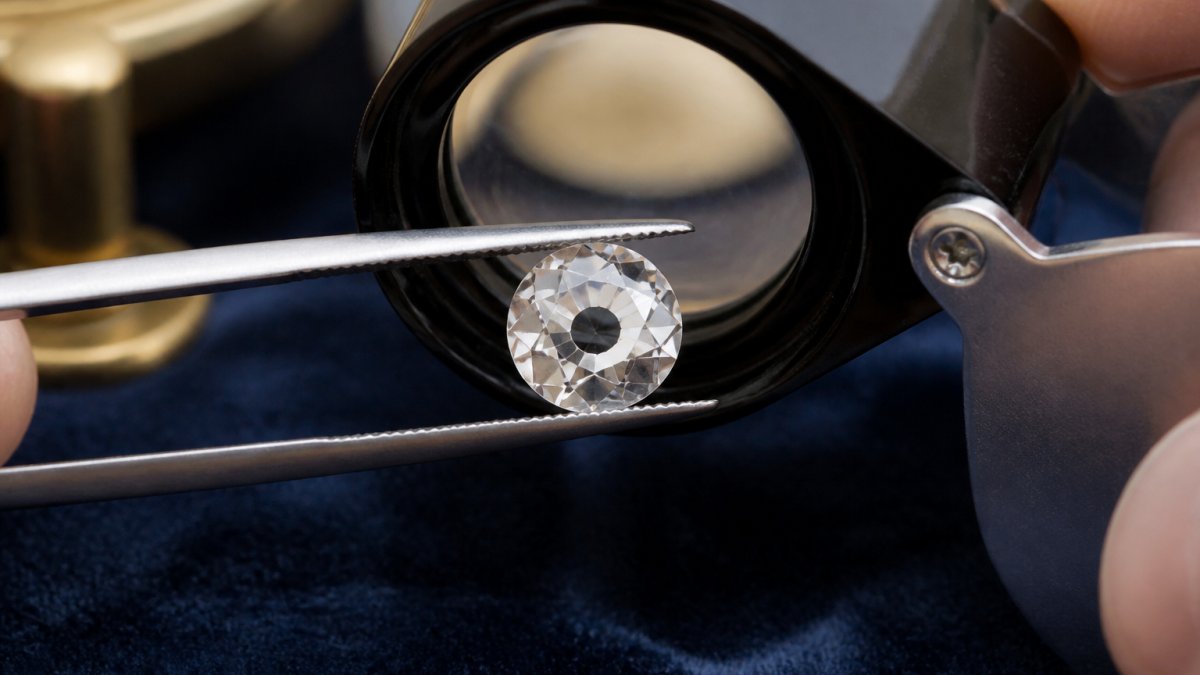
That open culet is the signature. It appears as a small dark dot at the center of the stone when viewed face up. Modern cuts minimize it; Old European cuts celebrate it.
| Feature | Old European Cut | Modern Round Brilliant |
|---|---|---|
| Table size | Roughly 50-55% | Roughly 53-60% |
| Crown | Higher, steeper | Lower, shallower |
| Culet | Visible, often large | None to tiny |
| Facets | Chunky, irregular | Precise, computer-modeled |
| Cut grade from GIA | Not issued | Issued |
| Light behavior | Broad, soft flashes | Tight, bright sparkle |
None of these proportions is a flaw. They are the design.
How Old European Cuts Compare to Modern Round Brilliants
Old European cuts and modern round brilliants answer different questions. The modern cut asks how much light can be returned to the eye. The antique cut asks how the light should feel when it gets there.
A Reddit commenter in a discussion on antique cut buying put it bluntly: antique cuts were never intended to maximize the same qualities as modern cuts, so modern cut rules do not apply. That is an individual opinion, not a grading standard, but it captures the trade-off accurately.
Practically, the modern brilliant wins on brilliance and fire. The Old European wins on character, and character is not gradeable.
Buyers often confuse Old European cuts with old mine cuts, which are cushion-shaped rather than round. Our guide on how to tell if a diamond is old mine cut walks through the differences.
Choosing an Antique Diamond Piece at LÖF
Choosing an antique diamond piece starts with accepting that the certificate will not make the decision for you. At LÖF, we build around antique diamonds precisely because their imperfections are the point. Each stone carries a history no modern cut can replicate.
Our pieces are handcrafted in 18k gold and platinum, using recycled and repurposed gold and ethically sourced gemstones.
The Tillie Ring is a statement antique-style domed ring set with Old European Cut diamonds, handcrafted in platinum and white gold or yellow gold. The Isotta Ring pairs Old European Cut diamonds with rock crystal and antique oval and marquise stones in 18k yellow gold. The Zig Zag Engagement Ring features a 4-carat antique diamond with two Old Miner Cut diamonds on zigzag shoulders.
If you want to understand what makes these stones distinctive before you buy, our guide on what makes vintage diamonds unique is the place to start. Ready to see one in person? View the Tillie Ring and judge the cut the way it was meant to be judged.

Frequently Asked Questions
Are old European cut diamonds graded the same way as modern diamonds?
No. Color and clarity follow the same D-to-Z and clarity scales, but the cut grade does not carry over. GIA does not apply a cut grade to Old European cuts, and modern cut grading was developed long after these stones were cut. A report on an antique stone will give proportions, polish and symmetry instead. Judge the cut by how the stone looks in person, not by a modern grade it was never designed to earn.
Do GIA cut grades apply to old European cut diamonds?
They do not. GIA does not issue a cut grade for Old European cuts, so a report showing no cut grade is normal rather than a red flag. The same report can still list proportions, polish and symmetry, which is where you should focus. Treat the absence of a cut grade as a signal to inspect the stone yourself or ask for detailed photography, not as evidence that the diamond is poorly made.
What should you look for when evaluating an old European cut diamond?
Start with the face-up view. Look for a small table, a high crown and a visible open culet, the three features that define the cut. Then check for a broad, soft pattern of light rather than the sharp arrows of a modern brilliant. Ask about polish and symmetry on the report, confirm the color and clarity grades, and view the stone in different lighting. A well-cut antique diamond should look lively, not dull or glassy.
How do you assess old European cut diamond cut quality without a grade?
Compare the stone against others of the same cut rather than against modern brilliants. Look at how much light returns from the center, whether the facets show contrast and whether the culet reads as a small dark point rather than a hole. Proportion matters most: a table around 50 to 55 percent and a depth near 60 to 65 percent is a useful starting range. Ask for video in natural light before buying online.
How do color and clarity affect the value of an old European cut diamond?
They matter, but the relationship differs from modern stones. Old European proportions tend to hold more body color than modern cuts, so an H or I stone can face up warmer than its grade suggests. Clarity follows the usual scale, though antique stones often carry minor inclusions from decades of wear. Because color reads differently, compare the stone face-up rather than judging the certificate number alone.
Does an old European cut diamond need a grading report?
A report is not mandatory, but it is worth having for any significant purchase. It confirms color, clarity and proportions and gives you a documented reference point. At LÖF, antique diamond pieces such as The Isotta Ring come with a certificate for the stones. For a high-value antique, an independent report plus your own inspection covers both the paperwork and the look of the stone.
The hardest part of buying an antique diamond is trusting your eye over a certificate that stays silent on the one thing that matters most. LÖF exists for that decision. We set antique diamonds in 18k gold and platinum, work only with recycled and ethically sourced materials, and handcraft every piece as an heirloom rather than a trend. Get started with LÖF and choose a stone with a history worth passing down.
