

Table of Contents
- Handcrafted vs. Machine-Cut Diamonds
- The Evolution of Diamond Cutting Technology
- Old Mine Cut vs Modern Brilliant
- Antique Diamond Jewelry Appraisal Cost
- Antique Diamond Engagement Ring Care
- Why Vintage Diamonds Are Considered Sustainable
- What Makes Vintage Diamonds Unique: The Bottom Line
- Frequently Asked Questions
Last Updated: September 25, 2026
Handcrafted vs. Machine-Cut Diamonds
The difference between a hand-cut and a machine-cut diamond comes down to human judgment versus mathematical precision. What makes vintage diamonds unique starts here: a cutter once chose every angle by eye and hand, and those choices left visible signatures no modern machine would ever produce.
Hand-cut stones from the 1800s and early 1900s carry deliberate quirks. A cutter working by feel might give a stone a slightly off-center culet or an asymmetric outline because that particular rough demanded it. Machine cutting, by contrast, follows a fixed blueprint: the same crown height, the same table size, the same girdle thickness, repeated across thousands of stones.
That distinction matters when you're buying. A modern brilliant cut is engineered for maximum light return under standardized conditions. An antique stone is engineered for character, and often for candlelight rather than LED.
At LÖF, we work with antique diamonds precisely because that human record is part of the stone's value, not a flaw to correct.
The Evolution of Diamond Cutting Technology
Diamond cutting technology evolved through distinct eras, and each era left its fingerprint on the stones we still trade today. The Gemological Institute of America's diamond grading overview documents how cut quality became a formal grading criterion only in the twentieth century, long after many antique stones were already set in jewelry.
The timeline runs roughly like this:
- Pre-1800s: Point cuts and rose cuts, with few facets and heavy reliance on candlelight
- Early 1800s: The Old Mine Cut emerges, with a high crown and a large culet
- Late 1800s to early 1900s: The Old European Cut refines proportions while keeping the small table and open culet
- Mid-1900s onward: The modern round brilliant standardizes 57-58 facets and precise angles
Each transition traded some warmth and depth for brightness. Modern stones win on light return. Antique stones win on the way they hold shadow.
Old Mine Cut vs Modern Brilliant
Old Mine Cut versus modern brilliant is the comparison that decides most antique purchases. An Old Mine Cut is a hand-cut antique diamond with a roughly cushion-shaped outline, a high crown, a small table, and a large open culet at the bottom. A modern brilliant is a machine-cut round diamond with standardized proportions designed for maximum light return.
Here's how they stack up on the specs buyers actually ask about:
| Feature | Old Mine Cut | Modern Brilliant |
|---|---|---|
| Outline | Cushion, often irregular | Perfectly round |
| Table size | Small (often 40-50% of diameter) | Larger, standardized (around 55-60%) |
| Crown height | High, steep crown (often 15-20% of diameter) | Moderate, uniform |
| Culet | Large, visible (sometimes a flat facet) | Pointed or none |
| Facets | Chunky, fewer (often 58 but irregularly placed) | 57-58, precisely aligned |
| Girdle | Often thin to extremely thin, sometimes knife-edged | Medium, uniform |
| Light behavior | Scintillation and depth | Fire and brilliance |
Why the Proportions Change the Light
The physics behind the table is straightforward. A modern brilliant's shallow crown and larger table push light back up through the top of the stone in a tight, bright return, that's the "brilliance" you see under showroom lighting. An Old Mine Cut's high crown and small table send light on a longer path inside the stone, bouncing between chunky facets before it exits. The result is less uniform brightness but more scintillation, those large, slow flashes that move as the stone tilts.
The large open culet matters too. In a modern stone the culet is pointed or absent, so light either exits cleanly or reflects back. In an Old Mine Cut the culet is a visible facet at the bottom, and light that hits it can leak out. That leak is why antique stones often look darker in low light and warmer in candlelight, the very conditions they were cut for.
The Grading Gap Buyers Hit
Here's the part most guides skip: the GIA and AGS cut-grading scales were built for modern round brilliants. They assume a specific table size, crown angle, and pavilion depth.
The practical upshot: an Old Mine Cut looks softer and warmer, with big flashes of light rather than pinprick sparkle. A modern brilliant looks brighter in a showroom. Neither is objectively better, but only one of them was cut by hand, and only one of them will ever be graded on a scale that actually fits it.
Antique Diamond Jewelry Appraisal Cost
Antique diamond jewelry appraisal cost typically runs higher than appraising a modern piece, because the appraiser has to identify the cut era and assess condition before valuing anything. A standard appraisal for a modern stone focuses on the four Cs. An antique appraisal adds historical provenance, cut classification, and wear assessment to the job.
Expect the process to involve:
- Verifying the stone is genuinely antique rather than a modern reproduction
- Grading color and clarity on antique-appropriate scales
- Documenting the setting, metal content, and any repairs
- Photographing inclusions and wear for the record
Antique Diamond Engagement Ring Care
Antique diamond engagement ring care follows one rule above all others: clean gently, and never assume the setting is as sturdy as a new one. But the reason isn't just age, it's the specific physical features of vintage stones and the metals they sit in.
Why Vintage Stones Need Different Handling
Three features of antique cuts change how you care for them:
- Thin girdles. Many Old Mine and Old European Cuts have girdles that are thin to extremely thin, sometimes knife-edged. The girdle is the stone's outer edge, and a thin one chips more easily than the medium girdle on a modern brilliant. Avoid knocking the ring against hard surfaces, and don't stack it against harder stones in a jewelry box.
- Large open culets. The culet is the flat facet at the bottom of the stone. On an antique cut it's often large and exposed, which means it can collect dirt and, in some settings, sit close to or below the metal. A soft brush reaches it; an ultrasonic cleaner can force debris into it or, worse, vibrate a fragile setting loose.
- Softer metal alloys. Antique settings were often made in 14k or lower gold, platinum alloys that were softer than modern formulations, or silver-topped gold. Hand-soldered joints and thinner prongs are common. These metals wear faster and can deform under pressure that a modern setting would shrug off.
A Safe Cleaning Routine
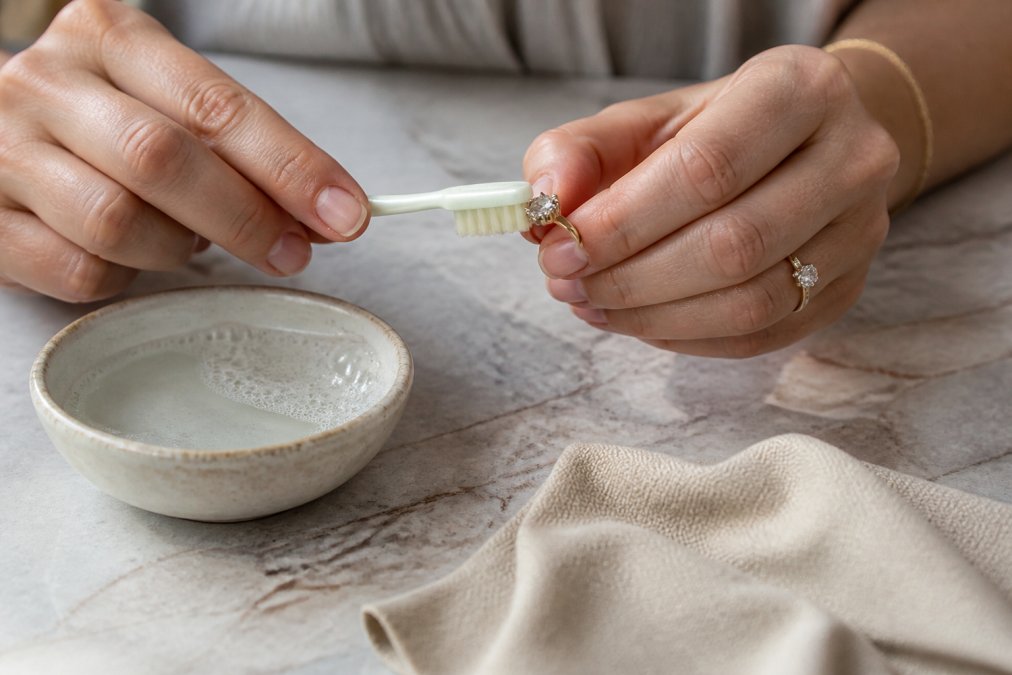
Warm water, a drop of mild dish soap, and a soft-bristled brush handle most cleaning safely. Soak for a few minutes, brush gently around the prongs and under the stone, rinse in a bowl of clean water (not over a drain), and pat dry with a lint-free cloth. Skip the ultrasonic and steam cleaners entirely unless a jeweler who knows antique pieces tells you otherwise.
Annual Checks and Storage
Have the setting checked by a jeweler once a year. Prongs thin over decades, and a single loose prong is how heirlooms get lost. Ask the jeweler to check the solder joints too, those are the weakest points on older pieces and the ones most likely to fail silently.
Why Vintage Diamonds Are Considered Sustainable
Vintage diamonds are considered sustainable because they require no new mining. The stone already exists, already has a history, and buying it puts no additional pressure on land, water, or labor in diamond-producing regions. The Kimberley Process Certification Scheme governs rough diamond trade to curb conflict stones, but a recycled antique diamond sidesteps the question entirely, since it entered the market long before modern certification existed.
What Makes Vintage Diamonds Unique: The Bottom Line
What makes vintage diamonds unique is the combination of human craft, historical record, and physical character that no modern machine can replicate. A hand-cut stone carries the cutter's decisions in its asymmetry, its chunky facets, and its warm color. It also carries real risks: grading discrepancies between appraisers, fragile antique settings, and the need for careful maintenance.
Frequently Asked Questions
Are vintage diamonds worth more than new diamonds?
Not always. Value depends on cut rarity, carat, color, and clarity. Old mine and Old European cuts with warm color grades and chunky facets often command a premium because they are scarce. However, a modern brilliant with better light performance may cost more per carat. Antique diamonds are valued for historical provenance and character, so a professional appraisal is essential to determine worth.
How do vintage diamond cuts differ from modern brilliant cuts?
Vintage cuts like old mine and Old European have larger culets, higher crowns, smaller tables, and chunkier facets. They produce a softer, candlelit glow rather than the sharp scintillation of a modern brilliant. Modern brilliants are engineered for maximum light return and fire, while antique cuts prioritize a romantic, subtle sparkle. Neither is better; they offer different optical properties.
Why are antique diamonds considered a sustainable jewelry choice?
Antique diamonds are recycled by nature. They already exist, so no new mining is required. Choosing them reduces demand for newly extracted stones and supports a circular approach to luxury. For consumers seeking conflict-free and environmentally responsible jewelry, antique diamonds offer a tangible way to own something beautiful without additional environmental cost.
What should I look for when buying an antique diamond?
Check the cut type, culet size, girdle thickness, and overall symmetry. Look for chips or abrasions near the girdle and culet. Ask about historical provenance if available. A reputable seller should provide a grading report or appraisal. Warm color grades and clarity characteristics are normal in antique stones, so focus on overall charm and durability rather than modern grading standards.
Choosing an antique diamond means accepting that no two are alike, and that the stone you buy will never be replicated. LÖF handcrafts sustainable fine jewelry around antique diamonds and recycled 18k gold and platinum, from the Old European Cut stones in The Tillie Ring to the antique marquise diamond in The Maze Ring. Each piece is built to be worn daily and passed down, not stored away. Explore the collection and choose options that become heirlooms.