

Last Updated: October 31, 2026
Quick Summary
To learn how to value and insure custom made jewelry, start by collecting the receipt, design sketch, material details and photos, then hire a gemologically qualified appraiser who values replacement cost. Confirm your policy pays replacement value or agreed value, and update the appraisal every three to five years.
- Gather the purchase receipt, design sketch, material details, photographs and any previous appraisal before contacting an appraiser.
- Choose an appraiser with gemological credentials and experience with bespoke or one-of-a-kind work.
- Replacement value is usually the relevant figure for insurance, because it reflects what a comparable piece costs today.
- Update jewelry appraisals every three to five years, since gold and stone prices change over time.
- Confirm whether your policy pays replacement value, agreed value or actual cash value before you buy.
Table of Contents
- Why Custom Jewelry Is Harder to Value Than Standard Pieces
- Step 1: Gather Your Jewelry Appraisal Documents
- Step 2: Choose a Qualified Appraiser for Custom Work
- Step 3: Understand Replacement Value vs. Resale Value
- Step 4: Get a Jewelry Appraisal for Insurance Purposes
- Step 5: Insure Custom Jewelry Through a Scheduled Item or Rider
- Common Mistakes: Underinsurance, Appraisal Inflation and Exclusions
- Your Next Step: Documenting Your Piece Before It Leaves the Studio
- Frequently Asked Questions
Why Custom Jewelry Is Harder to Value Than Standard Pieces
LÖF is a luxury jewelry maison that works with 18k gold, platinum and ethically sourced gemstones, and many of its pieces are made to order. To see how these pieces are built and documented from the start, read how legacy custom jewelry pieces are created.
That gap is what makes these pieces harder to value. Labor, design complexity and the choice of stones all change the final figure, and none of them show up on a store shelf.
- There is no identical retail listing to compare against.
- Handcrafted labor often costs more than the raw metal and stones.
- Antique or recycled materials can have a history that affects value.
How an appraiser actually builds a value for a custom piece
A useful starting point is to ask the maker for a written record of materials, weights and construction time. That record becomes the foundation for everything else in this guide. From there, most appraisers build an insurance valuation from four inputs rather than a single price tag:
- Materials at current replacement cost. The appraiser weighs the metal and prices it at today's market rate for the stated purity (for example, 18k gold or platinum), then adds the gemstones at current wholesale replacement cost using carat weight, cut, color, clarity and any laboratory certificates. This is why a gold price move can change a valuation even when the piece has not changed.
- Labor and manufacturing time. Custom work is priced by the hours and skill required, hand-fabrication, setting, engraving, finishing, not by a per-gram markup. A complex setting or hand-engraved surface can carry labor that exceeds the raw material cost.
- Design complexity and uniqueness. A one-off design with no direct retail equivalent is typically valued by estimating what a comparable custom commission would cost to reproduce today: same design intent, same materials, same maker skill level. Appraisers call this a comparable replacement cost approach.
- Maker and provenance records. For signed pieces, limited editions or pieces with documented provenance, the maker's identity and the paper trail can support a higher replacement figure because reproducing the piece means returning to the same workshop or designer.
What this means for insurance
Insurers do not usually pay the original commission price. They pay to replace the piece with a comparable one, so the valuation needs to reflect today's replacement cost, not last year's invoice.
Keep in mind that a valuation is an estimate, not a guarantee of payout. The policy wording, replacement value, agreed value, deductibles and exclusions, decides how a claim is settled, which is covered later in this guide.
Step 1: Gather Your Jewelry Appraisal Documents
Before you contact an appraiser, collect every document that proves what the piece is and what you paid. This is the paperwork that insurers and appraisers ask for first.
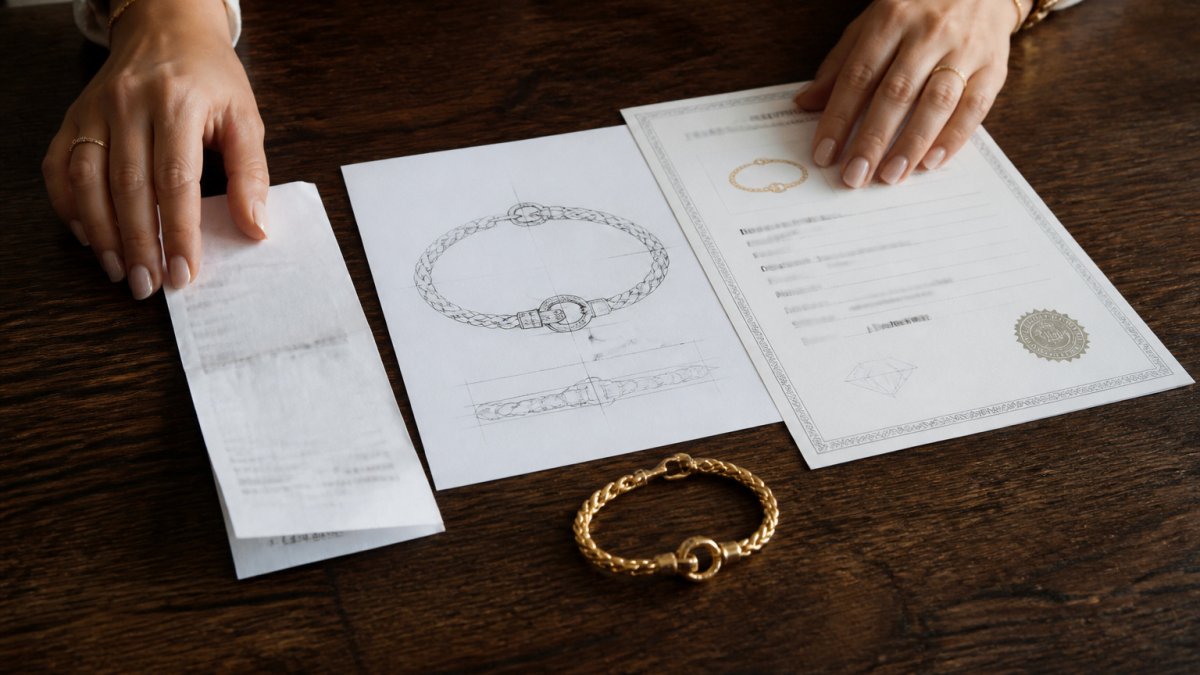
Start with these items:
- Purchase receipt or invoice showing the price, date and seller
- Design sketch or commission agreement that describes the custom work
- Material details such as metal purity, gemstone type and carat weight
Keep both digital and paper copies, and store them somewhere separate from the jewelry itself. Many owners find that a folder with clear dates saves hours later.
Step 2: Choose a Qualified Appraiser for Custom Work
Not every appraiser is equipped to value custom pieces. Look for someone with gemological training and experience with handmade or one-of-a-kind work.
When you compare appraisers, check for:
- Credentials from a recognized gemological or appraisal body
- Experience with custom and bespoke designs, not only mass-produced jewelry
- A written report that lists each material, measurement and the valuation method used
Ask whether the appraiser will state the basis of value, such as replacement value or market value. A report that does not say which basis it uses will cause problems when you file a claim.
Step 3: Understand Replacement Value vs. Resale Value
Replacement value and resale value are not the same thing, and mixing them up is one of the most common errors owners make.
Replacement value is what it would cost to buy a comparable piece today from a retailer. Resale value is what a buyer would pay you if you sold the piece.
For insurance, replacement value is usually the more relevant figure. Insurers generally pay to replace a lost or stolen item, not to buy it back at a secondhand price.
The valuation bases you will see on a policy
Custom jewelry policies usually use one of two bases, and the difference matters at claim time:
- Replacement value (RCV). The insurer pays to replace the item with a comparable piece of like kind and quality, up to the scheduled amount. If the replacement costs more than the scheduled value, you may be responsible for the difference, so the scheduled figure needs to reflect current replacement cost.
- Agreed value. The insurer and you agree on a fixed dollar amount at underwriting, and that amount is paid if the item is lost, stolen or destroyed, usually without a depreciation deduction. Agreed-value policies often cost more because the insurer carries the full stated risk.
A third figure, actual cash value (ACV), sometimes appears on homeowners policies. ACV is replacement cost minus depreciation, and for jewelry it usually produces a payout well below what it costs to replace the piece.
How the claim is actually settled
Even under a replacement-value policy, the settlement method can vary:
- Replace. The insurer sources or commissions a comparable piece, often through a jeweler it works with. You may have limited choice of maker.
- Repair. For damage rather than loss, the insurer may pay to restore the piece, re-setting a stone, re-tipping prongs, re-polishing. Custom work can complicate this if the original maker is no longer available.
- Cash settlement. Some policies allow a cash payout instead of replacement, sometimes at a reduced amount or only if replacement is not reasonably possible. Ask before you buy whether cash settlement is an option and at what basis.
Why this matters for custom pieces
A custom commission often has no direct retail comparable, so the appraiser's replacement-cost estimate and the policy's settlement clause have to work together. If the appraisal says replacement cost is $12,000 but the policy is written on an actual-cash-value basis, the payout after a loss may be far lower. Read the settlement clause, confirm the basis of value on the appraisal matches the policy, and revisit both when the piece is reappraised.
Step 4: Get a Jewelry Appraisal for Insurance Purposes
An insurance appraisal is a formal document that states the piece's value for coverage. Insurers use it to decide how much to cover and what the premium should be.
Guidance from jewelry sources suggests that appraisals should be updated every three to five years. Gold prices and stone prices move, so an old figure can leave you underinsured. You can confirm this with Robson's Jewelers 2026 appraisal guide.
Ask your appraiser for a report that includes:
- A description of the piece with photos
- Materials, weights and measurements
- The valuation date and the basis of value
The table below summarises the appraisal and documentation steps covered in this guide.
| Item | Value | Note |
|---|---|---|
| Appraisal update frequency | Every 3-5 years | Gold and stone prices move over time |
| Standalone premium estimate | 1-2% of appraised value per year | Rough guide only; varies by insurer and location |
| Example premium | $100-$200 | For a $10,000 ring |
| Replacement value | Cost to buy a comparable piece today | Usually the basis insurers use |
| Resale value | Usually lower than replacement value | Dealers need a margin |
Step 5: Insure Custom Jewelry Through a Scheduled Item or Rider
Standard homeowners or renters policies often cap coverage for jewelry at a low limit. A scheduled item or rider lifts that limit for specific pieces and lists them by name.
Standalone jewelry insurance is another option. Element 79 Jewelry describes this type of cover as an estimate of 1-2% of appraised value per year, which it gives as roughly $100-$200 for a $10,000 ring. Treat that as a rough guide, since actual premiums depend on your insurer and location. Element 79 Jewelry insurance guide
When you set up a scheduled item, make sure:
- Each piece is listed with its appraised value
- The policy states whether it pays replacement value or agreed value
- You know the deductible and any exclusions
Common Mistakes: Underinsurance, Appraisal Inflation and Exclusions
The three mistakes below cause the most trouble at claim time.
Underinsurance. Owners often insure a piece for what they paid years ago. If the value has risen, a loss leaves a gap.
Appraisal inflation. An appraisal amount is not automatically what an insurer will pay after a loss.
Exclusions. Read the exclusions list closely. Custom pieces with unusual stones or materials may fall outside standard cover.
Keep the appraisal current, check how the policy settles a claim, and ask questions before you buy. For guidance on restoring or resizing jewelry without losing its worth, see resizing vintage gold rings.
Your Next Step: Documenting Your Piece Before It Leaves the Studio
The best time to build your file is while the piece is being made. To understand the stages where documentation fits, read the bespoke jewelry design process. Ask the maker for a list of materials and a record of the piece's construction.
Once the piece is complete, book an appraisal and add it to your policy. To plan your timing, see how long bespoke jewelry takes to make. Your LÖF designs, such as The Margueritte Cuff, are easier to document when the paperwork is in place from day one.

Frequently Asked Questions
How often should custom jewelry be reappraised?
Appraisals are generally updated periodically, . Custom pieces need this more often than standard jewelry because their value depends on metal prices, gemstone market conditions and labor costs, which move over time. An outdated appraisal can leave you underinsured. Check your appraisal date each time you review your policy and schedule an update when it approaches the three-year mark.
Does homeowners insurance cover custom-made jewelry?
Standard homeowners and renters policies usually cover jewelry only up to a low sub-limit, which is often far below the value of a bespoke piece. To insure custom jewelry at its full value, you typically need a scheduled item, a rider or a standalone jewelry policy. Ask your insurer for the specific coverage limit on personal property and whether it applies to theft, loss and accidental damage. Provide your appraisal report when you schedule the item so the agreed amount is documented.
Can you insure handmade jewelry that has no market price?
Yes, but the insurer needs a documented value. Because a one-of-a-kind piece has no direct comparable on the market, an appraiser usually values it by estimating what it would cost to replace with the same metal, gemstones and craftsmanship. Include the design sketch, metal weight, gemstone details and labor cost in your documentation. This gives the insurer a basis for an agreed value or a replacement settlement.
What documents do you need to insure a bespoke piece?
Gather the purchase receipt or commission agreement, the design sketch or CAD file, photographs from several angles, and a detailed appraisal report. The appraisal should list metal type and weight, gemstone type, cut, carat weight, color and clarity, setting style and labor. Keep records of any repairs or modifications. Store copies digitally and with your insurer, because a claim after theft or loss depends on proof that the piece existed and what it was worth.
