

Table of Contents
- What Bespoke Jewelry Design Actually Means
- The Bespoke Jewelry Design Process Explained Step by Step
- Custom Jewelry Design Timeline: How Long It Really Takes
- The Cost of Bespoke Jewelry Design and What Drives It
- Ethical Sourcing in Fine Jewelry: What to Ask For
- Common Pitfalls in a Jewelry Commission and How to Avoid Them
- Appraisal, Insurance, and Caring for a One-of-a-Kind Piece
- Frequently Asked Questions
Last Updated: September 13, 2026
What Bespoke Jewelry Design Actually Means
Bespoke jewelry design means creating a piece from scratch around one specific wearer, not selecting from an existing collection. At LÖF, the maison is built on this idea: 18k recycled gold, platinum, ethically sourced gemstones, and antique diamonds shaped into bold, architectural, heirloom-quality pieces.
The word "bespoke" gets used loosely in fine jewelry. True bespoke means the design brief comes before the materials list: you define proportions, metal alloy, stone character, and finish from a blank page, not pick a setting and swap a stone.
This guide walks through the full bespoke jewelry design process explained step by step, from first consultation to final appraisal, plus the questions most buyers forget to ask.
The Bespoke Jewelry Design Process Explained Step by Step
The bespoke process moves through three phases: consultation and brief, design and digital modeling, then fabrication and finishing, with an approval gate between each.
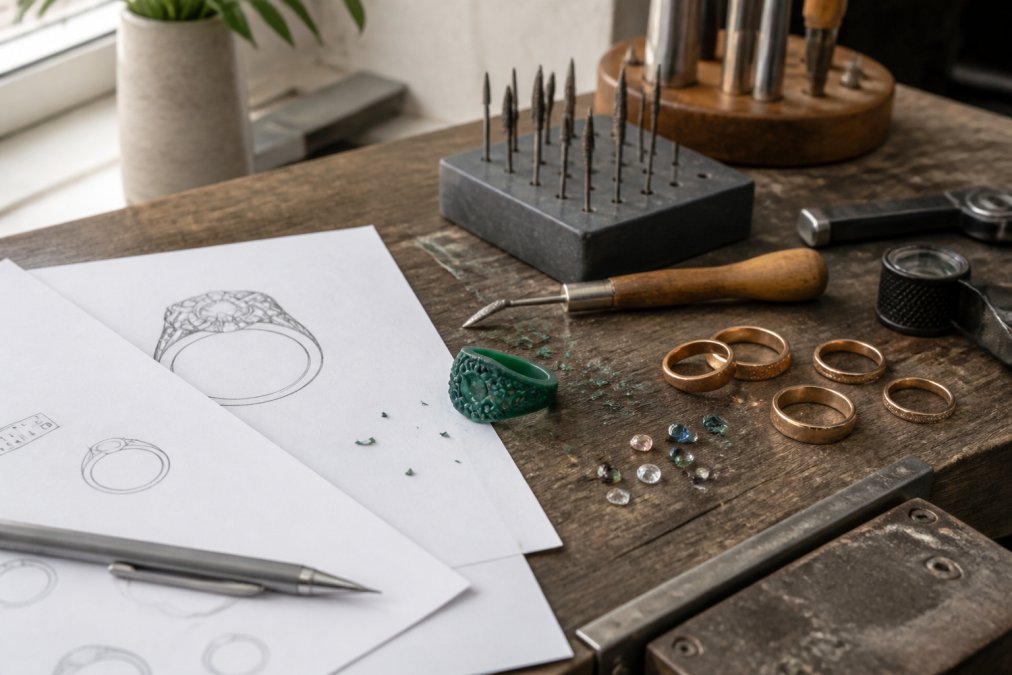
Step 1: Design Consultation and the Design Brief
The design consultation is where the piece is decided. A jeweler asks how you wear jewelry, what you already own, which proportions feel right, and what the piece needs to mark. From those answers comes the design brief: a written summary of silhouette, metal, stone type, approximate carat weight, and budget band.
Get the brief in writing before any deposit changes hands; skipping the specification produces costly revisions.
Step 2: Sketches, CAD Modeling, and 3D Rendering
Sketches come first, usually two or three directions. Once you pick one, the jeweler builds a CAD model and produces a 3D rendering you can view from every angle, showing how a stone sits in the metal and whether proportions work before anything is cast.
Ask for the rendering at scale on a hand or neck, not floating on a white background. Two rounds of refinement is typical; unlimited rounds usually signal a loose brief.
Step 3: Lost-Wax Casting, Stone Setting, and Finishing
Fabrication is where the design becomes metal, running through three sub-stages: casting, setting, and finishing.
Lost-wax casting. The jeweler carves a wax model, by hand or from a 3D-printed pattern derived from the CAD file, attaches it to a wax sprue, then invests it in a plaster-like refractory material. The investment cures, the wax is burned out in a kiln, and molten metal is forced into the cavity. Once cooled, the investment is broken away and the casting cut from the sprue.
Two casting routes matter for bespoke work. Hand-carved wax gives direct control over organic curves and suits one-off sculptural pieces; 3D-printed wax is more precise for geometric or symmetrical designs. A third option, hand fabrication from sheet and wire, skips casting entirely for forged structural elements, a thick cigar band is often forged rather than cast because forging compresses the metal grain for a denser, more durable result.
Stone setting. After casting and cleanup, the jeweler sets the stones; the style determines both look and labor. Prong settings are most common and easiest to retip. Bezel settings wrap a metal rim around the stone for maximum daily-wear protection. Pavé and channel settings seat many small stones flush and demand the most precision, one stone set too deep or shallow throws off the entire line. A baguette-set band like The Barbette Ring requires stones to sit flush and level across three joined bands.

Finishing. Finishing covers polishing, texturing, and applied detail. Polishing moves through progressively finer abrasives until the metal reaches the intended luster, high polish, satin, or brushed. Texturing can be applied by hand (hammering, engraving, etching) or by laser. Hand-painted enamel, like the black enamel on The Barbette Ring, is applied in thin layers and fired between coats. Hallmarking follows if the piece needs an official purity mark; in the UK it is a legal requirement above certain weight thresholds, carried out by an assay office (gov.uk).
Step 4: Final Quality Inspection and Delivery
Before shipping, the piece goes through a final inspection: checking stone security, verifying the hallmark, confirming the finish matches the approved sample, and photographing it for the client record. Confirm appraisal and insurance paperwork are in order.
Custom Jewelry Design Timeline: How Long It Really Takes
A custom jewelry design timeline typically runs six to twelve weeks from approved brief to delivery, depending on stone sourcing and setting complexity. Multi-stone rings with antique diamonds take longer because each stone is sourced individually.
Here is how the time usually breaks down:
| Phase | Typical Duration | What Causes Delay |
|---|---|---|
| Consultation and brief | 1-2 weeks | Undecided silhouette or budget |
| Sketches and CAD rendering | 1-3 weeks | Repeated design iteration |
| Stone sourcing | 1-4 weeks | Rare cuts, antique diamonds |
| Casting and setting | 2-3 weeks | Complex multi-stone settings |
| Finishing and hallmarking | 1-2 weeks | Hand enamel or engraving |
If a deadline is fixed, say so at the consultation. A jeweler can often compress casting and finishing, but stone sourcing is the one phase nobody controls.
The Cost of Bespoke Jewelry Design and What Drives It
The cost of bespoke jewelry design is driven by four things: metal weight and alloy, stone quality and rarity, labor hours in setting and finishing, and whether the design requires a new CAD model or adapts an existing one.
Metal choice moves the number more than most buyers expect: platinum is denser and costs more per gram than 18k gold, and a thick band uses considerably more of it. Antique diamonds and unusual cuts carry a premium because they are found, not ordered.
LÖF publishes its prices, which is useful when you are budgeting. The Initial Pendant starts at $20,000 with a choice of six colorways and a reversible princess-cut diamond setting. Button No. 01 begins at $6,000 with a signature zig zag etching and your choice of gemstone, which makes it a practical entry point for a first commission. The Margueritte Cuff sits at $41,500 in handcrafted 18k recycled gold with an old European cut diamond, and The Barbette Ring at $25,000 in 18k yellow gold with 1.5ct baguette diamonds and hand-painted black enamel.

Ethical Sourcing in Fine Jewelry: What to Ask For
Ethical sourcing in fine jewelry means traceable, conflict-free stones and metals with documentation you can review, a chain of custody provable at each step.
Sustainability claims in jewelry are hard to verify, and regulators have noticed. The U.S. Federal Trade Commission Green Guides set out when environmental marketing claims need substantiation, and vague terms like "eco-friendly" without evidence are exactly what those rules target. For diamond terminology specifically, the Federal Trade Commission Jewelry Guides govern how stones may be described in advertising.
So ask concrete questions:
- Where were the gemstones sourced, and can you name the origin?
- Are the diamonds antique or newly mined, and how is that documented?
- Is the gold recycled, and can you state the refining source?
- Which lab graded the stones, and is the report included with the piece?
- Will the piece carry a hallmark, and who applies it?
Common Pitfalls in a Jewelry Commission and How to Avoid Them
Most jewelry commission problems trace back to one of four mistakes, all avoidable before any metal is cut: buyers rush the brief, then try to fix specification problems during fabrication, when changes are expensive or impossible.
| Pitfall | Fix | Why It Matters |
|---|---|---|
| Skipping the written brief | Get silhouette, metal, and budget in writing | Prevents endless revisions |
| Approving CAD without scale context | Request the render on a hand or neck | Proportions read differently in isolation |
| Choosing a stone online only | Ask for video in multiple lighting conditions | Color shifts between screens |
| No agreed deadline in writing | Confirm dates at the brief stage | Stone sourcing cannot be rushed |
The one nobody warns you about is sizing on a ring worn daily. Fingers change size across seasons and over years, and a thick cigar band fits differently from a thin one. Get sized in person if you can, and ask how much resizing the design allows later.
Appraisal, Insurance, and Caring for a One-of-a-Kind Piece
Most bespoke guides stop at delivery. That is a mistake: a one-of-a-kind piece has no comparable sale to reference if it is lost, stolen, or damaged, which makes post-purchase documentation and care part of the commission.
Getting an Independent Appraisal
Commission an independent jewelry appraisal once the piece is finished, separate from the purchase receipt. The appraiser should not be the jeweler who made it, because an independent valuation carries more weight with insurers.
An insurance appraisal states replacement value, what it would cost to recreate the piece from scratch, including comparable stones and labor, and describes it in enough detail to identify: metal type and weight, stone count, carat weights, cut, color, clarity, measurements, setting style, and distinguishing features like hand-painted enamel or a signature etching. For a bespoke piece, it should also reference the original design drawings or CAD renders.
Expect the appraisal to cost a flat fee, typically based on the piece's complexity rather than its value. Ask for two copies: one for your records and one to submit to your insurer.
Insuring a Custom Piece
Fine jewelry usually exceeds the default coverage limits on a standard homeowner or renter policy, often capped at a few thousand dollars for theft. The standard solution is a scheduled personal property rider (sometimes called a floater), which lists the piece individually and covers it at the appraised value, usually without a deductible.
Your insurer will typically ask for:
- The independent appraisal
- A clear photograph of the piece from multiple angles
- Grading reports for any significant stones (GIA, AGS, or equivalent)
- The purchase receipt or commission invoice
A rider usually costs a small percentage of the appraised value annually. Review the appraisal every two to three years, or after significant metal or diamond price changes, because an outdated appraisal can leave you underinsured.
Day-to-Day Care by Material
Care depends on what the piece is made of, and the materials named in this guide each have specific needs:
- 18k recycled gold and platinum. Both are durable and can be cleaned with warm water, mild dish soap, and a soft-bristle brush. Platinum develops a patina over time that some wearers prefer; a jeweler can polish it back to a high shine if you prefer the original finish. Avoid chlorine, which can pit gold alloys over time, remove rings before swimming.
- Antique diamonds. Old European and old mine cuts have shallower crowns and larger culets than modern cuts, and their open culet can trap dirt more easily. Clean them gently and have prongs checked annually, since antique stones are sometimes set in older or thinner prongs that wear faster.
- Hand-painted enamel. Enamel is glass fused to metal, and it is more fragile than the metal beneath it. Never use ultrasonic cleaners or harsh solvents, which can lift the finish. Avoid knocking the piece against hard surfaces, and remove it before heavy manual work. If a chip occurs, it can usually be repaired by a jeweler who works with enamel, but matching the original color takes skill.
- Multi-stone settings. Pavé, channel, and baguette settings should be checked annually for loose stones. A single loose stone in a channel can work its way out and take neighboring stones with it.
Storage and Annual Checks
Store each piece separately in a soft pouch or lined box to prevent scratching and stone-to-stone abrasion. Keep the appraisal, grading reports, and hallmark details together, ideally a digital folder with scans plus a physical copy in a safe. Schedule an annual check with a jeweler: they can tighten prongs, re-polish, and confirm stones are secure.
What to Do If the Piece Is Damaged
Contact your insurer before any repair, and use a jeweler experienced with the specific materials, enamel, antique stones, and hand-finished metal all require different skills. If the piece is irreplaceable, the appraisal's replacement-value figure funds the recreation, which is why the original design documentation matters as much as the finished object.
Frequently Asked Questions
What are the steps involved in the bespoke jewelry design process?
A bespoke jewelry design process moves through six stages: design consultation and brief, sketches and concept development, CAD modeling and 3D rendering, wax carving and casting, stone setting and polishing, then final inspection and appraisal. Each stage ends with your approval before the next begins, so the piece stays aligned with what you asked for. Expect the full sequence to run several weeks rather than days, since casting, setting, and hallmarking cannot be rushed.
How long does the custom jewelry design timeline usually run?
Most commissions take six to twelve weeks from approved design to delivery. Simple pendants and bands sit at the shorter end; a custom engagement ring with sourced stones and hand-carved details sits at the longer end. Add two to three weeks if you want a specific antique diamond or a rare gemstone located for you. Ask for a written stage-by-stage schedule at the consultation so you can plan around a proposal, anniversary, or wedding date.
What does bespoke mean in jewelry, and how is it different from custom?
Custom usually means modifying an existing design: a different stone, a wider band, a longer chain. Bespoke means the piece is drawn from scratch around you, starting with a blank page and a design brief. That is why bespoke work involves sketches, CAD modeling, and a wax prototype you approve before any metal is cast. The result is one-of-a-kind, not a variation of something already in a catalog.
How do I know a brand is genuinely using ethically sourced gemstones and recycled metals?
Ask for documentation, not adjectives. Reputable ateliers can supply supplier declarations for gemstones, provenance details for antique diamonds, and confirmation that gold is recycled rather than newly mined. Certification bodies and independent appraisal reports back this up. If a brand describes its sourcing only in marketing language and cannot show paperwork, treat that as your answer. LÖF, for example, works in 18k recycled gold, platinum, and antique diamonds, and can speak to where each stone came from.