

Table of Contents
- The Bespoke Jewelry Design Process: A Step-by-Step Timeline
- Custom Engagement Ring Timeline: What to Expect
- How to Commission Custom Jewelry: A Step-by-Step Guide
- Factors That Influence How Long Bespoke Jewelry Takes to Make
- Rush Order Feasibility and Material-Specific Delays
- Communication Bottlenecks and Managing Client Expectations
- Conclusion: Planning Your Bespoke Jewelry Commission
- Frequently Asked Questions
Last Updated: September 24, 2026
The Bespoke Jewelry Design Process: A Step-by-Step Timeline
Most people assume a bespoke jewelry commission takes a few weeks. In reality, a fully handcrafted piece usually takes 8 to 14 weeks from first conversation to final polish. This guide from LÖF breaks down where that time goes, so you can plan around real deadlines instead of guesswork.
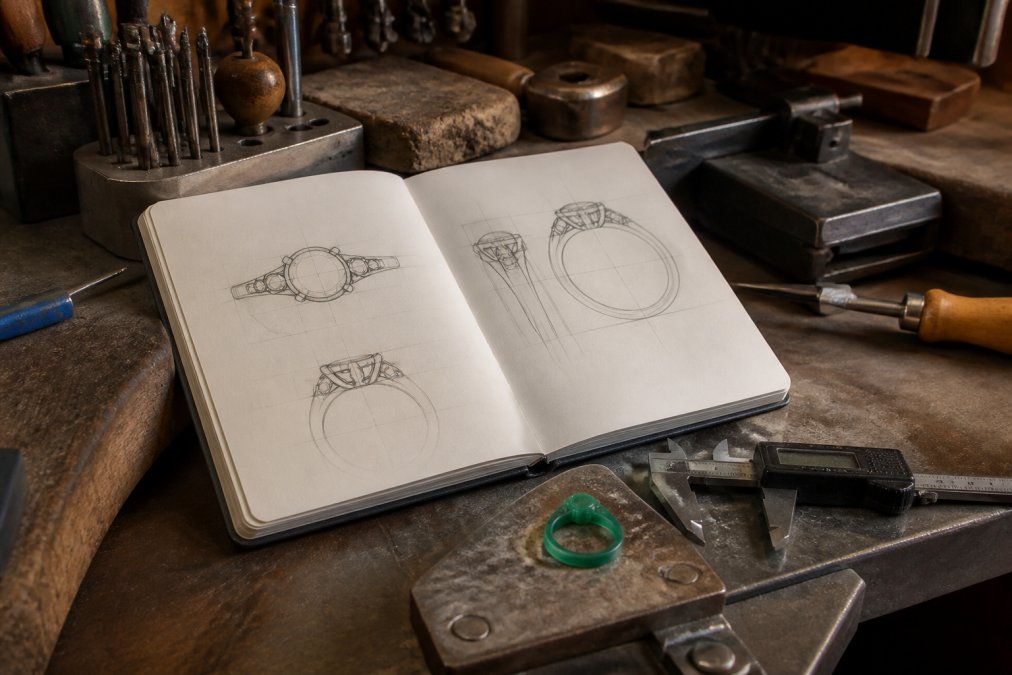
Phase 1: Consultation and Stone Sourcing (1-2 Weeks)
The first phase is the design consultation, where your ideas become a working brief. Most of this time goes into stone sourcing, not conversation.
Here's what happens:
- You discuss style, budget, metal choice, and occasion
- Your jeweler sources gemstone options that match the brief
- You review stones in person or through detailed photos and video
- You approve the final stone before design begins
Phase 2: Design and CAD Iteration (2-4 Weeks)
Design and CAD iteration moves your piece from idea to a precise, buildable plan, and runs 2 to 4 weeks for most custom commissions.
The workflow looks like this:
- Your designer produces hand sketches based on the brief
- You give feedback and request changes
- A 3D rendering or CAD design is built from the approved sketch
- You review the rendering and request final adjustments
- A wax model may be printed for a physical check
Phase 3: Fabrication, Setting, and Polishing (4-8 Weeks)
Fabrication is the longest phase because it's where the actual jewelry making happens. Expect 4 to 8 weeks for casting, setting, and polishing.
The bench work breaks down into:
- Casting or hand fabrication of the metal structure
- Metal smithing to refine links, edges, and proportions
- Stone setting, which is often the most delicate step
- Polishing to bring out the final finish
- Quality control before the piece ships
Custom Engagement Ring Timeline: What to Expect
A custom engagement ring typically takes 8 to 12 weeks from consultation to delivery, depending on stone sourcing and design complexity. If you're working toward a proposal date, start at least three months ahead.
The custom engagement ring timeline breaks down like this:
| Phase | Typical Duration | What Happens |
|---|---|---|
| Consultation and stone sourcing | 1-2 weeks | Brief, gemstone selection, approval |
| Design and CAD iteration | 2-4 weeks | Sketches, 3D rendering, wax model |
| Fabrication and setting | 4-8 weeks | Casting, setting, polishing, QC |
| Shipping and final check | 3-7 days | Delivery and inspection |
How to Commission Custom Jewelry: A Step-by-Step Guide
Commissioning custom jewelry follows a repeatable process. Here's the sequence that keeps projects on schedule.
- Book a design consultation. Bring inspiration images, your budget, and a target date.
- Agree on the brief. Confirm metal, gemstone type, size, and style direction in writing.
- Approve the stone. Review sourcing options and sign off before design begins.
- Review sketches and CAD. Give consolidated feedback rather than piecemeal notes.
- Approve the wax model or 3D rendering. This is your last easy chance to change the design.
- Confirm the production schedule. Ask for a written timeline with milestone dates.
- Wait through fabrication. Resist mid-build changes unless something is genuinely wrong.
- Inspect on delivery. Check the setting, finish, and sizing immediately.
Factors That Influence How Long Bespoke Jewelry Takes to Make
Several variables decide whether a commission finishes in 8 weeks or stretches past 14. Knowing them upfront helps you set realistic expectations.
The biggest factors include:
- Complexity of the design. Architectural shapes and multiple stones take longer than simple bands.
- Stone availability. Rare cuts and specific antique diamonds require longer sourcing.
- Metal choice. Platinum is denser and harder to work than 18k gold, which adds bench time.
- Number of design iterations. Each revision adds days to the CAD phase.
- Studio workload. A busy jewelry studio has a queue, and your piece joins it.
- Custom sizing. Non-standard sizes need extra fitting and adjustment.
Rush Order Feasibility and Material-Specific Delays
A rush commission is not a faster version of a normal one, it's a re-sequenced project. Understanding what can move, and what cannot, tells you whether your deadline is realistic before you commit.
What a rush actually changes
A studio compresses a timeline in three ways, and only three:
- Bench re-sequencing. Your piece jumps the queue and displaces another client's work. That is why rush fees exist, they compensate for the disruption, not for extra hours in the day.
- Parallel processing. Tasks that normally run in sequence (casting, then setting, then polishing) get overlapped where the metalwork allows. A simple band can be polished while a setting is prepped; a multi-stone piece usually cannot.
- Vendor escalation. Casting houses and stone suppliers offer expedited tiers. These cost more and are only available if the vendor has capacity that week.
The realistic floor
Even a well-prepared rush commission has a floor of about 4 to 6 weeks, because casting, setting, and polishing each have irreducible minimums:
- Casting and cleanup: roughly 5-10 business days, including sprue removal and initial finishing.
- Stone setting: 2-5 business days for a simple solitaire, longer for pavé or channel work.
- Polishing and QC: 2-4 business days, with a re-polish buffer if the setting reveals a flaw.
Material-specific delays
This is where most timelines quietly break. Different materials behave differently at every stage:
| Material | Sourcing | Bench time | Notes |
|---|---|---|---|
| 18k gold | Fast if standard alloy | Baseline | Easiest to cast and re-work |
| Platinum | Fast if standard | +20-40% | Higher melting point, denser, harder to finish |
| Antique/estate diamonds | Weeks to months | Baseline | Availability is the constraint, not labor |
| Rare colored gemstones | Weeks to months | +10-20% | Delicate stones need slower, cooler setting |
| Lab-grown stones | Days | Baseline | Predictable supply, standard setting |
What kills a rush
- Sourcing a specific antique diamond on a fixed deadline
- Complex multi-stone settings that cannot be parallelized
- Design changes after casting has begun
- A studio already at full bench capacity
- A custom alloy or non-standard metal finish
Communication Bottlenecks and Managing Client Expectations
Here's the part of the timeline no one puts in the brochure: the clock stops every time the project sits in your inbox. A commission quoted at 10 weeks can easily become 14 without a single extra hour of bench work, purely from slow approvals.
How response time compounds
Each phase has an approval gate. Miss it by a week and the delay doesn't just add a week, it pushes everything downstream, because the studio has already scheduled other work into your piece's slot.
A typical pattern:
| Gate | Typical client delay | Downstream impact |
|---|---|---|
| Stone approval | 3-7 days | Sourcing restarts if the stone is released |
| Sketch feedback | 2-5 days | CAD start pushed |
| CAD revision round | 3-7 days per round | Each round adds a full week |
| Wax/rendering sign-off | 2-4 days | Fabrication slot may be reassigned |
| Final delivery scheduling | 1-3 days | Shipping window shifts |
The three bottlenecks that matter most
1. Delayed stone approval. Nothing moves until you sign off. If you sit on a stone for two weeks and then reject it, sourcing restarts from zero. Ask your jeweler to hold options for a defined window (usually 5-7 days) so you know the real deadline.
How to keep a commission on schedule
- Ask for a written milestone schedule at the consultation. Not a single delivery date, a list of dates for stone approval, sketch review, CAD sign-off, wax approval, and delivery.
- Assign one decision-maker. Couples commissioning together should agree in advance who gives final approval, or feedback will loop.
- Respond within 48 hours at every gate. This single habit protects more of the timeline than any other.
- Flag your deadline in writing at the start. A studio that knows your date can sequence around it; a studio that finds out at week eight cannot.
- Consolidate changes. One revision round with five notes is faster than five rounds with one note each.
What good studios do differently
A well-run studio tells you when a request will push the delivery date rather than quietly absorbing it and missing the deadline, and flags bottlenecks the moment they appear, a hard-to-source stone, a casting re-run, a setting needing a second pass. If your studio goes quiet for more than a week during fabrication, ask for a status update. Silence is not progress.
Conclusion: Planning Your Bespoke Jewelry Commission
The honest answer to how long bespoke jewelry takes to make is 8 to 14 weeks, and the variables are mostly in your control. Start early, approve quickly, and keep design changes to the early phases where they're cheap.
Frequently Asked Questions
What does 'bespoke' mean for jewelry?
Bespoke jewelry is made to order from scratch, not selected from a display case. The term covers a piece designed around your specific stone, metal, and proportions, then fabricated by hand in a jewelry studio. At LÖF, the bespoke jewelry design process starts with a consultation, moves through CAD design and stone sourcing, and ends with fabrication, setting, and polishing. Every stage is built around your brief, which is why bespoke pieces take longer and cost more than ready-to-wear.
Why does custom jewelry take longer than off-the-shelf pieces?
Off-the-shelf jewelry is cast in batches and finished on a fixed production schedule. A custom commission runs on its own timeline: stone sourcing, CAD design iterations, wax model approval, casting, setting, and polishing all happen sequentially for one piece. Client approval points add time that mass-produced jewelry never has. Material-specific delays, such as sourcing an antique diamond or a specific gemstone, can also extend the schedule beyond the typical 6 to 12 week window.
Can I rush a bespoke jewelry order?
Rush orders are sometimes possible, but they depend on the complexity of the design and the availability of your chosen stones. A simple band in 18k gold may be compressed into a shorter window, while a piece requiring antique diamond sourcing or intricate setting cannot be rushed without compromising quality control. Ask about rush feasibility at the consultation stage, before design work begins. Communication bottlenecks, not bench time, are often the biggest cause of delays.
How does the complexity of a design affect the production timeline?
Complex designs add time at every phase. Intricate CAD work, multiple design iterations, and hand-finished details such as zig zag etching or custom clasps all extend the schedule. Setting a baguette diamond or an old European cut stone takes longer than a simple bezel. Handcrafted pieces from a jewelry artisan also move more slowly than cast multiples. A realistic custom engagement ring timeline for a detailed piece is often 8 to 12 weeks, compared with 6 weeks for a simpler commission.
Planning a bespoke piece around a real date is the hardest part of the process. LÖF takes the guesswork out with a clear, phase-by-phase timeline, handcrafted construction in recycled 18k gold and platinum, and ethically sourced gemstones and antique diamonds selected with you. Get started with LÖF and commission a piece built to last for generations.