

Table of Contents
- Why Sustainable Gold Jewelry Needs a Different Cleaning Approach
- Tools and Materials You Need Before You Start
- The Safest Way to Clean Sustainable Gold Jewelry, Step by Step
- The Best Jewelry Cleaning Solution for 18k Gold
- What to Avoid: Ultrasonic Cleaners, Abrasives, and Harsh Chemicals
- Professional Jewelry Cleaning Frequency: How Often Is Enough?
- How to Store Sustainable Jewelry to Slow Tarnish and Wear
- Disposing of Cleaning Solutions and Choosing Eco-Friendly Products
- Frequently Asked Questions
Last Updated: September 16, 2026
Why Sustainable Gold Jewelry Needs a Different Cleaning Approach
Sustainable gold jewelry is made from recycled or responsibly sourced precious metals and ethically obtained gemstones, designed to be kept for decades rather than seasons, which is why it needs gentler handling than the costume pieces most cleaning guides were written for.
At LÖF, every piece is crafted from 18k recycled gold, platinum, and ethically sourced stones. The metal is durable; what ages is the finish. Skin oils, lotions, perfume, and airborne sulfur compounds build up as tarnish and dull the shine long before the metal wears out, worth removing properly rather than aggressively.
Most advice online treats all gold the same. It isn't. A solid 18k recycled gold cuff and a thin gold vermeil chain react very differently to the same method, and the wrong technique can strip plating or scratch a polished surface in seconds.
Below: the full process, the tools worth buying, what to avoid, and how to store pieces so they need cleaning less often.
Tools and Materials You Need Before You Start
Gather everything before you touch the jewelry. Stopping mid-clean to hunt for a cloth leaves soap residue drying on the metal, which is how water spots form.
What you'll need:
- Mild dish soap, ideally a fragrance-free and dye-free formula
- A bowl of warm water, not hot
- A soft-bristled toothbrush, baby-soft or an old one with worn bristles
- A microfiber cloth
- A separate polishing cloth for the final buff
- A small strainer or a sink plug, so nothing disappears down the drain
Skip paper towels and tissue. Paper fibers are mildly abrasive and leave micro-scratches on polished gold over time.
The Safest Way to Clean Sustainable Gold Jewelry, Step by Step
The safest method for sustainable gold jewelry is a short soak in mild dish soap and warm water, then gentle brushing, a thorough rinse, and a soft buff with a microfiber cloth. Total time: about ten minutes, plus drying.
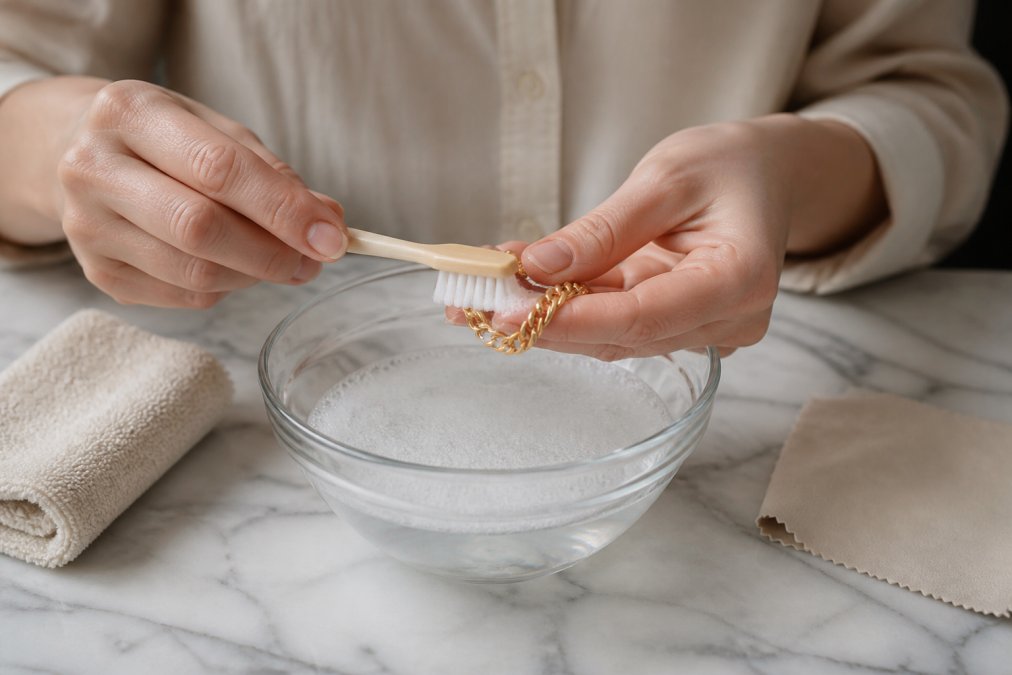
Here is the full sequence.
Step 1: Soak in Mild Dish Soap and Warm Water
Fill a bowl with warm water and add two or three drops of mild dish soap. Swirl to mix, then let the jewelry sit for five to ten minutes.
Warm water loosens dried lotion and skin oils without stressing the metal; hot water can loosen stone settings over repeated exposure, so keep it comfortably warm. For heavy grime, extend the soak to fifteen minutes rather than adding more soap.
Step 2: Gently Brush and Rinse Away Residue
Lift the piece out and brush with the soft-bristled toothbrush in small circles. Focus on the underside of settings, the inside curve of a cuff, and the clasp area, where grime collects and stays hidden.
Rinse under lukewarm running water, or dip the piece in a second bowl of clean water if it has delicate settings. Remove every trace of soap: dried soap leaves a dull film that looks like tarnish.
Step 3: Dry and Buff With a Microfiber or Polishing Cloth
Pat dry with a microfiber cloth, then air dry a few minutes to reach moisture trapped under settings. Finish with a polishing cloth, using light back-and-forth strokes rather than hard pressure.
Buffing restores the mirror finish. It does not remove metal; it removes the last traces of residue that scatter light and make gold look flat.
The Best Jewelry Cleaning Solution for 18k Gold
The best jewelry cleaning solution for 18k gold is mild dish soap diluted in warm water. It breaks down oils without the abrasives, acids, or ammonia in many commercial dips.
That surprises people who assume a dedicated product works better. In practice, 18k gold is an alloy: 75% gold and 25% other metals for strength and color.
For heavier tarnish on solid gold, a baking soda paste works as a targeted treatment: mix two parts baking soda with one part water, apply with a fingertip, work gently for under a minute, then rinse thoroughly. Use it rarely, baking soda is a mild abrasive.
A quick comparison of what actually works:
| Method | Best For | Frequency | Risk |
|---|---|---|---|
| Mild dish soap and warm water | All gold, including plated | Weekly to monthly | None |
| Baking soda paste | Heavy tarnish on solid gold | Occasionally | Mild abrasion |
| Commercial liquid dip | Not recommended for plated pieces | Avoid | Attacks alloys |
| Ultrasonic cleaner | Solid metal, no stones | Professional use only | Loosens settings |
What to Avoid: Ultrasonic Cleaners, Abrasives, and Harsh Chemicals
Most cleaning guides list what not to do without explaining why, which makes the warnings easy to ignore. For sustainable gold jewelry the stakes are higher: these pieces are designed to last decades, and damage from a single bad cleaning session can be permanent.
Ultrasonic cleaners. These machines vibrate cleaning fluid at 40,000 to 50,000 cycles per second, effective at dislodging grime from solid metal, but equally effective at shaking a stone loose from its setting. On gold vermeil or plated pieces, the vibration can lift plating at the thinnest edges.
For sustainable consumers, avoiding these methods extends the life of jewelry made with recycled or responsibly sourced materials, so the environmental investment pays off over decades rather than seasons.
Professional Jewelry Cleaning Frequency: How Often Is Enough?
Professional jewelry cleaning frequency of once a year is sufficient for most pieces worn daily, but for sustainable gold jewelry the annual visit is less about cleaning than preservation. A jeweler inspects prongs, tightens settings, and polishes with equipment that is not safe at home.
What actually happens during a professional cleaning:
- Inspection under magnification. A jeweler uses a loupe or microscope to check prongs, settings, and clasps for cracks, thinning, or loosening that you cannot see with the naked eye.
- Ultrasonic cleaning (when safe). For solid gold pieces with no delicate stones, a controlled ultrasonic bath removes grime from areas a toothbrush cannot reach, such as the underside of settings and the inside of clasps.
- Steam cleaning. High-pressure steam lifts oils and residue from textured surfaces without abrasion.
- Polishing. A jeweler uses a polishing wheel with progressively finer compounds to restore the surface. This removes a tiny amount of metal, which is why it should be done by a professional who knows how much is safe to remove.
- Tightening and adjustment. Prongs are retipped or tightened, clasps are adjusted, and chains are checked for weak links.
How to Store Sustainable Jewelry to Slow Tarnish and Wear
Storage is where most people undo their own cleaning. Tarnish is a chemical reaction between metal and airborne sulfur compounds, and oxidation speeds up in humid air, so how you store a piece directly determines how often it needs attention.
- Keep each piece in its own soft pouch or lined compartment so pieces cannot scratch each other
- Store in a dry place, away from bathrooms where humidity spikes daily
- Add a small anti-tarnish strip to the box, and replace it every few months
- Keep chains clasped and laid flat to prevent tangling and stretching
- Store silver and gold separately; the metals interact differently with airborne compounds
Disposing of Cleaning Solutions and Choosing Eco-Friendly Products
Disposal is the part almost every jewelry care guide skips, and it matters if you chose sustainable jewelry for environmental reasons.
Frequently Asked Questions
How do you clean gold jewelry without ruining it?
Use the gentlest method first: soak the piece in warm water with a few drops of mild dish soap for 10 to 15 minutes, then brush gently with a soft-bristled toothbrush, rinse, and dry with a microfiber cloth. Avoid abrasives, chlorine, and ultrasonic cleaners on plated or gold vermeil pieces. Solid 18k gold and platinum tolerate this routine well and can be cleaned every few weeks without damage.
Is hydrogen peroxide or rubbing alcohol safe for fine gold jewelry?
Rubbing alcohol is generally safe for solid gold and can remove oils and residue, but it does nothing for tarnish. Hydrogen peroxide is not recommended for sustainable gold jewelry. For everyday cleaning, mild dish soap and warm water remain the safer choice, especially on gold vermeil or plated pieces where the finish is thinner.
Does white vinegar damage sustainable gold jewelry?
White vinegar is acidic and can remove light tarnish. On solid 18k gold or platinum, a diluted vinegar soak is unlikely to cause damage, but it is unnecessary when soap and water work. If you do use vinegar, keep it brief, rinse thoroughly, and never combine it with baking soda on plated pieces.
How often should I professionally clean my fine jewelry?
For pieces worn daily, a professional inspection and cleaning once a year is a sensible baseline. Pieces with antique diamonds, delicate settings, or heavy buildup may need a visit every six months. Between professional cleanings, at-home care with mild dish soap and a polishing cloth keeps grime and tarnish in check. A jeweler can also check prongs and clasps, which matters more for heirloom-quality pieces you plan to pass down.