

Table of Contents
- The Short Answer: Density, Rarity, and Craftsmanship
- Platinum vs Gold Durability: Why Weight Matters
- Why Is Platinum Harder to Work With? The Craftsmanship Cost
- Platinum Purity: 950 vs 900 Alloys Explained
- Is Platinum Hypoallergenic? The Skin-Friendly Metal
- The Hidden Cost of Maintenance and Repolishing
- Resale Value Reality: What Your Platinum Is Actually Worth
- Is the Premium Price Worth It for Your Jewelry?
- Frequently Asked Questions
Last Updated: September 8, 2026
Platinum jewelry commands a premium price that often surprises first-time buyers, yet the reasons trace back to fundamental physical properties rather than marketing hype. The metal's density, rarity, and the specialized skill required to shape it all contribute to a final cost that typically exceeds gold.
The Short Answer: Density, Rarity, and Craftsmanship
Platinum jewelry is more expensive because it is roughly 60% denser than 14k gold, significantly rarer as a precious metal, and far more difficult for jewelers to cast, shape, and polish. These factors compound: you need more metal by weight, it costs more per troy ounce, and labor drives fabrication costs upward.
A platinum ring feels noticeably heavier than the same design in gold, one reason many buyers associate the metal with substance and permanence.
Platinum vs Gold Durability: Why Weight Matters
The weight difference between platinum and gold is not cosmetic; it directly influences how your jewelry wears over decades. Platinum's density means a standard band requires more metal to achieve the same dimensions, increasing both the upfront material cost and the physical durability of the piece.
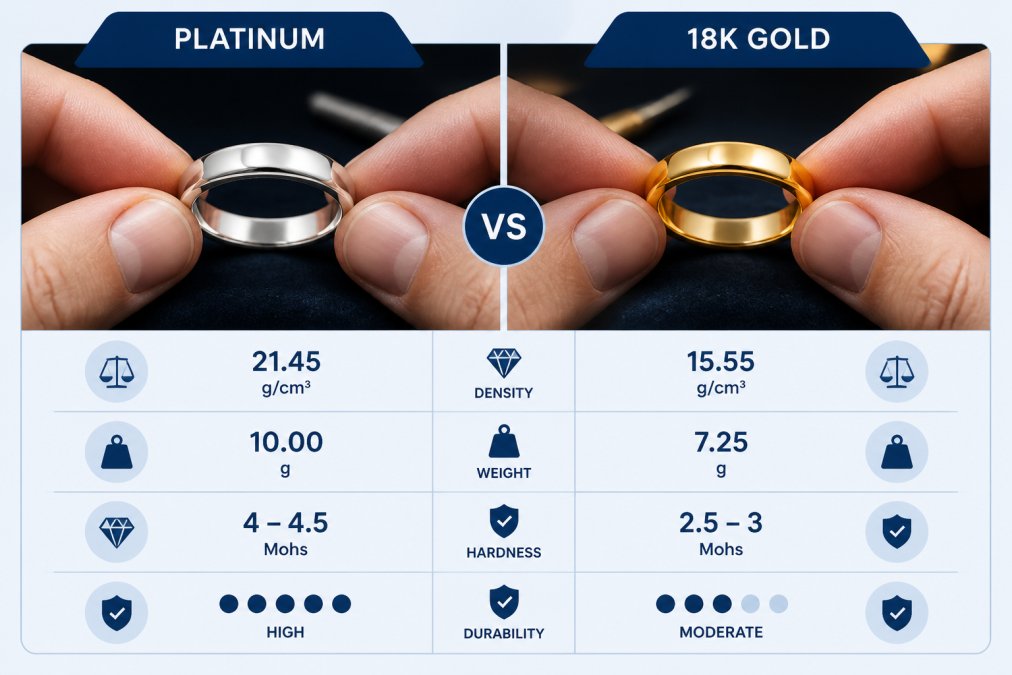
Unlike gold, which can bend or lose shape when prongs are knocked, platinum is malleable enough to absorb impact without breaking, yet dense enough to hold stones securely. The trade-off is that platinum scratches more readily than harder alloys, though the scratches displace metal rather than remove it, so the surface can be polished back to smoothness without losing material.
For daily wear, platinum settings protect gemstones more reliably than most gold alloys. The metal's tensile strength allows for thinner, more elegant settings that still hold a diamond securely, which is why many engagement rings use platinum for the basket and prongs even when the band is gold.
Why Is Platinum Harder to Work With? The Craftsmanship Cost
The craftsmanship premium for platinum is a direct consequence of the metal's physical properties and the specialized workflow it demands, baked into every step from casting to final polish.
Casting and Melting Point
Platinum's melting point is approximately 3,215°F (1,768°C), compared to about 1,945°F (1,063°C) for 18k gold (chemicalelements.com). The higher temperature requires investment materials that withstand the heat without cracking, and many workshops use induction melting or torch casting with oxygen-propane or oxygen-acetylene mixtures. The mold must be heated to a higher burnout temperature to prevent thermal shock, adding time and energy to every casting cycle.
Work Hardening and Tool Wear
Platinum work-hardens rapidly, becoming stiffer and more resistant to further shaping, requiring more force and time than the same operation on gold. The metal also dulls cutting tools faster, so workshops often dedicate separate tooling to platinum. A bench jeweler who can complete a gold ring in a day will typically need two to three days for the identical piece in platinum.
The Alloy's Role in Workability
The specific alloy used in platinum jewelry, 950 platinum with ruthenium or iridium, is chosen for hardness and wear resistance, but that hardness comes at a cost. Ruthenium-hardened platinum is stiffer and more resistant to deformation, excellent for stone settings but more difficult to shape and polish. Cobalt-hardened platinum, sometimes used in 900 platinum, is even harder and more brittle, complicating repairs and resizing.
The Skill Gap and the Learning Curve
Most jewelers are trained primarily in gold and silver fabrication. Platinum requires a different touch: it does not flow the same way when soldered, does not take a high polish as quickly, and demands precise temperature control to avoid cracking. This is why many high-end workshops employ specialists who work exclusively in platinum, and the wage premium for that specialization is reflected in the retail price.
The craftsmanship cost is not a one-time event. Every repair, resize, or repolish on a platinum piece requires the same specialized skill set. A simple ring sizing that takes 20 minutes in gold can take an hour in platinum.
Casting platinum is prone to porosity, tiny gas bubbles trapped in the metal, which can weaken the structure and require additional finishing work. Hand-forging aligns the grain structure and produces a denser, stronger piece, but it is far more labor-intensive, doubling or tripling the labor cost compared to casting.
Platinum Purity: 950 vs 900 Alloys Explained
Platinum jewelry is not sold as 100% pure platinum. Pure platinum is too soft for daily-wear jewelry, so it is alloyed with other metals to increase hardness and durability. The two most common grades are 950 platinum and 900 platinum, but the choice of alloying metal, ruthenium, iridium, or cobalt, has a more significant impact on price and performance than the purity number alone.
The Alloying Metals and Their Trade-offs
-
Ruthenium-hardened 950 platinum is the modern standard for fine jewelry. Adding ruthenium at roughly 5% by weight produces an alloy that is harder than pure platinum but still ductile enough for intricate settings. It polishes to a bright white finish and holds up well to daily wear.
-
Iridium-hardened 950 platinum is an older formulation, still used by some traditional houses. Iridium is denser and harder than ruthenium, but also more brittle, making it more prone to cracking during casting or repair work. Because iridium is one of the rarest elements on Earth, its commodity price is volatile.
-
Cobalt-hardened 900 platinum is a less common but increasingly visible option, particularly in some European and mass-produced lines. Cobalt is significantly cheaper than ruthenium or iridium, lowering the raw material cost. However, cobalt-hardened platinum is harder and more brittle, making it more difficult to shape and resize. It also has a slightly different color, a touch grayer than ruthenium-hardened platinum, noticeable next to a bright white diamond.
Why 950 Platinum Is the Standard
The jewelry industry has largely converged on 950 platinum with ruthenium for good reason. It offers the best balance of purity, workability, and wear performance. The 5% alloying metal is enough to prevent the scratching and bending that would occur with pure platinum, but not so much that the metal becomes difficult to polish or repair.
The Price Impact of Alloy Choice
The alloy choice affects the price in two ways: raw material cost and fabrication cost. Ruthenium and iridium are both expensive, but the difference between them is small in the context of a finished piece. Cobalt is cheaper, but the added difficulty of working with it often negates the material savings. A more significant price factor is the purity grade itself. A 950 platinum piece contains more pure platinum by weight than a 900 platinum piece, and since platinum is priced per troy ounce, the higher-grade piece will have a higher intrinsic metal value. For a typical ring weighing 6 grams, the difference is about 0.3 grams of pure platinum, roughly $10-15 at current market prices.
How Alloy Choice Affects Long-Term Wear
Alloy choice also influences how the metal ages. Ruthenium-hardened 950 platinum develops a patina more slowly than softer alloys, so it holds its high-polish finish longer. Iridium-hardened platinum is more scratch-resistant initially but can be more difficult to repolish without removing metal. Cobalt-hardened platinum is more resistant to scratches but can be prone to chipping under sharp impacts, a concern for prongs holding a diamond.
A Note on Stamping and Hallmarks
In the United States, platinum jewelry is legally required to be stamped with its purity, such as "950" or "Plat 950 (the FTC)." In the UK and Europe, hallmarks are regulated by assay offices, and the standards are similar. When buying platinum, always check the stamp. A piece stamped "900" is not inferior by definition, but it should be priced lower than an equivalent 950 piece because it contains less pure platinum.

The alloy breakdown is a central factor in both the upfront price and the lifetime cost of ownership. A 950 ruthenium-hardened piece is the safest choice for most buyers, offering the best combination of purity, durability, and repairability.
Is Platinum Hypoallergenic? The Skin-Friendly Metal
Platinum is naturally hypoallergenic, making it an excellent choice for anyone who experiences skin reactions to the nickel commonly found in white gold alloys. Pure platinum does not contain nickel, and the alloy metals used in 950 platinum, such as ruthenium and iridium, are generally well tolerated by sensitive skin.
White gold, by contrast, is typically alloyed with nickel or palladium to achieve its white color, and many pieces require rhodium plating to maintain that bright finish. When the rhodium wears away, the underlying metal can cause irritation for nickel-sensitive wearers. Platinum requires no plating because its natural color is white.
For those who plan to wear a ring daily for decades, this distinction matters. The absence of plating means platinum never needs periodic re-plating, an ongoing cost and inconvenience associated with white gold.
The Hidden Cost of Maintenance and Repolishing
Platinum develops a natural patina over time, a soft satin finish that some owners love and others mistake for scratching, and restoring a high-polish look requires professional repolishing that adds to the lifetime cost of ownership.
The patina itself is not damage; it is the metal's surface becoming microscopically textured through daily wear. Many jewelers will tell you that a lightly patinated platinum ring looks distinguished, but if you prefer a mirror finish, you will need periodic polishing. Each repolishing removes a negligible amount of metal, so the ring does not lose significant weight over its lifetime.
The maintenance reality is a key reason why platinum jewelry is more expensive over the long term, not just at the point of purchase.
Resale Value Reality: What Your Platinum Is Actually Worth
Platinum's resale value depends on the prevailing precious metal spot price, and because platinum trades below gold on many days, the scrap value of a platinum piece may be lower than you expect.
The honest picture is that platinum jewelry holds intrinsic value through its precious metal content, but the craftsmanship premium and brand markup depreciate the moment you leave the store. Unlike investment-grade bullion, jewelry carries fabrication costs that do not translate to resale.
World Platinum Investment Council market data on supply and pricing trends shows that platinum prices are driven by industrial demand, particularly from automotive catalytic converters, which makes the metal's value more volatile than gold. For buyers considering platinum as an investment, the jewelry itself is not the vehicle; the wear and legacy value are the real returns.
The resale reality does not diminish platinum's appeal for heirloom pieces meant to be passed down. The value lies in the durability and the design, not in the liquidation price.
Is the Premium Price Worth It for Your Jewelry?
Platinum's premium price is justified when you prioritize durability, hypoallergenic comfort, and a metal that requires no plating to maintain its white color over decades of daily wear.
The decision ultimately comes down to how you weigh the trade-offs. Platinum offers superior stone retention and a naturally white finish that never needs rhodium dipping, but it costs more upfront and develops a patina that requires periodic polishing. Gold, particularly 18k yellow gold, offers warmth and a lower initial price.
For those drawn to bold, architectural designs meant to last generations, platinum's weight and permanence feel appropriate. At LÖF, our platinum pieces, such as The Savoy Ring with its Asscher-cut sapphire and pavé diamond band, or The Pear Wedding Band with its graduated diamond setting, are crafted to be worn daily and passed down.

The choice between platinum and gold comes down to your priorities: platinum rewards those who value durability, hypoallergenic comfort, and a metal that ages gracefully without plating, while gold offers warmth and a lower entry point. For discerning collectors seeking heirloom-quality jewelry crafted from recycled platinum and ethically sourced stones, LÖF creates statement pieces designed for daily wear and future generations.
Frequently Asked Questions
Is platinum actually worth more than gold?
The platinum spot price is often lower than gold per troy ounce, yet platinum jewelry costs more at retail. The higher price comes from density: a platinum ring weighs about 60% more than a similar gold ring, so it requires more precious metal. Add the difficulty of working with platinum and its higher purity percentage, and the final piece carries a premium that reflects material and labor, not just the spot price.
Why do jewelers not like platinum?
Platinum has a high melting point and requires specialized tools and higher temperatures during the casting process. It is also denser and more malleable when heated, which makes precision work slower and more technically demanding. Many jewelers prefer gold because it is easier to shape, solder, and polish quickly. This extra labor and skill requirement directly raises the craftsmanship cost of platinum pieces.
Is platinum jewelry worth buying for everyday wear?
For daily wear, platinum offers superior durability and is naturally hypoallergenic, making it ideal for sensitive skin. Unlike white gold, it needs no rhodium plating and will not fade to a yellow tint. The metal does develop a patina over time, which many wearers find appealing. If you value a low-maintenance, heirloom-quality piece that holds up to wear and tear, the higher upfront cost is often justified.
Does platinum jewelry hold its value over time?
Platinum jewelry has good intrinsic scrap value because of its high purity percentage, typically 95% pure compared to 75% for 18k gold. However, the retail markup includes design and craftsmanship, which you will not recover at resale. As an investment, platinum bullion is more direct, but as a wearable asset, your ring retains meaningful precious metal content that contributes to its long-term worth.