

Table of Contents
- What Ethical Bespoke Jewelry Craftsmanship Actually Means
- Bespoke Versus Made-to-Order: The Difference That Matters
- Ethical Gemstone Sourcing Standards: Certifications, Traceability and Origin
- Recycled Gold vs Mined Gold in Jewelry: What Changes on the Bench
- The Benefits of Bespoke Jewelry: Longevity, Fit and Lower Waste
- Inside the Studio: Hand-Fabrication, Ethical Labor and Cutting and Polishing
- How to Verify Ethical Claims Before You Commission a Piece
- Common Myths About Ethical Bespoke Jewelry Craftsmanship
- Frequently Asked Questions
Last Updated: September 20, 2026
What Ethical Bespoke Jewelry Craftsmanship Actually Means
Ethical bespoke jewelry craftsmanship means creating one-of-a-kind pieces from responsibly sourced materials, made by fairly paid artisans, using methods that minimize environmental harm and maximize the life of the finished piece. At LÖF, every commission is built on recycled 18k gold, platinum, and ethically sourced gemstones and antique diamonds, because the ethics live in the supply chain, not the marketing copy.
Most guides treat "ethical" as a materials checklist, which misses the point. A piece can use recycled gold and still be made in unsafe conditions. Ethics in bespoke work is cumulative: origin, labor, process, and longevity all count.
Buyers commissioning heirloom pieces increasingly ask for proof, not promises. Below: what each claim requires, how the major certifications differ, and how to verify a maker's story.
Bespoke Versus Made-to-Order: The Difference That Matters
Bespoke means the design does not exist until you commission it. Made-to-order means you select from an existing design and the maker produces it in your size or metal. Both can be ethical. Only one is genuinely bespoke.
That difference drives everything downstream. A bespoke piece is drawn, modeled, cast, and finished around a single client, so there is no unsold inventory and no speculative production.
| Factor | Bespoke | Made-to-Order |
|---|---|---|
| Design origin | Created for you | Selected from catalog |
| Production waste | Minimal, no dead stock | Low, but shared patterns |
| Lead time | Longer, typically weeks | Shorter |
| Fit and proportion | Built to your measurements | Adjusted to standard sizing |
| Resale and legacy value | Higher, one of one | Standard |
Ethical Gemstone Sourcing Standards: Certifications, Traceability and Origin
Ethical gemstone sourcing standards trace a stone from mine to setting and confirm it was extracted, cut, and traded without funding conflict or exploiting labor. But "certified" is used loosely in jewelry marketing, and the major frameworks do very different jobs. Knowing which one a maker actually holds, and which one they are quietly implying, is the difference between a verified claim and a vibe.
| Framework | What it covers | What it does NOT cover | Typical use in bespoke |
|---|---|---|---|
| Kimberley Process | Rough diamond trade; blocks conflict diamonds from legitimate markets | Labor conditions, small-scale mining, cutting/polishing, colored stones | Baseline for diamond origin; widely held, weakly differentiating |
| OECD Due Diligence Guidance | A due-diligence process for responsible mineral supply chains, including human rights | It is guidance, not a certification; no audit or seal | Used by serious studios as a sourcing methodology |
| Responsible Jewellery Council (RJC) | Business-level certification across the supply chain (ethics, human rights, environment) | Does not certify an individual stone's origin | Held by larger brands and refiners; useful signal, not a stone-level proof |
| Fairmined | Artisanal and small-scale gold mining: fair price, labor standards, community development | Gemstones; large-scale mining | Relevant to gold sourcing, not stones |
| Fairtrade Gold | Fair price and premium for small-scale gold miners, with labor and environmental criteria | Gemstones; large-scale mining | Same scope as Fairmined, gold only |
- Origin documentation, paperwork identifying the country or region of extraction
- Chain of custody, records showing every hand the stone passed through
- Labor assurance, evidence that cutters and polishers were paid and protected
Lab-Grown, Antique and Natural Stones: How the Standards Differ
Lab-grown stones carry no mining impact, and their origin is fully documented because they are made in a facility, their strongest ethical argument, and why they sidestep most of the certification machinery above. The scrutiny shifts to the growing facility's energy source and labor conditions, which most certification frameworks were not designed to assess.
Recycled Gold vs Mined Gold in Jewelry: What Changes on the Bench
Recycled gold is refined from existing jewelry, industrial scrap, and electronic waste rather than newly extracted ore. Chemically, it is identical to mined gold. The difference is entirely in what did not have to happen to produce it.
The Benefits of Bespoke Jewelry: Longevity, Fit and Lower Waste
Longevity is the most underrated sustainability feature in jewelry. A piece worn weekly for forty years has a fraction of the per-wear footprint of a trend piece worn twice. Bespoke work is built to be repaired, resized, and handed down, the opposite of disposable design.
Inside the Studio: Hand-Fabrication, Ethical Labor and Cutting and Polishing
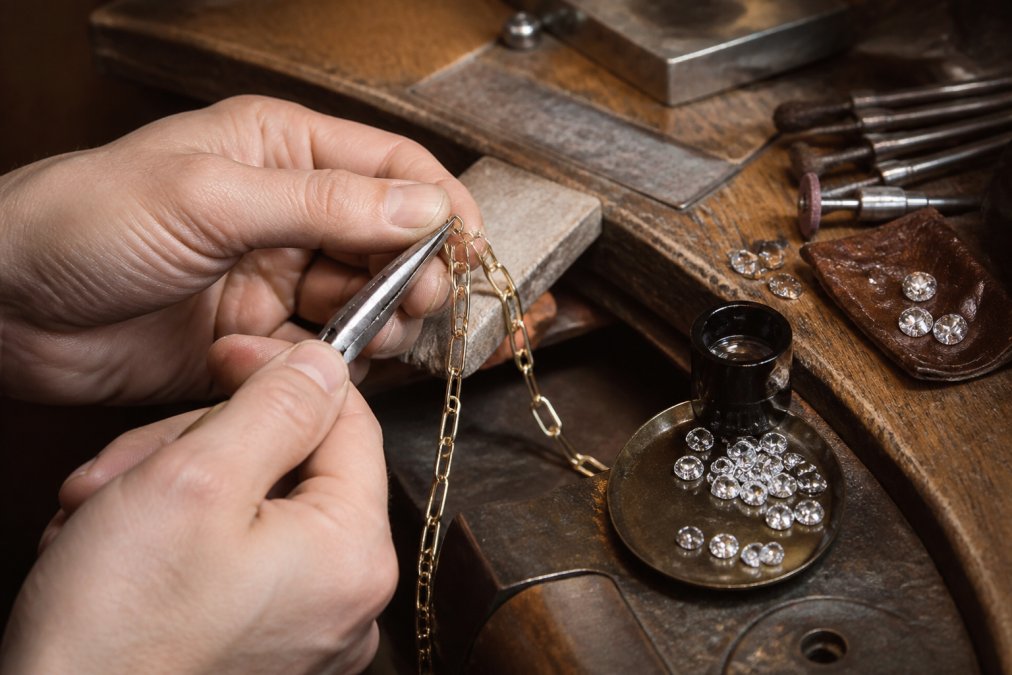
What ethical labor actually looks like on the bench
Labor is where most ethical claims quietly fail, because it is the hardest thing to verify from the outside. A studio that pays fair wages, limits hours, and trains apprentices produces better work over time, because hand-fabrication rewards skill accumulated across years. Ethical labor standards are not a cost center; they are why the craftsmanship is good.
- Named makers. Can the studio tell you who actually made your piece, by name? Anonymous bench work is the norm in mass production and the exception in good bespoke.
- Apprenticeship. Does the studio train? A workshop that only hires finished jewelers is not building the craft; one that trains is.
- Hours and pace. Rush timelines are usually absorbed by the bench, not the client. A studio that quotes realistic lead times is protecting its makers.
- Safety. Soldering, polishing, and pickling involve fumes, dust, and acids. Ventilation and protective equipment are basic, and their absence is a red flag.
The lapidary blind spot: cutting and polishing
Cutting and polishing deserve their own scrutiny, and this is the stage most ethical jewelry guides skip entirely. The lapidary, the person who turns a rough stone into a faceted one, sits at the weakest point of oversight in the gemstone chain. Rough stones are routinely mixed in trading hubs before cutting, so origin is often lost before the stone reaches a wheel, and cutting is frequently outsourced to low-cost workshops where silica dust, unventilated rooms, and piece-rate pay are common, and where no certification framework reaches.
- Who cuts and polishes the stones, and in which country?
- Is the cutting shop a named partner, or a broker's anonymous subcontractor?
- Does the cutter work on-site with the jeweler, or is the stone shipped out and returned?
- For antique stones, was the stone re-cut, or kept in its original cut?
How to Verify Ethical Claims Before You Commission a Piece
Verification comes down to asking specific questions and watching whether the answers get vaguer or sharper. Vague answers under pressure are the clearest signal you will get.
Use this checklist before you commit:
- Ask which refinery processed the gold and request chain-of-custody documentation
- Ask the origin of each gemstone and whether it is natural, lab-grown, or antique
- Ask who cuts and polishes the stones, and where that work happens
- Request the name of any certification the studio holds, then verify it independently
- Ask what happens if the piece needs repair in ten years
- Ask whether the design is genuinely bespoke or adapted from an existing pattern
Common Myths About Ethical Bespoke Jewelry Craftsmanship
Myth: Ethical jewelry is always more expensive. Ethical materials carry a premium, but bespoke work is priced around labor hours and stone quality, not a sustainability surcharge. The cost difference usually reflects handwork, not ethics.
Frequently Asked Questions
What does bespoke jewelry mean?
Bespoke jewelry is made for one person from the ground up: the design, metal, stones and finish are decided with you, then hand-fabricated in the studio rather than pulled from a display case. This is why it takes longer and costs more than ready-to-wear. It also means the piece fits your proportions, matches your existing jewelry and carries a documented material story, which is the practical side of ethical bespoke jewelry craftsmanship.
How can you verify the ethical sourcing of gemstones?
Ask for the paper trail, not the promise. Reputable studios can show supplier invoices, country-of-origin declarations and certification for conflict-free diamonds, plus details on antique or lab-grown stones. For recycled gold, request refining documentation that traces the metal back to post-consumer sources. If a maker cannot name where a stone came from and who cut it, treat the ethical claim as unverified. Written provenance is the standard to hold them to.
What is the difference between sustainable and ethical jewelry?
Sustainable jewelry focuses on environmental impact: recycled precious metals, lower energy use, waste reduction and a smaller carbon footprint. Ethical jewelry focuses on people and provenance: fair labor, child labor prohibition, conflict-free diamonds and supply chain accountability. The two overlap heavily. A piece made from recycled gold but cut in a workshop with unsafe conditions is sustainable on materials and weak on ethics, so ask about both.
Why choose bespoke jewelry over mass-produced pieces?
Bespoke pieces are built to be repaired and passed down, so they stay in use for decades instead of being replaced. You choose the metal, the stone and the proportions, which means fewer compromises and no unsold stock destroyed at the end of a season. The benefits of bespoke jewelry also include a documented material history, so an heirloom comes with its own record rather than a vague claim about being responsibly made.