

Quick Summary
Jewelry hallmarking marks, such as karat numbers, fineness figures, maker's initials and assay symbols, reveal a piece's metal type, purity and origin. Read them in layers, starting with purity, then maker, then assay office mark, and check each against a reliable reference. Treat a stamp as a claim to verify, not a guarantee.
- Gold purity marks include 24K or 999, 18K or 750, 14K or 585, and 10K or 417.
- Sterling silver is marked 925, meaning 92.5 percent pure silver.
- Platinum is commonly marked 950 Pt, meaning 95 percent platinum.
- Gold-filled and gold-plated pieces can carry 14K-style numbers, so read the qualifier words around them.
- A missing or worn mark does not prove a piece is fake; seek a qualified appraiser's opinion.
Table of Contents
- What Jewelry Hallmarks and Stamps Actually Tell You
- How to Read a Gold Hallmark Meaning Step by Step
- Jewelry Purity Marks for Silver and Platinum
- Maker's Marks, Initials and Signatures Explained
- Reading Faint, Worn or Hidden Marks: An Inspection Workflow
- Antique Jewelry Hallmarks and What to Do When a Mark Is Missing
- Booking a Verified Review of Your LÖF Piece
- Frequently Asked Questions
How to Read Jewelry Hallmarks and Stamps Correctly
Last Updated: October 30, 2026
What Jewelry Hallmarks and Stamps Actually Tell You
Jewelry hallmarking produces small marks struck into metal that point to its metal type, purity, maker, origin, or date. Learning to read these marks is a useful first step.
Most people assume a stamp is a guarantee. It is not.
Jewelry hallmarking rules also differ by country and by weight threshold (Hallmarking: practical guidance - summary). Guidance from the UK Government hallmarking practical guidance explains how the UK system works, and it is a useful place to start if you buy British pieces.
Watch out: A stamp that looks official is not proof on its own. Counterfeit marks exist, so check the mark against a reliable reference.
How to Read a Gold Hallmark Meaning Step by Step
Gold marks usually show purity as a karat number or a fineness number, but reading one correctly means separating a true hallmark from a general stamp.
Work through these steps in order:
- Locate the mark on the clasp, inside the band, on the back of the pendant, or along the inner edge of a chain link.
- Note every character, including numbers, letters, symbols, and the shape of any outline or cartouche around them.
- Separate the purity mark (14K, 18K, 585, 750) from the maker's mark (usually initials) and any assay office or country symbol.
- Check whether the piece shows a date letter or import mark, which can narrow down origin and period.
- Compare the full set against a trusted reference before deciding what it means.
A national hallmarking office or an official government guide is the best first reference because it matches the marks the law actually recognizes. Use a commercial guide only as a supplement, and treat any single mark as one piece of evidence rather than a verdict.
Karat numbers and fineness marks
Karat measures gold purity on a 24-part scale. Pure gold is 24K, while 18K gold is 18 parts gold out of 24, or 75 percent. Fineness uses a thousand-part scale instead, so 750 also means 18K.
Common gold marks include:
- 24K or 999: nearly pure gold, rarely used in jewelry because it is soft
- 22K or 916: about 92 percent gold, common in some Asian and Middle Eastern jewelry traditions
- 18K or 750: 75 percent gold, a common choice for fine jewelry
- 14K or 585: about 58 percent gold, durable and widely sold
- 10K or 417: about 42 percent gold, the lowest purity marked as gold in many markets
Higher karat means more gold and a softer metal. Lower karat means a harder, more scratch-resistant alloy. That trade-off matters for daily-wear rings and bracelets, where a 14K piece often outlasts an 18K piece of the same design.
Gold-filled and gold-plated markings
Gold-filled and gold-plated pieces can look nearly identical to solid gold, which is why these marks matter. Gold-filled jewelry has a thick layer of gold bonded to a base metal, usually brass or copper.
Look for terms such as "GF," "gold-filled," or a fraction like 1/20 14K, which points to a gold-filled piece where the gold layer is 1/20 of the total weight. "GP," "gold-plated," "gold vermeil," or "HGE" (heavy gold electroplate) points to a thinner layer.
Assay office and responsibility marks
In systems with compulsory hallmarking, the assay office mark identifies the laboratory that tested the piece, and the responsibility mark identifies the maker or importer who submitted it. Together they let you trace a piece back to a accountable party. When you read a gold hallmark, note whether an assay office mark is present: its absence on a piece sold as newly hallmarked is a reason to ask questions, not proof of fraud, since rules vary by country and weight threshold.
The article lists common gold purity marks and what each one means, so a reader can match a stamp to its metal content quickly.
| Mark | Gold content | Note |
|---|---|---|
| 24K or 999 | Nearly pure gold | Rarely used in jewelry because it is soft |
| 22K or 916 | About 92 percent gold | Common in some Asian and Middle Eastern traditions |
| 18K or 750 | 75 percent gold | Common choice for fine jewelry |
| 14K or 585 | About 58 percent gold | Durable and widely sold |
| 10K or 417 | About 42 percent gold | Lowest purity marked as gold in many markets |
Jewelry Purity Marks for Silver and Platinum
Silver and platinum follow their own marking systems. Learning these lets you judge metal content quickly.
- 925 or Sterling: 92.5 percent pure silver, the standard for sterling silver jewelry
- 900 or 800: lower silver content, common in European and older pieces
- 950 Pt or PLAT: 95 percent platinum, a dense and durable metal
- 900 Pt: 90 percent platinum, often mixed with iridium or ruthenium
A 925 mark is one of the most reliable signs of sterling silver in everyday jewelry. Platinum marks are usually stamped clearly because the metal is valuable and often tested. Still, always confirm unusual marks, since some pieces use plated or mixed metals with misleading wording.
Maker's Marks, Initials and Signatures Explained
A maker's mark identifies who produced the piece. It is usually a set of initials, a symbol, or a registered trademark.
Many makers used their initials alongside a country or assay symbol.
Signatures are different. A signature is often a name engraved or written by hand, not a stamp.
Watch out: A maker's mark identifies a company, not the metal content. A famous name does not guarantee solid gold or platinum.
Reading Faint, Worn or Hidden Marks: An Inspection Workflow
Many marks are faint from years of wear, polishing, or sizing. Hidden marks sit inside bands or under clasps.
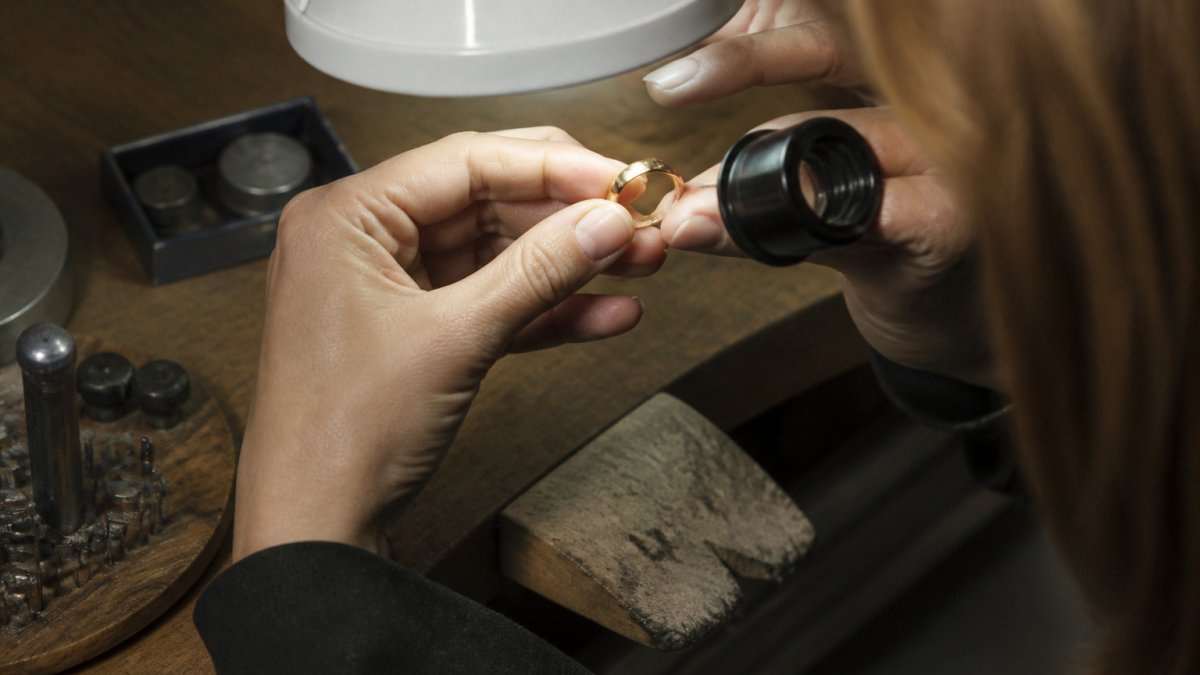
!Close-up of hands holding a gold ring under a daylight-balanced lamp beside a magnifying loupe, inspecting the inner band
Follow these steps:
- Use good daylight or a bright, neutral lamp. Avoid warm tungsten light, which can hide fine detail.
- Clean the area gently with a soft cloth to remove dirt, but do not scrub or use abrasive polish.
- Use a 10x jeweler's loupe to read small or worn characters. A phone camera zoomed in can supplement, but a loupe gives truer depth.
- Check the inside of rings, the back of pendants, beneath clasps, and along chain end caps.
- Photograph the mark from several angles with a neutral background so you can compare later.
- Note the spacing, font shape, depth of strike, and any symbols or outlines around the mark.
If a mark is still unreadable after these steps, stop. Forcing a loupe or cleaning chemicals onto a worn stamp can erase it for good.
What a stamp can and cannot prove
A stamp is a claim, not a test result. It can be misleading, counterfeit, incomplete, or worn. A "925" mark on a silver-colored ring does not confirm the core metal, and a "750" mark does not rule out a plated or hollow construction. Distinguish the stamp from independent testing: an assay, X-ray fluorescence (XRF) scan, or acid test performed by a qualified jeweler gives evidence about the metal itself, while the stamp only records what someone asserted.
When a mark is ambiguous or absent
Use a short decision tree rather than guessing:
- Mark is clear and complete: record it, compare against an official reference, and keep the photo with your purchase records.
- Mark is partial or worn: photograph it, note what is legible, and have a jeweler read it under magnification before drawing conclusions.
- Mark is absent: do not assume the piece is fake. Look at construction, wear patterns, style, and stone cutting, then seek a qualified appraiser's opinion.
- Mark conflicts with the piece's appearance: treat the metal as unverified and request professional testing before buying, selling, or insuring.
A qualified appraiser can examine the piece under magnification and, where appropriate, arrange metal testing. Ask for a written description of metal and stone content, and keep records of any repairs, since resizing can change where marks appear or remove them entirely.
Documenting marks for insurance and resale
Good records make a mark more useful later. Photograph each mark, note its location and what you read, and file it with receipts and appraisal documents. For insurance and resale, a mark supports the description but does not establish value on its own; condition, maker reputation, design, and independent appraisal do that work. When you sell, present the mark alongside any testing or appraisal record so a buyer can verify rather than trust.
Antique Jewelry Hallmarks and What to Do When a Mark Is Missing
Antique pieces may carry no hallmark at all, or only a partial one. Many older items were made before modern marking laws, and some were repaired or resized, which can remove or move a stamp.
A missing mark does not prove a piece is fake. It means you need other evidence. Look at construction, wear patterns, style, and the cut of any stones.
When a mark is missing or ambiguous, consider these options:
- Ask a qualified appraiser to examine the piece under magnification
- Request a written description of metal and stone content before you buy
- Compare construction and tooling with known examples from the same era
- Keep records of any repairs, since resizing can change where marks appear
If a resized ring has lost its mark, a reputable jeweler may be able to confirm metal type through testing.
Booking a Verified Review of Your LÖF Piece
For current details on review options, please visit our website or contact us directly.
Last Updated: October 30, 2026
Frequently Asked Questions
What do the numbers stamped on jewelry mean?
Numbers such as 585 or 750 indicate the fineness of the metal, meaning the proportion of pure metal in the alloy. 585 denotes 58.5 percent gold, which is 14 karat, and 750 denotes 75 percent gold, which is 18 karat. For silver, 925 indicates sterling silver, which is 92.5 percent pure silver. The number shows metal content only; it does not confirm the piece's age, maker or origin, which other marks in the same set may reveal.
How can you tell if a jewelry stamp indicates real gold?
Look for a fineness or karat mark on the piece, then check whether it is accompanied by a maker's mark or assay mark where the jurisdiction requires one. A stamp is a strong clue, not proof on its own. If a piece is marked 14K or 585 but feels unusually light or tarnishes in an unusual way, have it tested by a qualified jeweler or independent assay service before relying on the mark.
What is the difference between a hallmark and a maker's mark?
A hallmark is an official or standardised set of marks that can include a fineness mark, an assay office mark and a date letter, depending on the country. A maker's mark identifies the manufacturer or designer, usually as initials or a symbol. Many pieces carry both. Hallmarking systems and their requirements vary by jurisdiction, so the meaning of a given mark depends on where the piece was made and assayed.
Can jewelry be genuine if it has no hallmark?
Yes. Many jurisdictions only require hallmarking above a certain weight or for specific metals, and small or older pieces are often unmarked. A missing mark is not evidence of fraud, but it does mean you cannot confirm metal content from the piece itself. In that case, ask the seller for documentation or arrange independent testing before purchase.
