

Table of Contents
- What Makes an Antique Diamond Different from Modern Stones
- The Girdle Frost Test: Your First Verification Step
- Examining Facet Patterns and Hand-Cut Characteristics
- Thermal Conductivity and Diamond Tester Methods
- The Culet Examination and Patina Assessment
- How to Identify Old Mine Cut Diamonds
- Antique Diamond Certification Process and GIA Authentication
- Understanding Antique Diamond Jewelry Appraisal Cost
Last Updated: August 20, 2026
What Makes an Antique Diamond Different from Modern Stones
An antique diamond is a stone cut and polished by hand before modern mechanical cutting techniques became standard, typically before 1920. These diamonds possess distinctive characteristics that set them apart from contemporary stones.
The most obvious difference lies in the cutting style. Antique diamonds were shaped using hand tools and eyesight alone, meaning no two stones are identical. Modern diamonds follow precise mathematical formulas that produce uniform facet patterns. An antique stone's facets are often asymmetrical, with varying angles that catch light differently than a contemporary brilliant cut.

Antique diamonds typically show natural wear on the girdle, the widest part of the stone, where settings once held it. They may display girdle frost, a frosted or slightly textured surface that develops from years of contact with metal. The way light moves through an antique stone feels different to the eye, older cutting techniques prioritized fire and brilliance differently than today's standards, often showing more rainbow sparkle and less pure white brilliance.
At LÖF, we work exclusively with antique diamonds sourced ethically and authenticated rigorously, because understanding these differences helps you recognize authentic stones and make informed decisions about your purchase.
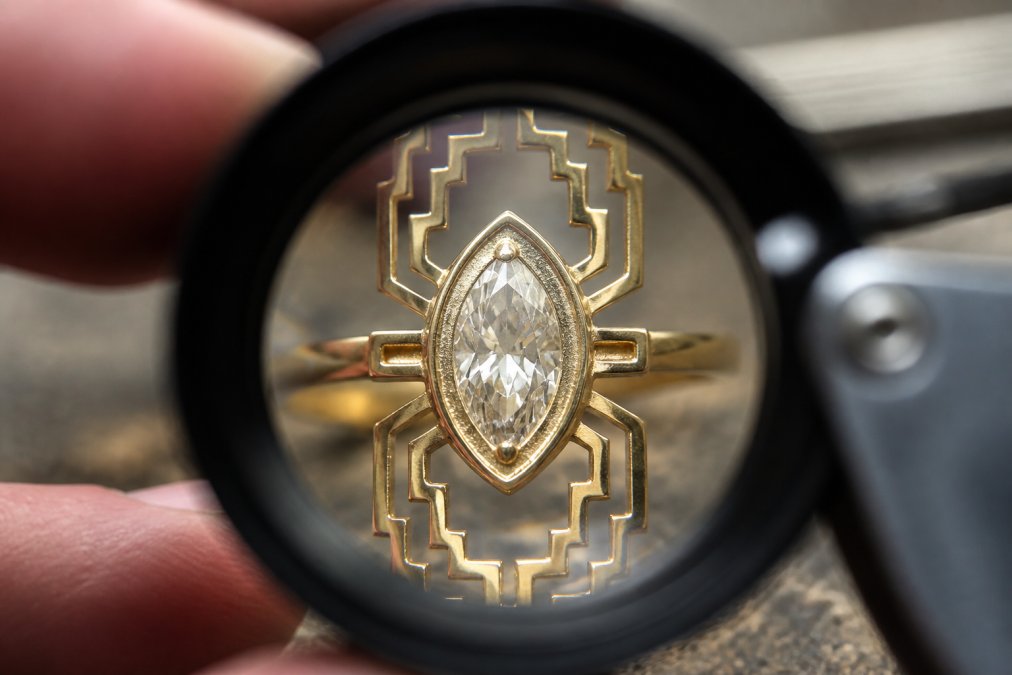
The Girdle Frost Test: Your First Verification Step
The girdle frost test is one of the most reliable initial checks you can perform yourself without specialized equipment. The girdle, the narrow band around the diamond's widest point, reveals the stone's age and authenticity.
What the Girdle Tells You
A frosted girdle appears slightly textured or matte, almost like fine sandpaper under magnification. This frosting develops naturally over decades as the girdle contacts the metal of the setting. Modern diamonds have polished girdles that reflect light like mirrors. A polished girdle on a stone represented as antique is a red flag.
The frosting isn't uniform, it appears in patches where the setting made contact, creating an irregular pattern. This randomness authenticates it; a consistent frosted appearance across the entire girdle suggests artificial aging or a modern stone treated to look old.
How to Perform the Test Safely
You'll need a jeweler's loupe, which magnifies 10 times. Hold the loupe about an inch from your eye and position the diamond so light hits the girdle at an angle. Rotate the stone slowly, watching how the girdle surface catches light. A frosted girdle scatters light diffusely, while a polished girdle creates sharp reflections. If examining a stone in a setting, ask the jeweler to remove it temporarily so you can inspect the entire girdle. Antique diamonds sometimes show patchy frosting, with some areas polished and others frosted, this mixed appearance indicates authentic wear and resetting over the stone's lifetime.
Examining Facet Patterns and Hand-Cut Characteristics
The facet pattern reveals a diamond's cutting era as clearly as a fingerprint. Hand-cut stones display asymmetries that authenticate an antique diamond.
Old European Cut vs. Old Mine Cut Diamonds
The Old European cut emerged around 1890 and remained popular through the 1920s. It features a round shape with 58 facets, a table comprising 40-50% of the diamond's width, and steeper crown angles that create a distinctive warm, glowing quality.
The Old Mine cut predates the European style, originating in the 1700s and dominating until the 1890s. It's cushion-shaped rather than round, with a larger table and fewer facets. An Old European cut appears rounder when viewed from above, while an Old Mine cut shows a more cushion-like silhouette. Under magnification, the Old European shows more facets and organized pattern, whereas the Old Mine displays more chaotic arrangement.
Spotting Hand-Cut Asymmetries
Modern diamonds cut by computer-controlled lasers show perfect symmetry. Hand-cut antique diamonds never achieve this precision. When examined under magnification, you'll notice facets that don't align perfectly. Look specifically at the crown facets, the triangular facets visible from the top. In an antique cut, these triangles vary slightly in size and angle. In a modern brilliant cut, they're uniform. This comparison alone can quickly separate authentic antique diamonds from modern stones represented as old.
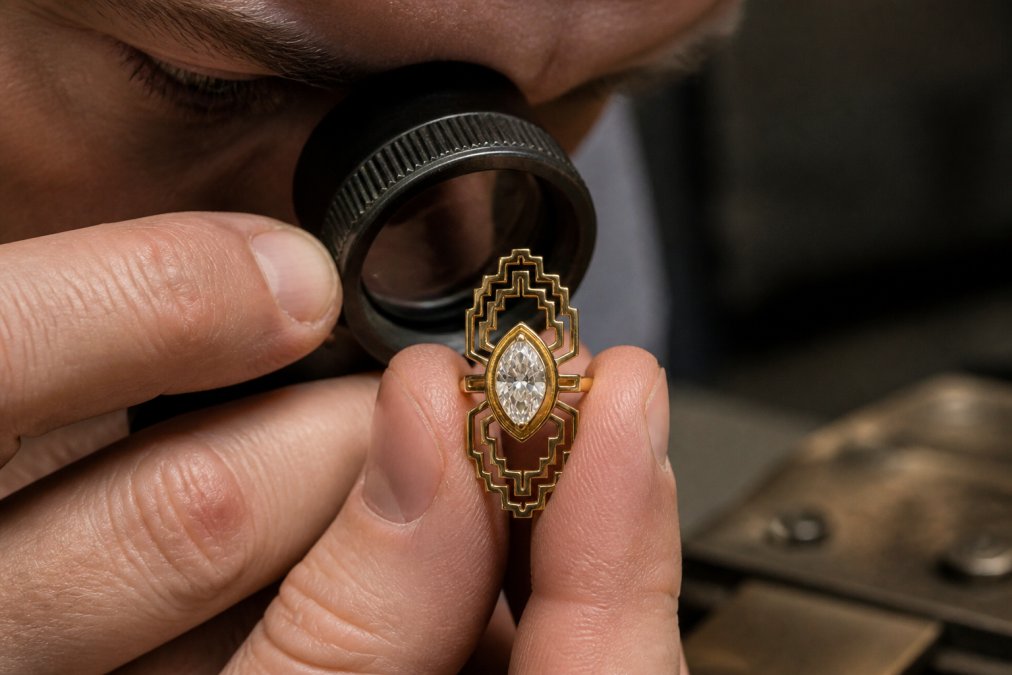
Thermal Conductivity and Diamond Tester Methods
Diamond testers rely on thermal conductivity, the speed at which heat moves through a material. Diamonds conduct heat far more efficiently than other gemstones, allowing these devices to distinguish them from imitations.
How Thermal Probes Work
A thermal probe applies heat to the stone's surface and measures how quickly that heat dissipates. A real diamond absorbs and conducts heat rapidly, causing the probe's temperature to drop quickly. Moissanite, a lab-created stone, conducts heat almost as efficiently as diamond, which can challenge older thermal probe models. Modern thermal probes have been calibrated to detect moissanite. Professional gemologists warm stones to room temperature before testing for accuracy.
Distinguishing Real Diamonds from Moissanite and Cubic Zirconia
Cubic zirconia fails thermal testing dramatically because it's a poor heat conductor. Moissanite is the real challenge, it's a silicon carbide stone that conducts heat almost as well as diamond. A thermal probe alone may not distinguish between them reliably. However, moissanite shows birefringence, a doubling of light rays visible under magnification that creates a subtle rainbow effect. A diamond shows no birefringence. For antique diamonds specifically, moissanite wasn't commercially produced until 1998, so if you're verifying an antique stone, moissanite isn't a concern.
The Culet Examination and Patina Assessment
The culet is the tiny facet at the bottom point of a diamond. In modern diamonds, it's either absent or extremely small. In antique diamonds, it's often larger and more pronounced, carrying visible evidence of the stone's age.
Reading the Culet for Age Clues
An antique diamond's culet frequently shows a flat surface rather than coming to a sharp point. This flat culet was intentional; cutters believed it reduced chipping risk. Examine the culet under magnification. An authentic antique culet shows wear patterns and microscopic scratches from centuries of handling. The surface isn't mirror-polished like a modern culet would be. Instead, it shows a slightly textured appearance with fine scratches running in various directions. A polished, pristine culet on a stone claimed to be antique suggests recent repolishing.
Natural Wear and Patina Patterns
Patina on an antique diamond develops unevenly across the stone's surface. Areas exposed during setting show more wear than protected areas. The crown typically shows more patina than the pavilion, which was hidden inside the setting. Authentic patina appears as subtle cloudiness or frosting in patches, never uniformly across the entire stone. Beware of stones showing uniform patina coverage, which suggests artificial aging or treatment.
How to Identify Old Mine Cut Diamonds
Old Mine cut diamonds represent the earliest mechanized cutting era, roughly 1700s through 1890s. They're distinctly different from Old European cuts and modern brilliants.
An Old Mine cut appears cushion-shaped when viewed from above, with rounded corners rather than sharp angles. The table is large, often 50-60% of the stone's width, much larger than modern proportions. The crown is high and steep, giving Old Mine diamonds their characteristic warm, glowing appearance. The facet arrangement is notably irregular, with triangular facets that vary in size and pavilion facets that don't align with mathematical precision. Look for the "chunky" appearance that Old Mine cuts are known for, with large visible facets creating a faceted appearance rather than the smooth, glowing quality of modern brilliants.
Antique Diamond Certification Process and GIA Authentication
Professional certification provides the most reliable verification of antique diamond authenticity. The Gemological Institute of America (GIA) and American Gem Society (AGS) are the primary certifying bodies that issue grading reports for diamonds.
What GIA and AGS Certificates Tell You
A GIA certificate documents the diamond's carat weight, color grade, clarity grade, and cut characteristics. For antique diamonds, the cut section is particularly valuable, the certificate identifies the cutting style and notes unusual characteristics. The certificate includes a diagram showing the diamond's proportions and facet arrangement, which is crucial for antique stones because it documents the original cutting pattern. GIA certificates also note surface characteristics visible under magnification, creating a permanent record of the stone's authentic appearance at certification.
When Certification Matters Most
Certification is essential when making a significant financial investment in an antique diamond. If purchasing a stone worth more than a few thousand dollars, certification is non-negotiable. Certification also matters when buying from sources you don't know personally. However, certification isn't required for every antique diamond purchase. Smaller stones or pieces where the investment is modest may not justify the certification cost. The verification methods covered earlier provide sufficient authentication.
Understanding Antique Diamond Jewelry Appraisal Cost
Professional appraisals for antique diamonds typically range based on the stone's size, complexity, and the appraiser's expertise.
What Professional Appraisals Include
A comprehensive appraisal documents the diamond's dimensions, weight, color, clarity, and cutting style. The appraiser examines the stone under magnification, tests it with specialized equipment, and compares it against reference standards. For antique diamonds, the appraisal includes assessment of the cutting era and style, documentation of signs of age, patina, wear, and any evidence of recutting or repolishing. The appraisal provides an estimated value for insurance purposes and becomes your documentation if you ever need to file an insurance claim or prove authenticity during resale.
Why Investment in Verification Protects Your Purchase
Spending on professional verification protects you from costly mistakes. The cost of certification or appraisal is typically 0.5-2% of the stone's value. For a stone worth tens of thousands of dollars, this investment is minimal compared to the protection it provides.
At LÖF, we recognize that purchasing antique diamonds requires confidence in authenticity. Our pieces like The Maze Ring and The Tillie Ring feature antique diamonds that have been carefully selected and authenticated. When you invest in heirloom-quality jewelry crafted with ethically sourced antique stones and sustainable 18k gold or platinum, you're building a piece designed to pass through generations.

Verifying antique diamond authenticity protects one of the most significant jewelry investments you'll make. Whether examining a stone you already own or evaluating a potential purchase, the methods outlined here, girdle frost testing, facet pattern analysis, thermal conductivity checks, and culet examination, provide reliable ways to assess authenticity without expensive equipment. For stones representing substantial financial investment, professional certification through GIA or AGS offers definitive authentication and permanent documentation.
| Verification Method | Best For | Time Required | Equipment Needed |
|---|---|---|---|
| Girdle Frost Test | Initial authenticity check | 5-10 minutes | 10x loupe |
| Facet Pattern Examination | Identifying cutting era | 10-15 minutes | 10x loupe, reference images |
| Thermal Conductivity Testing | Distinguishing from imitations | 2-3 minutes | Diamond tester device |
| Culet and Patina Assessment | Confirming age and wear | 10-15 minutes | 10x loupe |
| Professional Certification | Investment-level verification | 2-4 weeks | GIA/AGS submission |
Gemological Institute of America's diamond grading standards
American Gem Society's gemstone authentication guidelines
Smithsonian Magazine's guide to antique diamond cuts and characteristics
Frequently Asked Questions
How much does it cost to verify an antique diamond?
Professional antique diamond appraisal costs typically range from £150 to £400 depending on the stone's complexity and your gemologist's expertise. For high-value pieces or certification through GIA or AGS, expect £300-£600. This investment protects against overpaying for inauthentic or misrepresented stones. Many luxury jewelers, including those specializing in antique diamonds like LÖF, can provide guidance on reputable appraisers in your area.
What is the difference between an antique diamond and a vintage-style diamond?
Antique diamonds are genuine stones cut and mined before 1920, featuring hand-cut facets, natural patina, and characteristic girdle frosting. Vintage-style diamonds are modern stones cut to mimic antique proportions (Old European or Old Mine cuts) but lack the aged characteristics and hand-cut asymmetries. Antique diamonds typically command higher prices due to scarcity and historical provenance, while vintage-style stones offer similar aesthetics at lower cost. LÖF sources genuine antique diamonds for signature pieces like The Maze Ring and The Tillie Ring.
Can you test an antique diamond at home without damaging it?
Yes. The girdle frost test, water displacement test, and loupe examination are non-destructive home verification methods. Thermal conductivity testers (diamond testers) are also safe when used correctly on the stone's table or pavilion. Avoid abrasive tests or extreme temperature changes. However, these methods provide preliminary screening only. For definitive authentication of high-value antique diamonds, professional gemological examination with proper magnification and specialized equipment is essential to confirm authenticity and assess clarity, carat weight, and cut characteristics.
Do antique diamonds have GIA certificates?
Antique diamonds may have GIA or AGS certificates if they were submitted for grading after 1950 (when GIA was founded). Many older stones lack certification because they were graded informally or traded before formal gemological standards existed. GIA certificates for antique diamonds confirm authenticity, carat weight, clarity grade, and color grade, but do not assess whether the stone is truly antique, only that it meets current grading standards. Reputable dealers like LÖF can provide documentation and appraisal history for antique pieces, even without original GIA certification.
This article was written using GrandRanker