

Last Updated: November 26, 2026
Quick Summary
Choose ethical hoop earrings by verifying the supply chain before you fall for the design: ask who mined or recycled the metal, who made the piece, and what proof the seller can show. Ethical hoop earrings should come with documented sourcing, labor and environmental standards rather than vague adjectives.
- Jewelry is ethical when sourcing, labor and environment can all be documented by the seller.
- Solid 18k gold is a durable choice for everyday wear because the alloy runs through the piece.
- Hoop sizes range from roughly 10mm huggies to 60mm statement hoops, with weight climbing fast.
- A hinged closure snaps shut and sits flush, making it the most secure option for daily wear.
- Divide price by expected days of wear, since cost per wear favors solid metal over plated hoops.
Table of Contents
- How Do You Choose Ethical Hoop Earrings?
- What Makes Jewelry Ethical?
- Ethical Gold Hoop Earrings: Metals, Purity and Finishes
- Sustainable Hoop Earrings: Environmental Trade-Offs by Material
- Hoop Earring Sizes, Weight and Comfort for Daily Wear
- Lifecycle Cost, Repairability and End-of-Life
- Choose Your Ethical Hoop Earrings at LÖF
- Frequently Asked Questions
How Do You Choose Ethical Hoop Earrings?
Choose ethical hoop earrings by verifying the supply chain before you fall for the design. That means asking who mined or recycled the metal, who made the piece, and what proof the seller can show. LÖF builds its jewelry from 18k gold and platinum, set with ethically sourced gemstones and antique diamonds, so the answer to "how do you choose ethical hoop earrings" starts with evidence rather than adjectives.
Most buying guides treat "ethical" as a mood. It is not. It is a set of claims you can test, and this guide shows you exactly how to test them.
Below, we break down what makes jewelry ethical, how to audit a supply chain in ten minutes, and which metal and size choices hold up to daily wear for years.
What Makes Jewelry Ethical?
Jewelry is ethical when its metal and stones are sourced without funding conflict or severe environmental harm, its makers work under fair conditions, and the seller can document both. Those three pillars, sourcing, labor and environment, are the usual basis for the definition.
Sourcing, Labor and Environmental Standards
Start with sourcing. Recycled gold and recycled silver avoid new mining entirely, while antique diamonds and estate stones re-enter circulation instead of being dug up again. Responsible mining certifications matter for newly extracted metal, but they vary widely in rigor.
Labor standards are harder to see. Artisan-made and small-batch production usually mean shorter, more traceable chains. Ask who physically made the earrings and where.
Environmental impact follows the metal. Recycled precious metals carry a far lighter footprint than freshly mined ones, though recycling still uses energy and chemicals.
A Practical Supply-Chain Verification Checklist
Use this checklist before you buy. A serious seller answers most of it without hesitation:
- Ask for the metal's origin: recycled, certified fair-mined, or undisclosed
- Request the specific gold purity, such as 18k or 14-karat gold
- Ask whether gemstones are traceable to a named supplier or country
- Confirm who manufactured the piece and in which country
- Request any third-party certification or audit documentation
- Check whether the brand publishes a supply-chain transparency statement
- Ask about the closure type and whether it is repairable
- Confirm the return window before committing
If a seller deflects on origin but talks endlessly about "conscious luxury," that is your answer. For a deeper walkthrough, our guide on how to verify ethical jewelry sourcing breaks the audit into step-by-step questions you can send directly to a brand.
Ethical Gold Hoop Earrings: Metals, Purity and Finishes
The metal you choose determines durability, cost per wear, and how the earring ages. Solid gold in 18k is a durable choice for everyday wear because the alloy runs through the entire piece, not just a coating.
Solid Gold, Gold Vermeil, Gold Fill and Sterling Silver
Here is how the four main options compare:
| Material | What It Is | Durability | Best For |
|---|---|---|---|
| Solid 18k gold | 75% gold alloyed through the piece | Decades, repairable | Daily wear, heirlooms |
| Gold vermeil | Sterling silver base, thick gold plating | Years, plating can wear | Lower-budget gold look |
| Gold fill | Base metal bonded with thick gold layer | Several years | Mid-budget everyday |
| Sterling silver | 92.5% silver alloy | Years, tarnishes | Sensitive skin, casual wear |
Gold plating is the thinnest option and the first to fade, especially on hoops that rub against hair and skin. Gold vermeil sits above it with a legally defined minimum thickness in most markets. Gold fill holds up better than plating but still is not solid.
Sustainable Hoop Earrings: Environmental Trade-Offs by Material
"Sustainable" is the least regulated word in jewelry. The honest version of this section compares three metal pathways, newly mined, recycled, and reclaimed, and explains where each claim stops being useful. The goal is not to find a perfect material but to understand which trade-offs you are accepting.
Newly mined vs. recycled vs. reclaimed metal
Newly mined precious metal carries the heaviest footprint: land disturbance, water use, chemical processing, and community impacts at the mine site. Certification schemes such as Fairmined and Fairtrade Gold reduce harm and improve miner conditions, but they do not make extraction free of impact.
Recycled metal avoids new extraction. The limit is refining: recycled gold and silver still pass through energy-intensive refining and, in some cases, chemical processes. Recycled content is a real win, not a zero-impact one.
Reclaimed and antique metal, old jewelry melted and reworked, behaves like recycled metal with an added provenance story. It is the most circular option available, and it is why antique stones and estate pieces carry a strong environmental case.
The plating and finishing problem
Plating and vermeil introduce a different trade-off. Gold plating uses chemical baths and, on hoops that rub against hair and skin, wears through in a few years. When plating fails, the piece is usually discarded rather than repaired, which multiplies its footprint across replacements.
How to read a sustainability claim
Treat these claims as tiers of evidence. Strongest: a named certification with a checkable certificate number, plus a published supplier list. Middle: a specific, verifiable statement such as "100% recycled gold from [refiner]." Weakest: unqualified words like "eco-friendly," "conscious," or "green" with no mechanism behind them. A brand that can explain its refining partner and its factory is making a claim you can evaluate; a brand that cannot is making a mood.
For a fuller picture of extraction's effects, read our breakdown of the environmental impacts of precious metal mining.
Hoop Earring Sizes, Weight and Comfort for Daily Wear
Hoop earring sizes range from roughly 10mm huggies to 60mm statement hoops, and the right diameter depends on your earlobe, your hair, and how long you wear them. Comfort comes down to three things: weight, thickness, and how the closure sits against your ear.
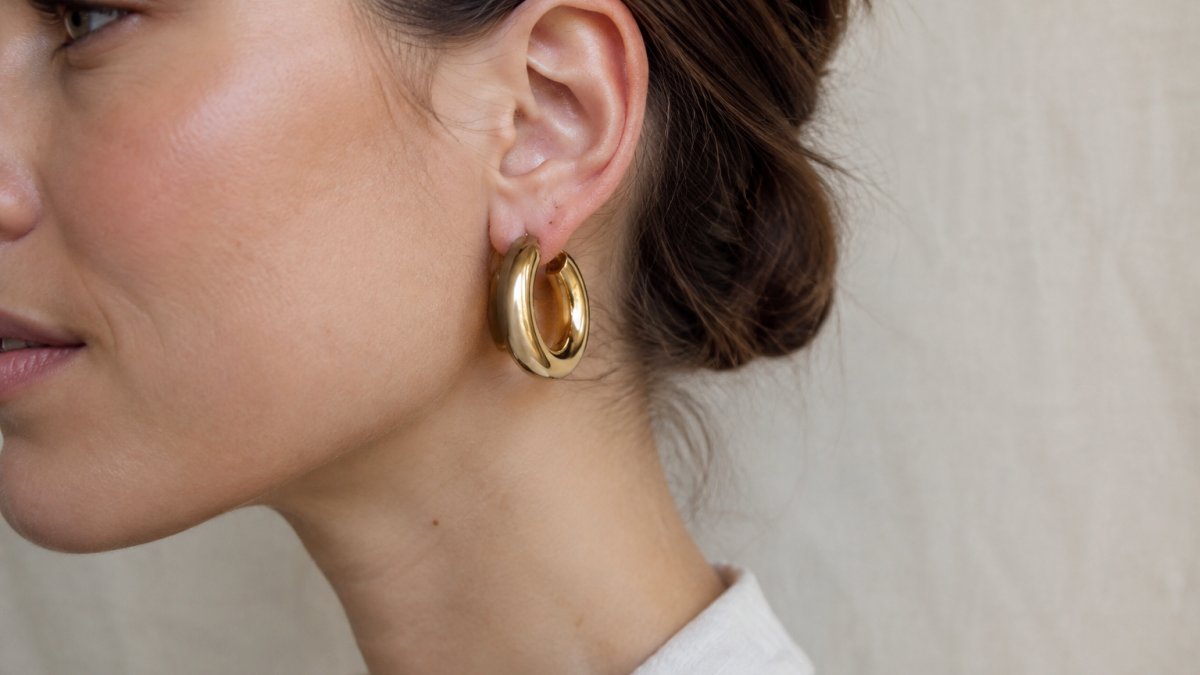
A 10mm huggie earring hugs the lobe and disappears under hair, which makes it the safest pick for sleeping and office days. Diameters around 20-30mm read as classic hoops. Anything above 40mm becomes a statement, and weight climbs fast with thickness.
Lightweight construction matters more than most buyers expect. Heavy hoops pull the piercing over hours, and thin earlobes feel it first.
Closures, Thickness and Sensitive Ears
Closure type decides both security and comfort. A hinged closure snaps shut and sits flush, which is the most secure option for daily wear. A secure clasp matters if you plan to wear the same pair constantly.
Skin sensitivity is where material disclosure becomes personal. Nickel-free construction and solid gold reduce reaction risk, while plated base metals are the usual culprit behind irritation. Ask what the post and hinge are made from, not just the visible hoop.
For care routines that keep gold looking new, our guide on how to care for 18k gold earrings covers cleaning, storage and what to avoid.
Lifecycle Cost, Repairability and End-of-Life
Cost per wear is the only price comparison that matters. A plated hoop at a low price that lasts two years costs more annually than a solid gold pair worn for decades. Divide the price by the number of days you expect to wear the earrings, and the math usually favors solid metal.
Repairability extends that math further. Solid gold hoops can be re-polished, re-shaped and re-soldered by a jeweler. Plated pieces cannot be economically re-plated at small scale, so they go to landfill.
End-of-life options for fine jewelry are strong: resale, inheritance, or melting and reworking. That circularity is the practical case for buying fewer, better pairs.
Choose Your Ethical Hoop Earrings at LÖF
LÖF offers jewelry crafted from 18k gold and platinum, set with ethically sourced gemstones and antique diamonds.
The Édith Huggies have a 10mm diameter. The Margueritte Hoops are chunky solid yellow gold. The Édith Hoops have an 8mm hoop width and 30mm diameter, and the Baker Hoops pair 18k gold with black enamel.
If you are still deciding between silhouettes, our guide on gold stud or hoop earrings walks through which shape suits which routine.
The hardest part of buying ethical jewelry is not finding something beautiful. It is finding a seller who will answer the origin question without flinching. LÖF is a luxury jewelry maison founded by jeweler and designer Morgan Mackintosh, offering sustainable fine jewelry in 18k gold, platinum, ethically sourced gemstones and antique diamonds. Browse the collection and choose a pair that suits you.
Browse the full earrings collection to compare silhouettes, diameters and metals side by side.
Frequently Asked Questions
Should I get 8mm or 10mm hoop earrings?
An 8mm hoop sits close to the lobe and reads as a subtle everyday pair, while a 10mm hoop adds visible presence without becoming a statement piece. If you want one pair that works from morning to evening, 10mm is the more flexible middle ground. For a second or third piercing, 8mm usually fits better because it will not crowd the neighbouring hole. Check the actual diameter listed on the product page rather than judging from photos, since close-up shots make small hoops look far larger than they are.
What should I look for when buying ethical hoop earrings?
Ask four questions before you pay. First, what metal is used and at what purity, for example solid 18k gold rather than plating over brass. Second, whether the gold or silver is recycled or traceable, and whether the brand will say where it came from. Third, how the stones were sourced and whether the brand discloses treatment and origin. Fourth, whether the piece can be repaired. A brand that answers all four in writing is doing more than most. Vague words like conscious or responsible without detail are a warning sign.
Are recycled gold hoop earrings more ethical?
Recycled gold avoids new mining, so it sidesteps the land disturbance, water use and labour risks tied to extraction. That makes it a meaningful improvement, but it is not automatically fair-trade gold: recycling says nothing about who refined it or under what conditions. The stronger claim combines recycled or repurposed metal with a named refiner and disclosed labor standards. Ask a brand which of those it can evidence, and treat recycled as one useful data point rather than the whole answer.
Which metals are best for sustainable hoop earrings?
Solid 18k gold and platinum are solid metals rather than plated or bonded layers. Sterling silver is a good lower-cost option but tarnishes and needs more care. Gold vermeil and gold fill are plating or bonded layers over a base metal, so they wear through with daily use and cannot be restored the way solid metal can. If you have sensitive ears, solid gold or platinum with a nickel-free finish is the safer choice.
