

Table of Contents
- Ethical Luxury Brands for Women Over 50: What Actually Matters
- How to Identify Ethical Fashion Brands Without Falling for Greenwashing
- Sustainable Luxury Brands for Women: Quality, Fit, and Age-Inclusive Sizing
- Quiet Luxury Brands for Women Over 50: Timeless Over Trendy
- Ethical Jewelry Brands: What to Look for in Recycled Metals and Traceable Stones
- Cost Per Wear, Care, Repair, and Resale: Getting Real Value from Ethical Luxury
- Conclusion: Building a Wardrobe You Can Pass Down
- Frequently Asked Questions
Last Updated: October 14, 2026
Ethical Luxury Brands for Women Over 50: What Actually Matters
Ethical luxury brands for women over 50 are labels that combine high-end craftsmanship with verified responsible production, traceable materials, and designs built to last decades rather than seasons. For a woman who has spent years building a wardrobe, the question is no longer "what's trending" but "what will I still wear, and be proud to wear, in ten years."
That shift changes how you should shop. At LÖF, we work with 18k recycled gold, platinum, and antique diamonds, so we think about longevity constantly. And the honest truth is that most "sustainable luxury" marketing is unverifiable. Below, we'll show you how to separate proof from packaging, which certifications actually mean something, and how to calculate what a piece really costs you per wear.
How to Identify Ethical Fashion Brands Without Falling for Greenwashing
Greenwashing is when a brand markets itself as sustainable without verifiable evidence behind the claims. The fix is simple: ask for documents, not adjectives. A brand that genuinely sources responsibly will happily show you chain-of-custody records, certification numbers, and named suppliers. One that won't is telling you something.
Certifications and Proof to Look For
Third-party certification is the fastest way to cut through marketing language, because an outside body has audited the claim. Look for named certifications rather than vague phrases like "consciously made." Fashion Revolution's Fashion Transparency Index scores major brands on exactly this kind of disclosure, and the gap between the best and worst performers is wide.
For jewelry specifically, ask about recycled metal content and stone provenance. Reputable houses can tell you where their gold came from and whether their diamonds are antique, reclaimed, or newly mined under a recognized responsible-sourcing framework.
Questions to Ask Before You Buy
- Can you show me certification for this material or stone?
- Where was this made, and by whom?
- Is the metal recycled, and what percentage?
- How do you handle repairs and resizing after purchase?
- What happens to this piece at the end of its life?
A brand that answers all five without hesitation is worth your money. One that deflects to a sustainability landing page is not.
Sustainable Luxury Brands for Women: Quality, Fit, and Age-Inclusive Sizing
Sustainable luxury brands for women earn the label through materials and construction, not marketing. The brands worth your attention share three traits: they publish their material sourcing, they design for a real body over time, and they offer repair or resizing rather than pushing replacement.
Fit matters more as you get older, and it's where most luxury brands quietly fail. Sizing that assumes a 25-year-old frame, shoulder seams that don't allow for layering, and jewelry proportions that overwhelm a smaller frame are all common problems.
- Adjustability in closures, straps, and bands
- Proportion guidance rather than one-size photography
- Resizing and repair services offered as standard
- Fabric and metal weight that holds structure without stiffness
For jewelry, proportion is everything. A bold architectural ring reads as a statement on a larger hand and as an heirloom piece on a smaller one, so knowing your measurements before you buy online saves returns and disappointment.
Quiet Luxury Brands for Women Over 50: Timeless Over Trendy
Quiet luxury brands for women over 50 prioritise cut, material, and finish over visible logos. This is the aesthetic that ages best, because it was never tied to a season in the first place. A well-cut coat or a solid gold band doesn't date the way a logo-heavy piece does.
The throughline here is slow fashion: fewer pieces, better made, worn repeatedly. That approach lowers your environmental impact and your cost per wear at the same time. It also means the piece you buy this year still works with what you bought five years ago, which is the quiet advantage of timeless design.
How to Tell Real Quiet Luxury from Minimalist Marketing
Where quiet luxury goes wrong is when "understated" becomes an excuse for thin materials and high prices. Four checks separate a genuinely well-made piece from one coasting on minimalism:
- Weight and hand-feel. A quality wool coat has heft; a cheap one feels light and papery. Pick it up before you trust the price tag.
- Closure quality. Real horn buttons, metal zips, and reinforced buttonholes cost more to make and last longer. Plastic buttons on a luxury garment are a warning sign.
- Finishing inside. Look at the lining, the seam allowances, and whether the hem is hand-finished or overlocked. The inside tells you more than the outside.
- Repairability. A brand that offers alterations, re-lining, and re-soling is signalling that the piece is meant to be kept, not replaced.
Cost Per Wear: The Quiet Luxury Math
Quiet luxury only pays off if you actually wear the piece. The calculation is simple: purchase price divided by the number of times you wear it.
| Piece | Price | Wears per year | Years worn | Cost per wear |
|---|---|---|---|---|
| Well-cut wool coat | High | 60 | 10 | Low |
| Trend jacket | Low | 8 | 1 | High |
| Solid gold band | High | 300 | 20 | Very low |
| Seasonal statement piece | Mid | 3 | 1 | Very high |
The expensive item is often the cheaper one. This is the calculation that reframes ethical luxury entirely: durability and timeless design aren't just values, they're the two variables that drive cost per wear down.
Building a Quiet Luxury Wardrobe by Occasion
A quiet luxury wardrobe isn't a single look, it's a small set of pieces that cover the occasions a woman over 50 actually dresses for:
- Everyday: one excellent knit, one pair of well-cut trousers, one flat shoe you can walk in for hours.
- Work or public life: a structured blazer, a silk or fine-cotton shirt, a leather bag with a clean silhouette.
- Travel: a packable coat, a scarf that doubles as a layer, and jewellery that doesn't need to be removed at security.
- Formal: a single statement piece, a bold ring, a cuff, a pair of hoops, that carries the outfit so the clothing can stay simple.
This is where ethical luxury and quiet luxury converge. The piece you choose for a formal occasion should be the same piece you reach for on a Tuesday, because that's how it earns its cost per wear and its place in your wardrobe over decades.
Ethical Jewelry Brands: What to Look for in Recycled Metals and Traceable Stones
Ethical jewelry brands are those that can document recycled metal content and traceable stone provenance. Recycled gold performs identically to newly mined gold, so there is no quality trade-off, only an environmental one.
Antique and reclaimed diamonds are worth understanding, because they carry a genuine advantage. They were mined decades ago, so they add no new extraction to the world, and old European cuts have a character that modern brilliant cuts don't replicate.
When you shop, ask three questions. Is the gold recycled, and can it be verified? Who certifies the sourcing? the Responsible Jewellery Council maintains a certification framework for exactly these questions, and a brand's membership status is publicly checkable.
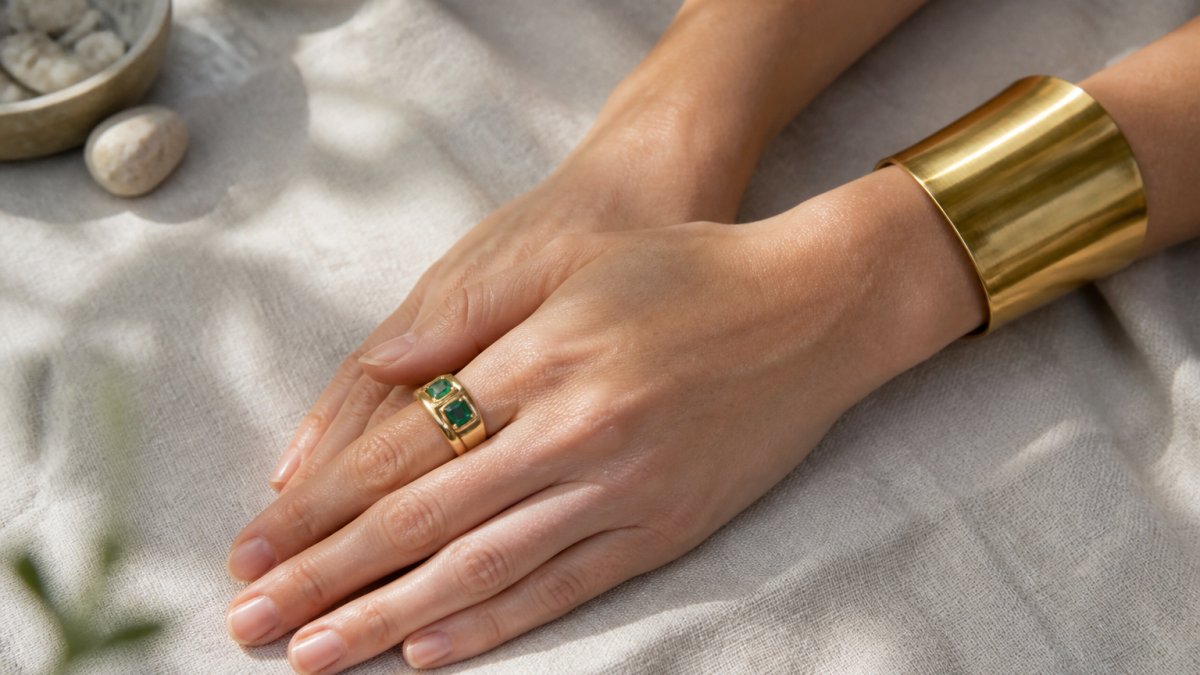
At LÖF, this is the standard we build to: 18k recycled gold and platinum, ethically sourced gemstones, and antique diamonds in pieces like The Astor Ring, whose architectural triple-bar silhouette is set with baguette diamonds or emeralds.

Cost Per Wear, Care, Repair, and Resale: Getting Real Value from Ethical Luxury
Cost per wear is the purchase price divided by the number of times you actually wear the piece. A $5,000 ring worn three times a week for ten years costs you roughly $3 per wear. A $400 trend piece worn twice costs $200 per wear. The expensive item is often the cheaper one.
This is the calculation that reframes ethical luxury entirely. Durability and timeless design aren't just values, they're the two variables that drive cost per wear down. Care, repair, and resale extend the curve further:
| Factor | What It Does | Why It Matters |
|---|---|---|
| Cost per wear | Price ÷ wears | Reveals true value over time |
| Care routine | Prevents damage | Protects the finish and structure |
| Repair and resizing | Extends usable life | Avoids replacement purchases |
| Resale value | Recovers part of cost | Rewards timeless, well-made pieces |
Care is unglamorous but decisive. Store gold separately to avoid scratching, remove jewelry before swimming or cleaning, and have claws and settings checked periodically. Repair beats replacement every time, both financially and environmentally. And resale is the quiet test of quality: pieces that hold value are the ones that were well made to begin with.
For occasion dressing, the same logic applies. A single well-chosen statement piece, like The Margueritte Cuff in 18k recycled gold with an old European cut diamond, does more work across a decade of events than five seasonal purchases. the Ellen MacArthur Foundation's work on circular fashion makes the same case at industry scale: keeping what exists in use is the highest-value environmental strategy available.

Conclusion: Building a Wardrobe You Can Pass Down
The hardest part of shopping ethically at this level isn't finding beautiful pieces. It's finding brands that will show you the proof behind their claims, and that design for a body and a life that keeps changing. Most labels ask you to take sustainability on faith, and faith is not a sourcing standard.
We built LÖF around the opposite assumption. Every piece is made from 18k recycled gold, platinum, ethically sourced gemstones, and antique diamonds, with bold architectural designs intended to be worn now and handed down later. Explore The Margueritte Hoops, The Astor Ring, and the rest of the collection, and choose pieces you'll still be wearing in thirty years.

Get started with LÖF and build a wardrobe that outlasts the trend cycle.
Frequently Asked Questions
How can you tell whether a luxury fashion brand is ethical?
Look for third-party certification and traceability rather than marketing claims. Check whether the brand names its suppliers, publishes a sustainability report, and uses certified recycled metals or organic fibers. For jewelry, ask for proof that stones are conflict-free and metals recycled. A brand that answers these questions in writing, with specifics rather than vague promises, is far more likely to be genuine than one that only uses words like 'conscious' or 'responsible' without evidence.
Are ethical luxury brands worth the investment for women over 50?
Cost per wear is the better measure than the price tag. A well-made piece in 18k recycled gold or platinum, worn several times a week for years, often costs less per wear than fast-fashion alternatives that tarnish or lose shape within months. Ethical luxury also holds resale value and can be repaired rather than replaced. For women over 50 building a smaller, higher-quality wardrobe, that durability and timeless design usually justify the higher upfront cost.
What should women over 50 look for in sustainable luxury clothing and jewelry?
Prioritize fit, comfort, and versatility over trends. Look for inclusive sizing that actually accommodates your measurements, natural fibers or recycled metals that age well, and designs that work across multiple occasions. Check whether the brand offers repair or resale services. For jewelry, 18k gold and platinum resist tarnishing and allergic reactions far better than plated alternatives, making them a practical choice for daily wear as well as special occasions.
What are quiet luxury brands for women over 50?
Quiet luxury means understated design, exceptional materials, and no visible logos. The value sits in craftsmanship and longevity rather than branding. For women over 50, this often means architectural jewelry in solid gold, tailored pieces in organic fibers, and a palette that works across seasons. These brands tend to cost more upfront but deliver better cost per wear and resist going out of style, which aligns with conscious consumption and building a wardrobe of versatile essentials.