

Table of Contents
- What Antique Jewelry Restoration Actually Costs in 2026
- Jewelry Restoration vs Repair: What You're Actually Paying For
- The Antique Jewelry Restoration Process, Step by Step
- Antique Diamond Jewelry Appraisal Cost and Why It Comes First
- DIY vs Professional Antique Jewelry Restoration: The Real Risks
- Does Restoration Hurt Value? Heirloom Preservation and Insurance
- How to Choose a Master Jeweler for Antique Restoration
- Frequently Asked Questions
Last Updated: October 3, 2026
What Antique Jewelry Restoration Actually Costs in 2026
The cost of restoring antique jewelry typically runs from modest sums for simple re-polishing to significant investment for structural rebuilds, and the final figure depends almost entirely on what has failed.
Most quotes break down into four cost drivers: metal work, stone work, finishing, and specialist labour. A ring that only needs a polish and a rhodium refresh sits at the low end.
Price Ranges by Damage Type
| Damage Type | Typical Work Required | Relative Cost Band |
|---|---|---|
| Surface scratches, dull finish | Polishing, ultrasonic clean | Lowest |
| Worn or thinned prongs | Prong retipping or rebuilding | Low to moderate |
| Cracked or thin shank | Shank replacement, soldering | Moderate |
| Loose or missing stones | Gemstone setting, stone sourcing | Moderate to high |
| Broken filigree or intricate metalwork | Hand reconstruction, laser welding | High |
| Full structural rebuild | Custom remounting, new alloy | Highest |
Prong retipping and shank replacement are the two most common line items. Both are routine for any master jeweler, and both scale with the intricacy of the setting.
Jewelry Restoration vs Repair: What You're Actually Paying For
Jewelry restoration and jewelry repair are different disciplines, and confusing them is the fastest way to ruin an heirloom. Repair fixes a fault.
A repair shop will solder a cracked shank and hand it back.
That difference in thinking is what you pay for. It is also why two quotes for the same ring can differ so widely. One is pricing a job.
The Antique Jewelry Restoration Process, Step by Step
Every reputable restoration follows roughly the same sequence. Skipping a step is how pieces get damaged.
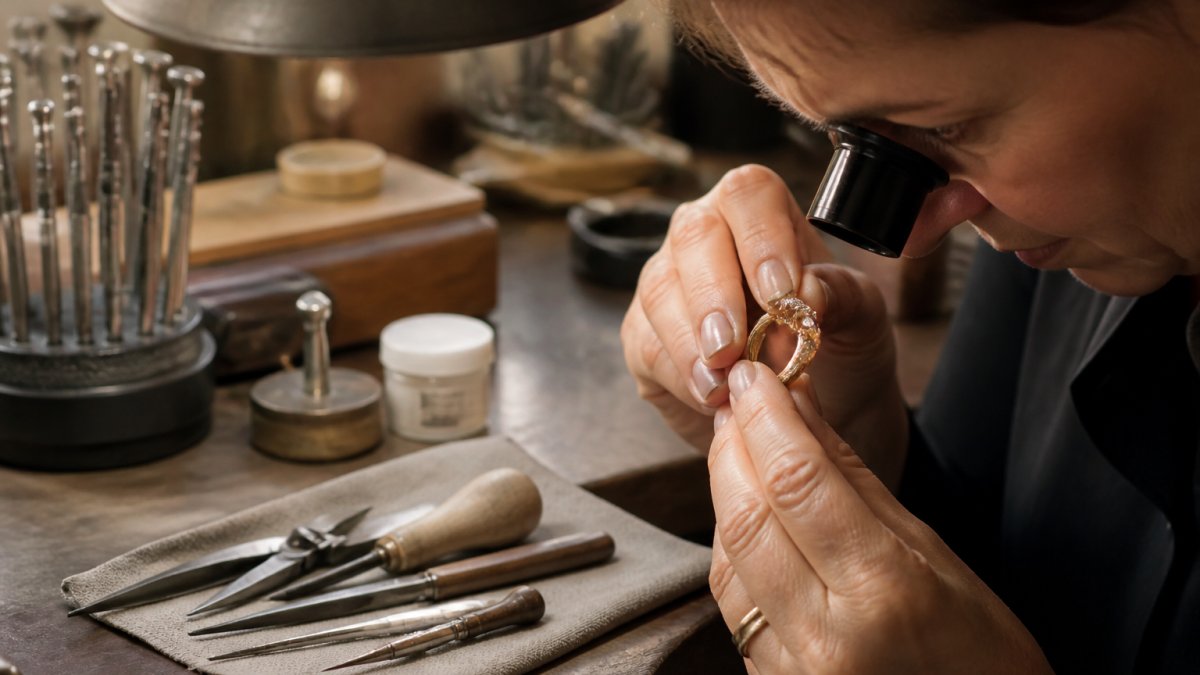
- Intake and documentation. Photographs, weight, stone count, and a written condition report before anything is touched.
- Structural integrity assessment. The bench checks for metal fatigue, hairline cracks, and previous repairs.
- Cleaning. Ultrasonic and hand cleaning to reveal the true condition of the metal and stones.
- Stone security check. Every setting is tested. Loose stones are tightened or removed before metalwork begins.
- Metalwork. Prong retipping, shank replacement, or filigree repair, using period-appropriate techniques.
- Stone resetting. Stones are returned to their settings once the metal is stable.
- Finishing. Polishing to the correct finish for the era, not to a modern mirror shine.
- Final inspection and appraisal update. Condition report updated, and valuation adjusted if the piece has changed materially.
Structural Integrity Assessment and Metal Fatigue
Metal fatigue is the hidden cost driver in antique restoration. Gold and platinum weaken with decades of wear, particularly at stress points like the shank base and prong tips.
A proper assessment tests for hairline fractures, thinned metal, and previous repairs that may have introduced incompatible alloys. This is the step that separates a restoration bench from a repair counter.
Laser Welding, Soldering, and Period-Correct Craftsmanship
Laser welding has changed antique restoration more than any other technique in the last two decades. It allows a bench to fuse metal at a precise point without heating the surrounding area, which protects adjacent stones and original patina.
Traditional soldering still has its place, particularly on larger structural joins. The skill is knowing which technique suits the piece.
Antique Diamond Jewelry Appraisal Cost and Why It Comes First
An appraisal is not a formality. It is the baseline that tells you whether restoration is worth doing at all. Antique diamond jewelry appraisal cost varies by the complexity of the piece and the credentials of the appraiser, but the appraisal itself is what protects you from spending more on restoration than the piece is worth.
A qualified appraisal documents the stones, the metal, the era, and the current market valuation. Without it, you are restoring blind.
For pieces with antique diamonds, an appraisal also confirms authenticity. Old European Cut, Old Miner Cut, and antique marquise stones have cutting signatures that a trained appraiser can verify.
DIY vs Professional Antique Jewelry Restoration: The Real Risks
DIY restoration is almost always a false economy on antique pieces. The risks are specific and expensive.
- Polishing compounds strip patina. The soft, aged surface that gives antique gold its depth is gone in seconds with the wrong wheel.
- Heat damages stones. A torch near an antique emerald or opal can fracture it.
- Home soldering introduces incompatible alloys. This creates problems that cost more to undo than the original repair would have cost.
Professional restoration exists because the failure modes are not obvious until they have already happened. If a piece has sentimental or financial value, the bench is the only sensible option.
Does Restoration Hurt Value? Heirloom Preservation and Insurance
Restoration done well protects value. Restoration done badly destroys it. That is the honest answer, and it is why the choice of jeweler matters more than the price of the work. But the mechanism behind that sentence is where most owners get caught out, so it is worth walking through properly.
How Restoration Changes an Appraisal
An appraisal is a snapshot of a piece at a moment in time. It records the metal, the stones, the era, the condition, and a valuation based on comparable sales or replacement cost. When a piece is restored, three of those inputs change:
- Condition improves. A ring with a cracked shank and worn prongs is appraised in that condition. After restoration, it is a structurally sound piece, and the valuation should reflect that.
- Original material may be reduced. If a shank is replaced, some original metal is gone. For most pieces this is neutral or positive, because the piece is now wearable. For museum-grade or highly collectible pieces, any loss of original material can be a value consideration, and a specialist appraiser will say so.
- Provenance may be affected. If the piece has documented history, the restoration itself becomes part of that history. Keep the condition report and the invoice. They are the paper trail.
The practical rule: restore first, then appraise. An appraisal done before restoration is a baseline. An appraisal done after restoration is the number your insurer will actually use.
What Insurers Actually Require
Most jewelry insurance policies, whether a standalone valuable-articles policy or a rider on a homeowner's policy, require an up-to-date appraisal at the time the policy is written and often at renewal. After restoration, the piece has materially changed, and an outdated appraisal can leave you underinsured at exactly the moment you need to claim.
Two terms matter here, and they are not interchangeable:
- Replacement value is what it would cost to source or rebuild a comparable piece today. This is what most insurers reimburse on a claim.
- Market value is what the piece would sell for in the current market. This is what matters for resale, estate planning, and equitable distribution.
A good appraisal states both, and states which one the valuation figure represents. If your appraisal does not, ask for a revised one.
Heirloom Preservation: The Principle That Should Guide Every Decision
For heirloom preservation, the goal is to keep as much original material as possible while returning the piece to a wearable, structurally sound condition. Those two goals sometimes conflict, and how a bench resolves the conflict tells you what kind of bench it is.
A bench that defaults to replacement over repair is not preserving anything. A bench that refuses to replace a failed shank because "original is better" is not serving the owner either.
The Documentation Chain
For any piece with sentimental or financial value, keep a simple file:
- The pre-restoration condition report and photographs
- The written quote, itemized by metalwork, stonework, and finishing
- The post-restoration invoice
That file is what protects you in an insurance claim, an estate settlement, or a future sale. It is also what a good bench will offer to assemble for you without being asked.
For collectors building a legacy, this is where sustainable practice and good restoration overlap. Our The Tillie Ring and The Maze Pinky Ring both use antique diamonds that come with certificates, which makes the appraisal and insurance chain straightforward from the start.

How to Choose a Master Jeweler for Antique Restoration
Choosing the right bench is the single highest-use decision in the whole process. Use this checklist before you hand over anything.
- Ask specifically about experience with the era of your piece, not just jewelry in general.
- Request examples of filigree repair or period-correct work if your piece has intricate metalwork.
- Confirm whether the bench uses laser welding or torch soldering, and why.
A master jeweler will welcome these questions. A repair counter will find them inconvenient.
For owners investing in new heirloom pieces rather than restoring old ones, the same logic applies to the maker. LÖF pieces such as The Shard Ring and The Isotta Ring are built at the bench over weeks, which means the structural work is done properly the first time.


Frequently Asked Questions
What is the difference between jewelry repair and jewelry restoration?
Repair fixes what has failed: a snapped chain, a loose prong, a cracked shank. Restoration goes further and returns the piece to its original condition, matching period-correct techniques, patina, and stone settings. A repair might cost a fraction of a restoration because it addresses one fault. Restoration involves assessment, disassembly, structural work, refinishing, and often custom remounting, which is why antique jewelry restoration quotes vary so widely between pieces.
Does restoring antique jewelry decrease its value?
It can, if the work erases original details. Replacing period-correct filigree with modern cast parts, over-polishing away patina, or resetting original stones into a contemporary mount all reduce collector value. Restoration that preserves authenticity, keeps the original metal alloy where possible, and uses reversible techniques tends to protect valuation. Ask your jeweler to document every change, and get an appraisal before and after so you have a paper trail for insurance.
How much does an antique diamond jewelry appraisal cost, and do I need one before restoring?
An appraisal before restoration establishes the piece's current condition, stone grades, and replacement value, which protects you if anything goes wrong at the bench. It also tells you whether the restoration spend makes sense against the piece's worth. Appraisal cost varies with the number of stones, the detail of the report, and whether the jeweler issues a formal valuation. Treat it as part of the restoration budget, not an optional extra.
Can a jeweler make a new ring out of an old one?
Yes, and this is where custom remounting comes in. A jeweler can lift antique diamonds out of a worn setting and rebuild them into a new piece, either period-correct or fully bespoke. This is often the smarter route when the original shank has metal fatigue or the setting no longer holds stones securely. Expect the cost to reflect bench hours, new precious metals, and the intricacy of the new design rather than a simple repair fee. LÖF, for example, builds pieces such as The Tillie Ring around Old European Cut diamonds set in platinum and gold, showing how antique stones can anchor a modern heirloom.
How do I find a qualified professional for antique jewelry restoration?
Look for a master jeweler who regularly handles vintage and antique pieces, not a general repair counter. Ask three questions: do you do on-site work or send pieces out, how do you handle period-correct sourcing for filigree and shank replacement, and can you show before-and-after documentation? A specialist will talk about structural integrity, stone security, and patina preservation before quoting a number. If the answer is only a price, keep looking.
Restoring an antique piece is a decision about what you want it to become, not just what it costs to fix. The right bench will tell you when restoration is worth it and when it is not. At LÖF, we build and restore with the same standard: 18k gold and platinum, ethically sourced gemstones, recycled and repurposed gold, and antique diamonds with documented provenance. If you are commissioning a piece meant to be passed down, choose options that start with that standard.